
Unique Pump Systems, Kailash Industrial Complex, Vikhroli (W)
Understanding the individual components of a gear pump is fundamental to correct specification, installation, operation, troubleshooting, and maintenance. Each part plays a precise role in the pump's ability to move fluid reliably, safely, and efficiently. This guide covers every major component of both external gear pumps and internal gear pumps, with materials, functions, and engineering insights.
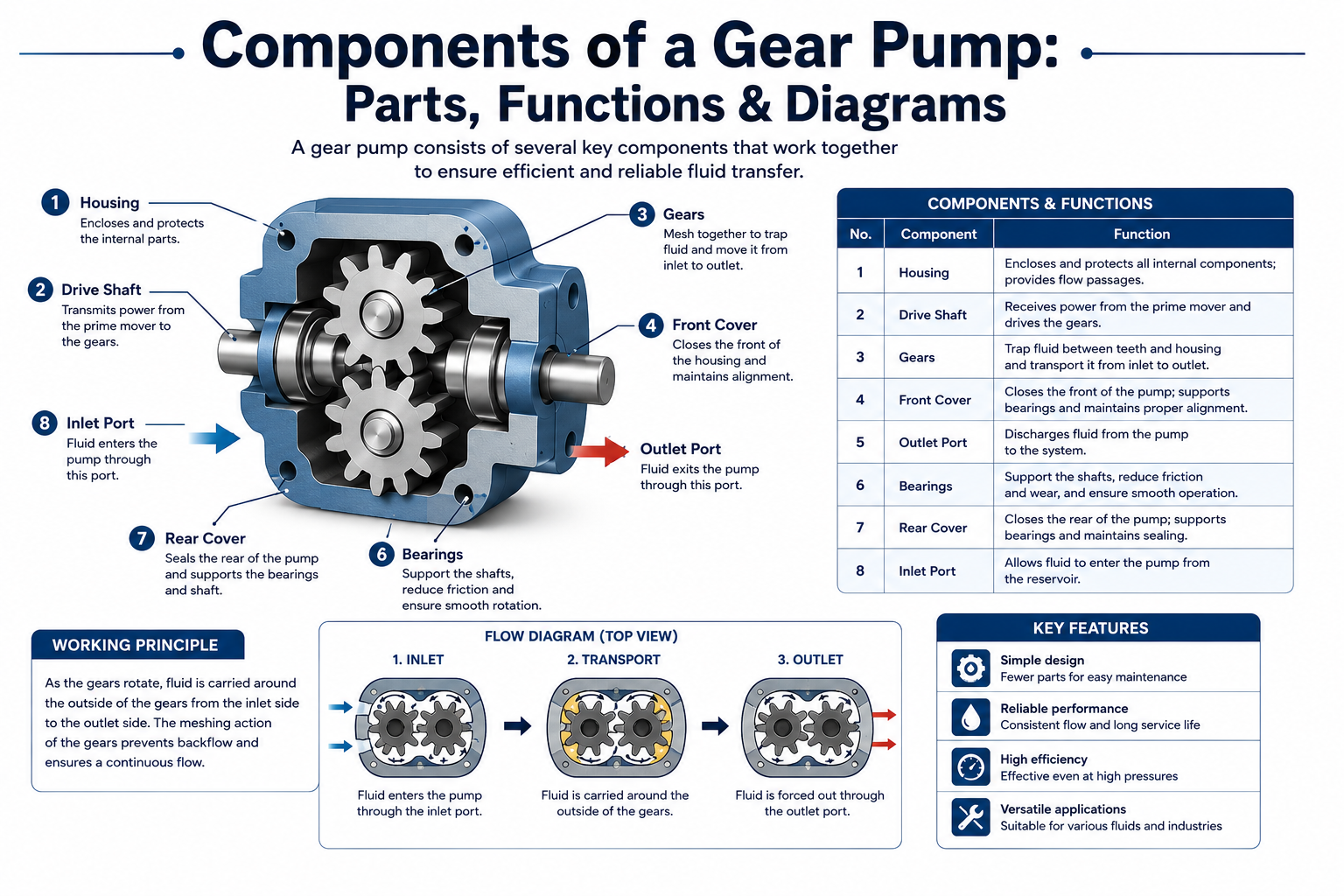
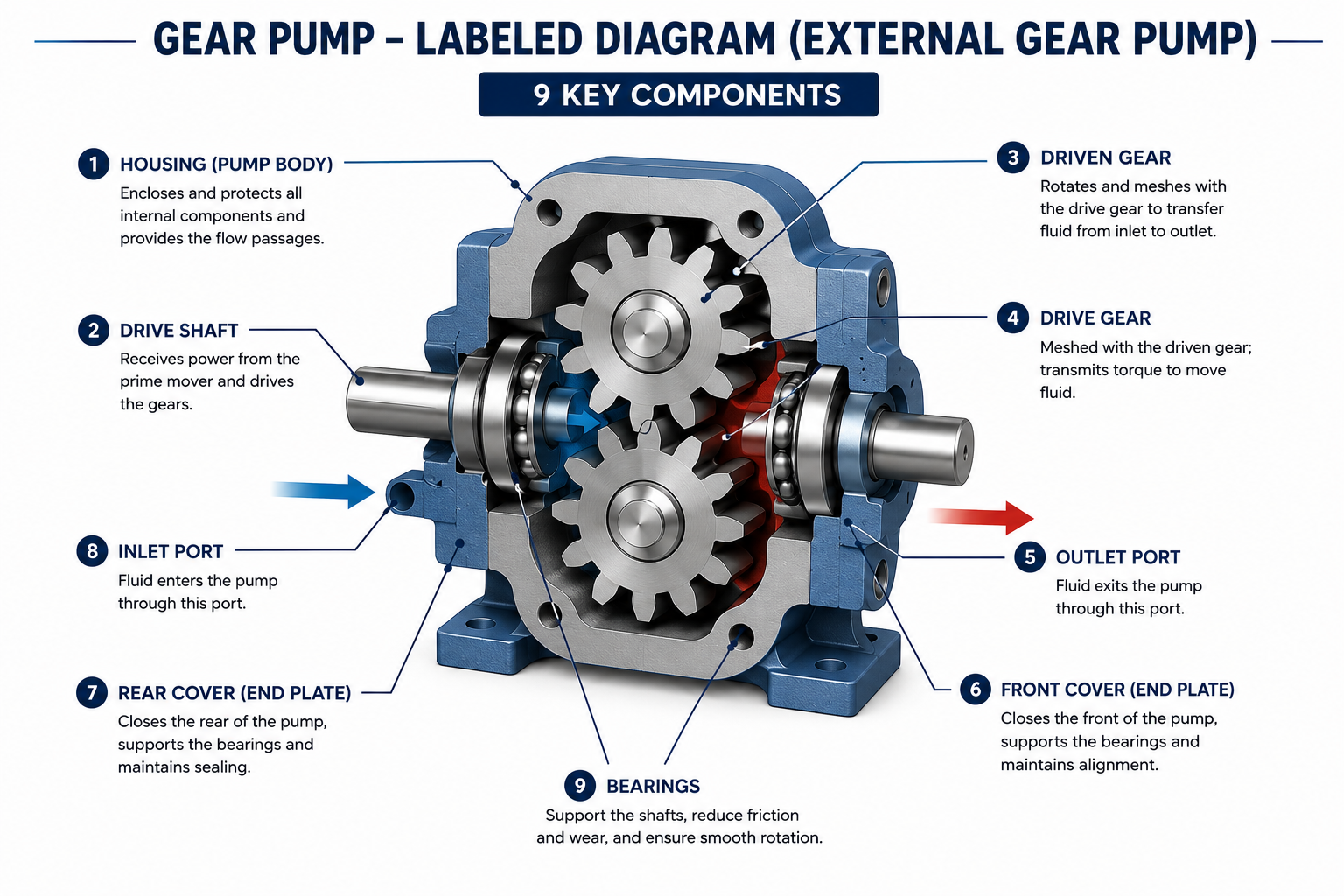
The housing (also called the casing or body) is the outer shell that encloses all moving parts and defines the pump's geometry. It is precision-machined to provide very tight clearances around the gears — these clearances are fundamental to the pump's ability to maintain pressure and prevent internal recirculation (slippage) of fluid.
Common Materials:
Engineering Note: Gear-to-casing clearance is typically 0.1–0.3 mm. As this clearance increases through wear, internal slippage increases and volumetric efficiency drops.
The driver gear is directly coupled to the prime mover (electric motor, diesel engine, hydraulic motor, or PTO). It is the gear that receives rotational energy and converts it into pumping action. In external gear pumps, it is identical in size to the driven gear. In internal gear pumps, the driver is the smaller inner gear (pinion).
Materials:
The driven (or idler) gear receives motion from the driver gear through their meshing teeth. It does not connect to any external shaft — it rotates freely, supported by its own shaft and bearings within the housing. Together, the driver and driven gear create the expanding and contracting fluid pockets that produce flow.
In external gear pumps, the driver and driven gears rotate in opposite directions. In internal gear pumps, both gears rotate in the same direction — resulting in gentler, lower-shear flow.
Shafts are the mechanical backbone of the pump. The drive shaft connects the motor to the driver gear and transmits torque. The idler shaft supports the driven gear. Both shafts must be precisely aligned to prevent uneven gear contact, bearing overload, and premature seal failure.
Materials: Carbon Steel, Alloy Steel (EN8, EN24), Stainless Steel 316
Bearings support the gear shafts radially and, in some designs, axially. In gear pumps, sleeve bearings (bushings) are common because they are compact and the pumped fluid itself often provides lubrication. In high-pressure or high-speed applications, rolling-element (ball or roller) bearings are used for higher load capacity.
Maintenance Alert: Bearing wear is the most common cause of gear pump failure. When a piece of paper passes freely through the clearance, the bearing needs replacement.
Sealing is critical in gear pumps. Shaft seals (lip seals or mechanical seals) prevent fluid leaking around the drive shaft. Gaskets and O-rings seal the casing joints and end plates. Mechanical seals are preferred for hazardous, toxic, or high-pressure fluids.
| Seal Type | Application | Fluid Compatibility |
|---|---|---|
| Oil Lip Seal (NBR) | Standard mineral oils, water | Up to 100°C, non-aggressive |
| Mechanical Seal (SS/Carbon) | Chemical, aggressive, hazardous | Wide chemical range |
| Viton (FKM) Seal | High-temperature, solvents | Up to 200°C |
| PTFE Seal | Aggressive acids, alkalis | Universal chemical resistance |
| Gland Packing | High-viscosity, abrasive slurries | General industrial |
The inlet port connects to the suction piping and is the opening through which fluid at low pressure is drawn into the pump as the gears unmesh. The outlet port is where the fluid, now at high pressure, is discharged into the system piping.
Because gear pumps are positive displacement, they will continue building pressure indefinitely if the discharge is blocked. The pressure relief valve (PRV) is a spring-loaded device, typically integrated into the pump body or fitted externally, that opens at a preset pressure and recirculates fluid back to the suction side.
CRITICAL: Never operate a gear pump without a functioning pressure relief valve on the discharge side. Blocked discharge + no PRV = catastrophic pump failure.
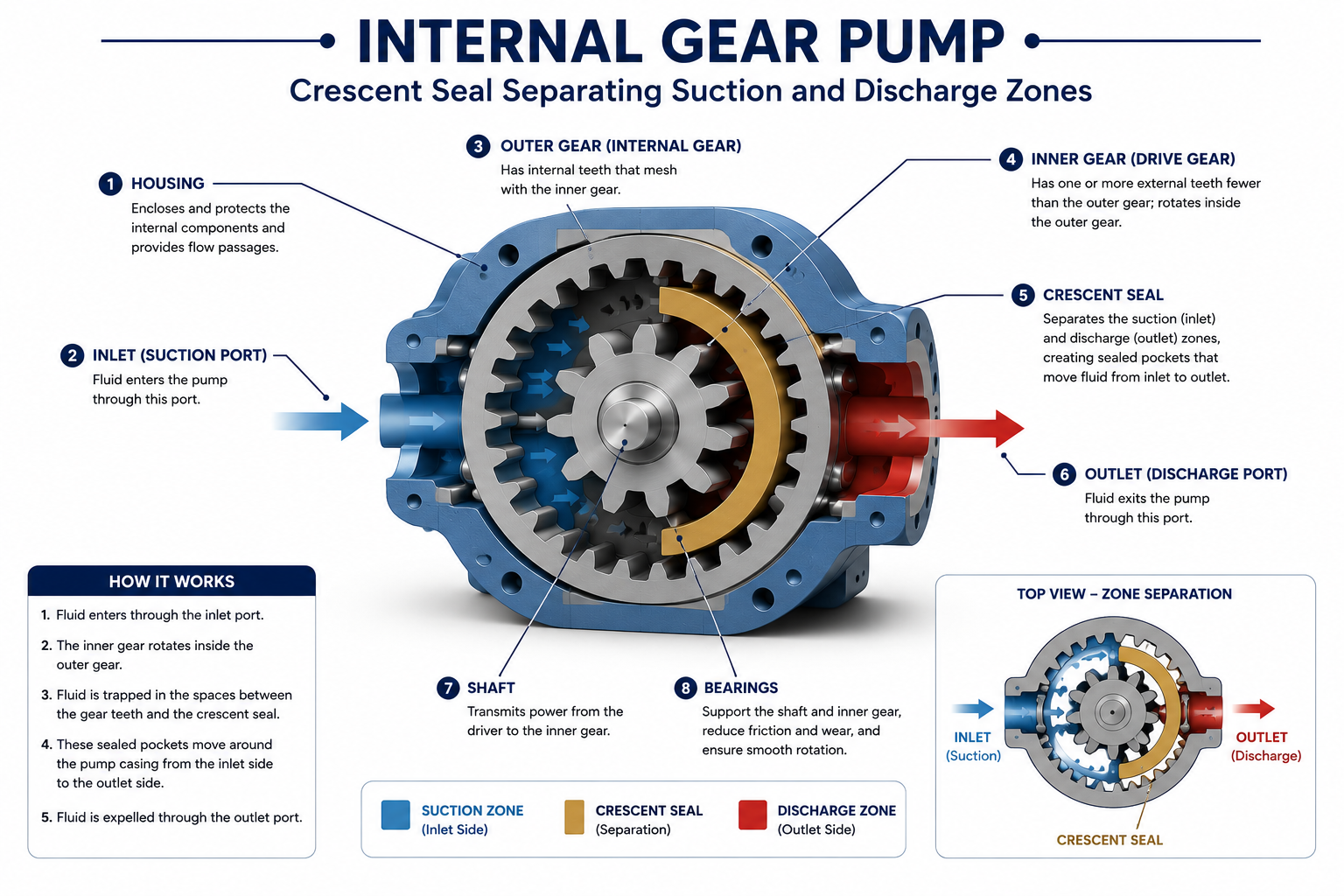
The crescent seal is a fixed, crescent-shaped metal piece unique to internal gear pumps. Positioned between the inner pinion and outer rotor, it fills the gap between the two unequal-sized gears. As gears rotate, it acts as both a seal and a divider — preventing high-pressure discharge fluid from migrating back to the low-pressure suction side.
| Component | Standard Material | Food/Pharma Grade | Corrosive Fluid Grade |
|---|---|---|---|
| Housing | Cast Iron | SS316L | SS316L, Hastelloy |
| Driver Gear | Carbon Steel (C45 hardened) | SS316 hardened | SS316, Duplex SS |
| Driven Gear | Carbon Steel (C45 hardened) | SS316 hardened | SS316, Duplex SS |
| Shafts | EN8 / EN24 steel | SS316 | SS316, Titanium |
| Bearings | Bronze bushing / Steel bearing | PTFE bushing, SS bearing | Ceramic, PTFE |
| Shaft Seal | NBR lip seal | FDA-approved mechanical seal | Viton / PTFE mechanical seal |
| Crescent Seal | Carbon Steel / Bronze | SS316 | SS316, PTFE-coated |
The 10 main components are: Housing, Driver Gear, Driven (Idler) Gear, Shafts, Bearings/Bushings, Seals & Gaskets, Inlet Port, Outlet Port, Pressure Relief Valve, and (for internal gear pumps) the Crescent Seal.
The crescent seal is a stationary, crescent-shaped piece of metal fitted between the inner gear (pinion) and the outer rotor. It seals the space between the two gears and acts as a divider — keeping the suction zone and discharge zone separated.
Gear pumps are positive displacement — they generate pressure regardless of downstream conditions. If the discharge is blocked, pressure builds rapidly. A relief valve opens at a preset pressure and routes fluid back to suction, protecting the pump and system.
Common housing materials include cast iron (general industrial), aluminium alloy (lightweight), SS304/SS316 (food, pharma, corrosive chemicals), gun metal/bronze (marine), and ductile iron (high-strength).
No. Gear pumps rely on the pumped fluid for lubrication and cooling. Even brief dry running causes rapid wear, heat expansion, and permanent damage to gears and bearings.