
Unique Pump Systems, Kailash Industrial Complex, Vikhroli (W)
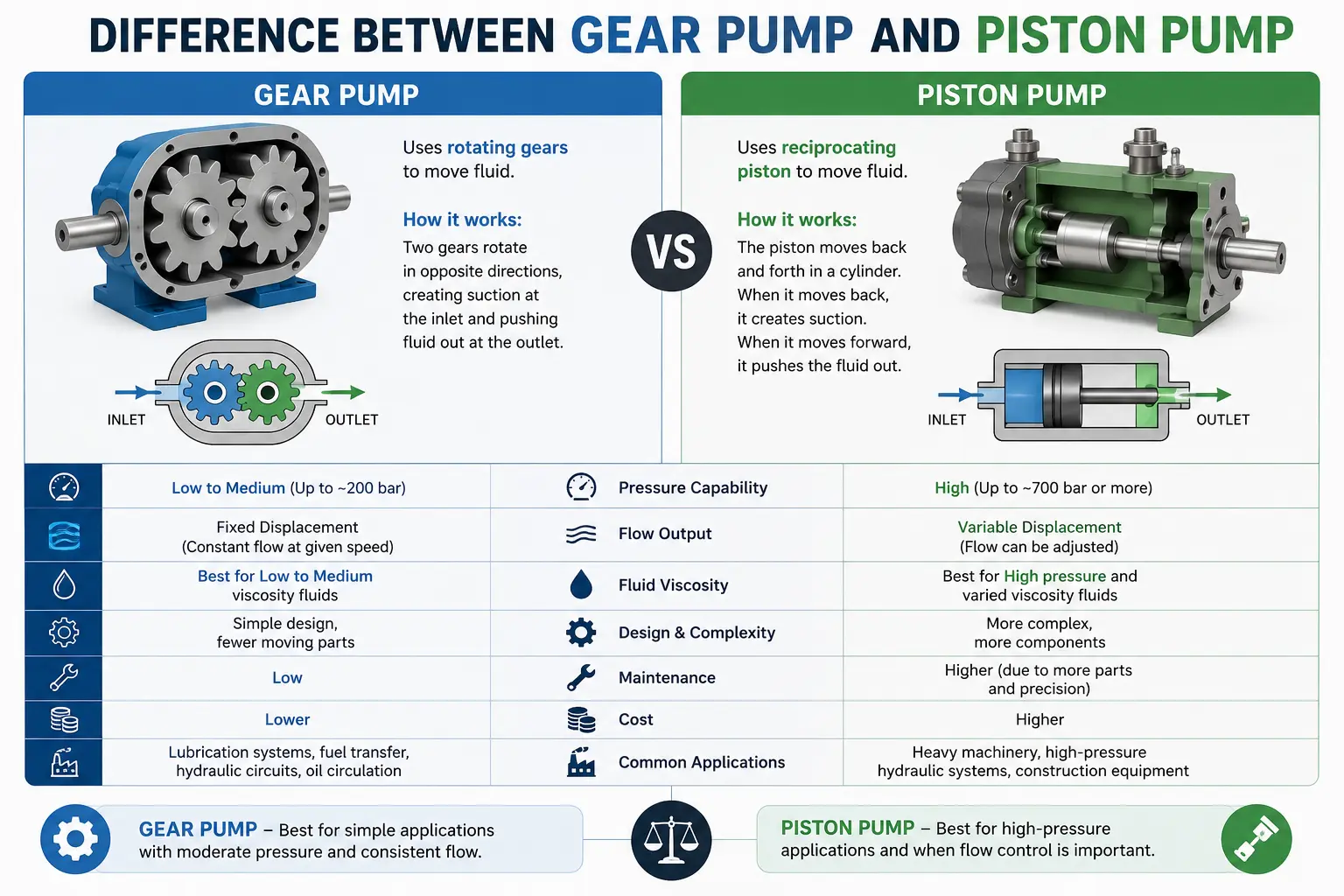
A gear pump moves fluid using two meshing gears that trap liquid between the gear teeth and the casing, giving steady low-to-medium pressure flow at low cost. A piston pump uses reciprocating pistons to displace fluid, delivering far higher pressure, better efficiency, and variable flow, but at a higher price and with more complex maintenance.
Ask any maintenance engineer which pump to buy and you will usually get the same two names: a gear pump or a piston pump. Both are positive displacement pumps. Both move a fixed volume of fluid per revolution. Both are used in hydraulics, lubrication, chemical dosing, fuel transfer and oil handling.
But they are not interchangeable. Choosing the wrong one is one of the most expensive mistakes in a fluid handling system. A gear pump pushed beyond its pressure rating will wear out its bushes in months. A piston pump fed with dirty or thin fluid will scuff its barrel and fail even faster.
People search for the difference between gear pumps and piston pumps because product datasheets rarely explain the trade-offs in plain language. They list pressure and flow, but not why one pump costs four times more than the other, or why one tolerates contamination and the other does not.
In this guide you will learn:
This article is written from a pump manufacturing and application-engineering perspective, not from a sales brochure.
A gear pump is a rotary positive displacement pump. Two gears rotate inside a close-fitting casing. As the teeth come out of mesh on the suction side, they create an expanding space, and atmospheric pressure pushes fluid in. The fluid is carried around the outside of the casing in the tooth cavities, then squeezed out as the teeth mesh again on the discharge side.
There are two main families:
A well-built rotary gear pump will run continuously for years on clean lubricating fluid with almost no attention beyond seal replacement.
A piston pump is a reciprocating positive displacement pump. Pistons slide inside precision-bored cylinders. On the intake stroke the piston retracts and draws fluid in through a valve or port plate; on the delivery stroke it pushes the fluid out at high pressure.
Common configurations include:
The defining advantage is control. By tilting the swash plate you change the stroke length, and therefore the flow, without changing motor speed. That single feature is why piston pumps dominate modern hydraulic systems where energy saving matters.
| Parameter | Gear Pump | Piston Pump |
| Pump family | Rotary positive displacement | Reciprocating positive displacement |
| Displacement type | Fixed only | Fixed or variable |
| Typical max pressure | 10–250 bar | 150–700+ bar |
| Volumetric efficiency | 80–90% | 92–98% |
| Overall efficiency | 75–85% | 85–95% |
| Viscosity range | Very wide, up to 100,000 cSt | Narrow, best 20–200 cSt |
| Contamination tolerance | Good | Poor — needs fine filtration |
| Self-priming | Excellent | Moderate, often needs flooded suction |
| Flow pulsation | Low to moderate | Moderate to high |
| Noise level | Moderate (external), low (internal) | Higher, especially at high pressure |
| Number of moving parts | Few (2–3) | Many (9–20+) |
| Purchase cost | Low | High (3–6x a gear pump) |
| Repair complexity | Simple, often on site | Specialist workshop |
| Typical service life | 10,000–20,000 hours | 15,000–40,000 hours if fluid is clean |
| Best for | Lubricating fluids, viscous fluids, transfer duty | High pressure, precise control, energy efficiency |
The simplest way to understand the difference is to picture what carries the fluid.
In a gear pump, the fluid rides around the outside of the gears in the space between the teeth. Nothing stops and starts. Rotation is continuous, so flow is continuous. The sealing is done by tiny clearances between gear tips and casing — usually 20 to 50 microns. That clearance is also the pump's weakness at high pressure: fluid slips backwards through it, and the slip increases as pressure rises and as the fluid gets thinner.
In a piston pump, the fluid is trapped in a cylinder and then physically pushed out by a solid piston. The sealing is done by a precision piston-to-bore fit plus, in many designs, piston rings. Because the piston can generate enormous force over a small area, pressure can be very high without a proportional loss in efficiency.
That single structural difference explains almost every other difference between the two pumps:
Pressure is where the two pumps separate most clearly.
If your system needs more than about 250 bar, the decision is made for you. Nothing else needs to be considered.
Both are positive displacement pumps, so flow is roughly proportional to speed. The differences are in stability:
For a hydraulic power unit that spends most of its cycle idling, a pressure-compensated piston pump can cut energy use dramatically because it destrokes to near-zero flow when no work is being done. A fixed gear pump keeps pumping and dumps flow over a relief valve as heat.
| Efficiency factor | Gear Pump | Piston Pump |
| Volumetric efficiency at rated pressure | 80–90% | 92–98% |
| Mechanical efficiency | 88–94% | 90–96% |
| Heat generated at partial load | High (relief valve dumping) | Low (destrokes on demand) |
| Suitability for continuous 24/7 duty | Good | Excellent |
| Energy cost over 5 years | Higher | Lower |
A useful rule of thumb: on a system running more than about 4,000 hours a year at variable load, the energy savings of a variable displacement piston pump usually repay the extra purchase cost within two to three years. On a small machine running two hours a day, they never will.
| Fluid type | Gear Pump | Piston Pump |
| Hydraulic oil (ISO VG 32–68) | Excellent | Excellent |
| Heavy fuel oil, bitumen, tar | Excellent (internal gear) | Poor |
| Molasses, glucose, resins | Excellent | Not suitable |
| Paint, adhesives, polymers | Good | Limited |
| Water and thin solvents | Poor (high slip, poor lubricity) | Poor to fair |
| Fluids with abrasive solids | Fair with hardened gears | Poor |
| Non-lubricating fluids | Requires special materials | Requires special construction |
Both pumps depend on the fluid to lubricate their own internals. Neither should be run dry, even briefly. If your fluid has no lubricity — dilute acids, thin solvents, water — a diaphragm pump is usually the safer answer. An aodd pump can run dry indefinitely, dead-head without damage and handle corrosive chemistry that would destroy a gear set within a shift.
| Requirement | Gear Pump | Piston Pump |
| Recommended ISO cleanliness code | 20/18/15 | 17/15/12 or better |
| Typical filtration | 25 micron | 10 micron or finer |
| Effect of dirt | Gradual efficiency loss | Rapid scoring and seizure |
| Tolerance of water in oil | Moderate | Low |
Piston pump warranty claims are rejected more often for fluid cleanliness than for any other reason. If your plant cannot maintain filtration discipline, a gear pump is the more forgiving investment even where a piston pump would technically perform better.
For noise-sensitive installations — hospitals, food factories, laboratories — an internal gear pump or a pulsation-damped system is usually easier to live with. Odd piston counts (7 or 9) are used specifically to smooth pulsation, which is why you rarely see an 8-piston pump.
| Cost element | Gear Pump | Piston Pump |
| Initial purchase | Low | High |
| Spare parts availability | Widely stocked | Often made to order |
| Repair time | Hours | Days to weeks |
| Skill needed for repair | In-house fitter | Trained specialist |
| Typical seal replacement cost | Low | Moderate |
| Cost of a failure | Contained | Can damage whole circuit with debris |
One underrated risk with piston pumps: when they fail, they often send metal debris downstream into valves, motors and actuators. A gear pump failure is usually contained to the pump itself. Factor that into your risk assessment for critical processes.
| Pros | Cons |
| Low purchase price | Limited maximum pressure |
| Simple construction, few parts | Fixed displacement only |
| Excellent with viscous fluids | Efficiency drops as clearances wear |
| Very good self-priming | Not ideal for thin, non-lubricating fluids |
| Easy field repair | Wastes energy at partial load |
| Compact for its flow rate | Noisier than internal designs at high speed |
| Pros | Cons |
| Very high pressure capability | High purchase and repair cost |
| Best-in-class efficiency | Demands very clean fluid |
| Variable displacement and precise control | Poor with high-viscosity fluid |
| Energy saving on variable-load systems | Complex, many moving parts |
| Long life when correctly maintained | Longer lead times for spares |
| Excellent for closed-loop hydrostatic drives | Pulsation can stress pipework |
| Application | Recommended Pump | Reason |
| Hydraulic power pack, light duty | Gear pump | Cost effective, adequate pressure |
| Injection moulding machine | Piston pump | High pressure, variable flow, energy saving |
| Lubrication oil circulation | Gear pump | Continuous low-pressure duty |
| Bitumen and asphalt transfer | Internal gear pump | Handles very high viscosity |
| Excavator and mobile hydraulics | Piston pump | Pressure and closed-loop control |
| Fuel oil burner feed | Gear pump | Reliable, low cost, self-priming |
| Chemical dosing of corrosives | Diaphragm pump | Chemical resistance, dry-run safe |
| Food-grade viscous products | Rotary lobe pump | Gentle, CIP-friendly, hygienic |
| Water hydraulics, high pressure | Piston pump | Pressure capability |
| Paint and resin transfer | Gear or diaphragm pump | Viscosity and shear considerations |
Where a product must not be damaged by shear — creams, sauces, yoghurt, slurries with fragile solids — neither a gear pump nor a piston pump is the right tool. A lobe pump moves product in large gentle cavities with no metal-to-metal contact in the pumping chamber, which is why it dominates dairy, food and pharmaceutical processing.
| Myth | Fact |
| "Piston pumps are always better" | They are better at high pressure and control, worse at viscosity, cost and contamination tolerance |
| "Gear pumps can't do high pressure" | Modern pressure-balanced gear pumps run reliably at 250 bar |
| "Positive displacement pumps don't need relief valves" | They absolutely do — they will burst a line before they stop pumping |
| "A bigger pump is safer" | Oversizing causes heat, wasted energy and premature wear |
| "Gear pumps are noisy by nature" | External designs are; internal gear pumps are among the quietest positive displacement pumps |
| "You can run a pump dry briefly" | Seconds of dry running can destroy sealing faces on either type |
| "Viscous fluid damages pumps" | Viscous fluid actually improves gear pump sealing; it is thin fluid that causes slip |
Step 1 — Define the fluid. Viscosity at minimum and maximum temperature, specific gravity, solids content, abrasiveness, chemical compatibility, lubricity, shear sensitivity.
Step 2 — Define the duty. Required flow, working pressure, peak pressure, duty cycle (continuous or intermittent), variable or constant demand.
Step 3 — Apply the pressure filter. Above 250 bar, choose a piston pump. Below 25 bar with viscous fluid, choose a gear pump. Between the two, continue.
Step 4 — Apply the viscosity filter. Above roughly 500 cSt, a piston pump becomes impractical. Choose an internal gear or lobe pump.
Step 5 — Apply the control filter. If flow must vary independently of drive speed, a variable displacement piston pump is the natural choice. Otherwise a fixed gear pump plus a VFD is often cheaper and simpler.
Step 6 — Apply the cleanliness filter. If you cannot guarantee ISO 17/15/12, avoid piston pumps.
Step 7 — Cost the whole life. Purchase price plus energy plus spares plus expected downtime over five years.
Step 8 — Confirm suction conditions. Calculate NPSH available. This is where the majority of "bad pump" complaints originate.
Step 9 — Specify the sealing and materials. Elastomer compatibility, seal face materials, casing metallurgy.
Step 10 — Validate with the manufacturer. Share the full duty sheet, not just flow and pressure.
| Maintenance Task | Gear Pump | Piston Pump | Frequency |
| Check for external leakage | Yes | Yes | Weekly |
| Oil cleanliness sampling | Recommended | Essential | Monthly / Quarterly |
| Filter element replacement | Standard | Critical | Per differential indicator |
| Coupling alignment check | Yes | Yes | Every 6 months |
| Vibration monitoring | Optional | Recommended | Quarterly |
| Seal replacement | Simple | Moderate | 8,000–15,000 hours |
| Case drain flow check | N/A | Essential wear indicator | Quarterly |
| Full overhaul | Simple, in-house | Specialist workshop | 15,000–30,000 hours |
A rising case drain flow on a piston pump is the single most useful early warning of internal wear. On a gear pump, the equivalent early warning is falling delivered flow at constant speed and pressure.
If your application involves high pressure, variable flow demand and clean fluid, the piston pump earns its higher price through efficiency and control. If it involves viscous fluid, moderate pressure, real-world contamination and a need for simple maintenance, a well-built gear pump is the smarter engineering decision — and usually the cheaper one across its entire life.
The best specification decision is made with real data: fluid properties at real temperatures, honest duty cycles and an accurate suction calculation.
Neither is universally better. A gear pump is better for viscous fluids, low to medium pressure, dirty environments and tight budgets. A piston pump is better for high pressure above 250 bar, precise flow control, and energy efficiency on variable-load systems. The correct answer depends entirely on your fluid, pressure and duty cycle.
Yes, within limits. Modern pressure-balanced external gear pumps operate reliably at 200–250 bar continuous. Beyond that, internal slip increases sharply and bushing loads become excessive, so a piston pump becomes the practical choice. Cast iron transfer gear pumps are usually limited to 10–25 bar.
Because a piston seals against a precision-machined bore that travels with the fluid, rather than relying on a fixed clearance between gear tips and casing. Less fluid slips backwards, so volumetric efficiency stays above 92 percent even at high pressure, where a gear pump may fall to 80 percent.
The gear pump, particularly an internal gear design. Thick fluid improves sealing at the running clearances, so efficiency actually rises with viscosity up to a point. Piston pumps struggle above about 500 cSt because the fluid cannot fill the cylinder fast enough on the intake stroke, causing cavitation.
Yes, always. Both are positive displacement pumps. If the discharge is blocked they will keep generating pressure until something fails — a pipe, a gasket, the pump casing or the motor. A correctly set pressure relief valve is a mandatory safety device, not an optional accessory.
With clean lubricating fluid, correct alignment and pressure within rating, 10,000 to 20,000 operating hours is typical before performance drops enough to justify an overhaul. Life falls sharply with abrasive contamination, dry running, cavitation or operation above the rated pressure.
Worn gear tip and side clearances, cavitation from a restricted suction line, air ingress through a failed shaft seal, excessive fluid temperature reducing viscosity, or a relief valve stuck partly open. Measure delivered flow at a known pressure and compare with the commissioning baseline to confirm.
They are generally louder than internal gear pumps, typically 75–90 dB(A), because each piston delivery creates a pressure pulse. Manufacturers use odd piston counts such as seven or nine to smooth this ripple. Pulsation dampeners and flexible hose sections reduce transmitted noise substantially.
Rarely without modification. Mounting flanges, shaft dimensions, port sizes and rotation direction usually differ, and the piston pump will demand better filtration and cleaner suction conditions. Treat it as a system redesign, including the filtration circuit and reservoir, rather than a like-for-like swap.
The gear pump, by a wide margin. It has fewer parts, spares are widely stocked, and a competent in-house fitter can rebuild one in a few hours. A piston pump usually needs specialist workshop attention, and its failures can send debris through the rest of the hydraulic circuit.
Only with special construction. Water has almost no lubricity and very low viscosity, so slip is high and the gears wear rapidly. For water and thin chemicals, diaphragm or centrifugal pumps are far more appropriate choices.
An external gear pump uses two side-by-side gears and suits general hydraulic and oil transfer duty at lower cost. An internal gear pump has a rotor turning inside a ring gear with a crescent partition, runs more quietly, produces smoother flow and handles much higher viscosities such as bitumen, molasses and heavy fuel oil.