
Unique Pump Systems, Kailash Industrial Complex, Vikhroli (W)
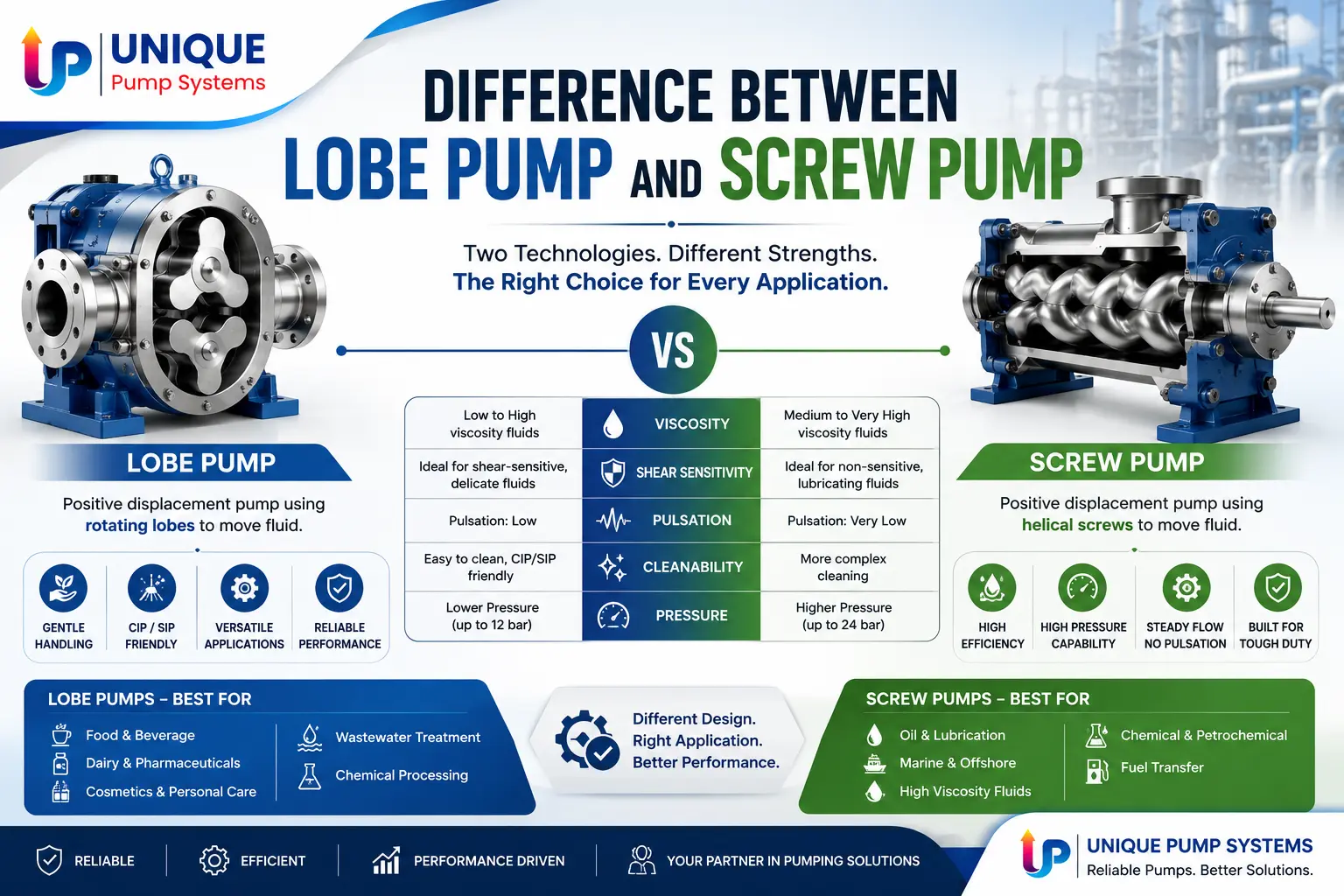
A lobe pump uses two rotating lobed rotors that trap fluid in large cavities, giving gentle low-shear handling of viscous products with solids. A screw pump uses intermeshing helical screws to move fluid axially, producing smoother, almost pulsation-free flow at higher pressures and better efficiency with very viscous liquids.
Lobe pumps and screw pumps are both rotary positive displacement pumps. Both are non-contact designs in their best-known forms. Both handle viscous fluids that would defeat a centrifugal pump. Both appear in food factories, chemical plants, oil terminals and wastewater works.
So why do experienced process engineers argue about them?
Because the two pumps solve the same problem in completely different ways. A lobe pump moves fluid around the casing in discrete pockets. A screw pump moves it along the axis in a continuous, advancing chamber. That difference in geometry drives everything: pulsation, pressure capability, efficiency, shear, cleanability and price.
Choosing wrongly is expensive. A lobe pump on a high-pressure long-line duty will run at excessive slip and wear out. A screw pump on a product with large soft solids can jam. A lobe pump on a very high viscosity, high-pressure duty will demand a huge motor, while a twin screw pump would do the same work with less power.
This guide covers:
A lobe pump has two rotors, each shaped with two, three or four lobes, turning in opposite directions inside a close-fitting casing. The rotors are driven by external timing gears, so they never touch each other. As they turn, fluid is drawn into the expanding space at the inlet, carried around the outside of the casing in the cavities between the lobes and the wall, and pushed out at the discharge.
Key features:
A well-built lobe pump is the standard choice in dairy, food, beverage, cosmetics and pharmaceutical processing precisely because the product is barely disturbed as it passes through.
Rotor types and their effect:
| Rotor Type | Pulsation | Solids Handling | Typical Use |
| Bi-wing (2 lobes) | Highest | Best — largest cavity | Whole fruit, meat, large particulates |
| Tri-lobe (3 lobes) | Medium | Very good | General food and process duty |
| Multi-lobe (4+) | Lowest | Moderate | Smoother flow, lower viscosity |
| Helical / twisted rotor | Very low | Good | Reduced pulsation and quieter running |
A screw pump moves fluid axially using one or more helical screws rotating inside a close-fitting bore or liner. As the screws turn, the sealed cavity formed between screw flights and housing advances steadily from inlet to outlet, carrying the fluid with it.
The main types are quite different from one another:
| Screw Pump Type | Construction | Character |
| Single screw (progressive cavity) | One metal rotor in an elastomer stator | Excellent with abrasives and very high viscosity, contacting design, gentle, wearing parts |
| Twin screw (timed) | Two intermeshing screws with timing gears | Non-contacting, hygienic versions available, good with solids, high flow |
| Three screw | One drive screw plus two idlers | Very smooth flow, high pressure, only for lubricating fluids |
| Two screw (untimed) | Screws in direct contact | Simple, lower cost, needs lubricating fluid |
The defining feature of all screw pumps is axial flow. Because the sealed cavity moves smoothly along the axis without opening and closing abruptly, the discharge is remarkably steady.
| Parameter | Lobe Pump | Screw Pump |
| Fluid path | Around the casing, in pockets | Axially along the screws |
| Rotor contact | Non-contacting (timed) | Non-contacting (twin/three screw) or contacting (PC pump) |
| Typical max pressure | 8–20 bar | 25–100+ bar (three screw, multi-stage PC) |
| Flow range | 1–500 m³/h | 1–1,200 m³/h |
| Pulsation | Moderate to high | Very low |
| Viscosity range | 1 to 1,000,000 cP | 1 to 1,000,000+ cP, better at the top end |
| Solids handling | Excellent, large soft solids | Good to excellent depending on type |
| Abrasive tolerance | Moderate | Excellent (progressive cavity) |
| Shear on product | Very low | Very low |
| Self-priming | Good | Very good |
| Dry running | Not permitted | Not permitted (PC pumps especially sensitive) |
| Bidirectional | Yes | Twin screw yes, PC limited |
| CIP / SIP capability | Excellent | Good (hygienic twin screw available) |
| Volumetric efficiency | 75–90% | 85–95% |
| Number of wear parts | Few | More (PC stator is consumable) |
| Footprint | Compact | Longer axially |
| Noise | Moderate | Low |
| Purchase cost | Medium to high | High (twin screw), medium (PC) |
| Maintenance cost | Low to medium | Medium to high |
| Best known for | Hygienic, gentle, versatile process duty | Smooth high-pressure flow, extreme viscosity, abrasives |
The clearest way to see the difference is to think about how the pumping chamber changes shape.
In a lobe pump, the chamber opens at the inlet, closes, travels around the casing, then opens again at the outlet. That opening and closing happens several times per revolution, and each event creates a small pressure pulse. Flow is therefore inherently pulsating, and the pulsation frequency depends on rotor lobe count and speed.
In a screw pump, the chamber is created at the inlet and travels smoothly to the outlet without changing volume. Nothing snaps open or shut. That is why screw pump discharge is close to pulsation-free, and why screw pumps are preferred where flow measurement accuracy or downstream equipment stability matters.
A second important difference is sealing length. A lobe pump seals with a short clearance between the rotor tip and the casing. A screw pump seals with a long helical clearance that may extend over several flight pitches. Longer sealing paths mean less slip at high pressure — which is exactly why screw pumps achieve much higher discharge pressures.
| Pressure Requirement | Recommended Choice | Reason |
| Up to 8 bar | Lobe pump | Cost effective, versatile, hygienic |
| 8–15 bar | Lobe pump (heavy duty) or twin screw | Depends on viscosity and duty cycle |
| 15–40 bar | Twin screw or multi-stage progressive cavity | Longer sealing path handles pressure |
| 40–100 bar | Three screw or multi-stage PC pump | Purpose-built for high pressure |
Both pumps are positive displacement, so flow is essentially proportional to speed and largely independent of pressure — with a correction for slip.
Slip is the fluid that leaks backwards through internal clearances. It increases with pressure and decreases with viscosity. Because a lobe pump has a short sealing path, its slip rises faster with pressure than a screw pump's does. On a low-viscosity fluid at high pressure, a lobe pump can lose a large fraction of its theoretical output.
Both pumps love viscous fluid. Viscosity improves sealing at the clearances, which reduces slip and improves volumetric efficiency.
| Viscosity | Lobe Pump | Screw Pump |
| Under 100 cP | Fair — high slip, run slower | Fair to good |
| 100–5,000 cP | Excellent | Excellent |
| 5,000–50,000 cP | Very good, reduce speed | Excellent |
| 50,000–500,000 cP | Good with large ports and slow speed | Excellent, preferred |
| Above 500,000 cP | Difficult, needs force-feed hopper | Preferred, especially single screw with hopper |
Rule of thumb: as viscosity rises, both pumps must run more slowly to allow the cavities to fill completely. Under-filling causes cavitation, noise and rapid wear. For very thick products, a screw pump with an oversized inlet or an auger-fed hopper is the more practical answer.
For thinner lubricating fluids such as hydraulic oil, fuel oil or lube oil, neither is usually the economical answer. A gear pump does that job with fewer parts, a smaller footprint and a fraction of the capital cost.
Both are considered low-shear pumps, but for different reasons.
Lobe pump:
Screw pump:
| Product Type | Better Choice | Why |
| Whole fruit in syrup | Lobe pump (bi-wing) | Largest cavity, gentlest transit |
| Minced meat and emulsions | Lobe pump | Gentle handling, hygienic design |
| Abrasive mineral slurry | Progressive cavity screw pump | Elastomer stator absorbs abrasion |
| Sewage sludge with fibres | Progressive cavity or twin screw | Handles rag and fibre |
| Chocolate and confectionery | Either, lobe more common | Hygiene and CIP drive the choice |
| Adhesives and sealants | Screw pump | Very high viscosity, steady flow |
| Yeast slurry and live cultures | Lobe pump | Minimal shear, gentle transit |
| Heavy fuel oil transfer | Three screw pump | Smooth flow, high pressure, lubricating fluid |
This is one of the biggest practical differences.
| Aspect | Lobe Pump | Screw Pump |
| Flow pulsation | 3–15% depending on rotor design | Under 1–3% |
| Pressure ripple | Noticeable | Minimal |
| Typical noise level | 70–85 dB(A) | 60–75 dB(A) |
| Pipe vibration risk | Moderate — may need dampening | Low |
| Effect on inline instruments | Can disturb flow meters and sensors | Negligible |
| Suitability for filling machines | Good with helical rotors | Excellent |
If your process includes inline metering, coating, filling or delicate downstream equipment, low pulsation is a genuine engineering requirement — not a luxury. Helical or multi-lobe rotors close some of the gap, but a screw pump still wins on smoothness.
| Condition | More Efficient Pump | Notes |
| Low pressure, medium viscosity | Lobe pump | Simpler drive train, fewer losses |
| High pressure, any viscosity | Screw pump | Lower slip through long sealing path |
| Very high viscosity | Screw pump | Better filling, lower inlet losses |
| Thin fluid at pressure | Screw pump | Lobe slip becomes severe |
| Intermittent duty | Lobe pump | Lower capital, faster start-stop |
| Continuous 24/7 duty | Screw pump | Efficiency gains repay capital cost |
Over a five-year life on continuous heavy duty, the efficiency advantage of a twin screw pump often outweighs its higher purchase price. On intermittent hygienic batch duty, the lobe pump's lower cost and faster cleaning usually win.
| Hygiene Feature | Lobe Pump | Screw Pump |
| Fully drainable design | Yes, standard | Yes, on hygienic twin screw |
| CIP cleanable in place | Excellent | Good to excellent |
| SIP steam sterilisation | Yes | Yes on hygienic models |
| Crevice-free product path | Yes | Yes on hygienic models |
| EHEDG / 3-A certification | Widely available | Available on selected models |
| Ease of strip-down | Very easy, front-loading covers | More involved |
| Ability to run CIP fluid at high flow | Limited by pressure | Excellent — twin screw can pump product and run CIP |
One notable modern advantage of the hygienic twin screw pump is that a single unit can pump viscous product at low speed and run high-flow CIP cleaning at high speed, removing the need for a separate CIP pump. That capability has won it a lot of new installations in dairy and beverage plants.
The lobe pump remains easier and cheaper to strip and inspect, which matters in plants with frequent product changeovers and short cleaning windows.
Both pumps have rotating shafts penetrating the pressurised product chamber, so sealing is critical.
| Sealing Option | Application |
| Single mechanical seal | General duty, non-hazardous fluids |
| Double / flushed seal | Abrasives, crystallising products, hazardous fluids |
| Cartridge seal | Fast, repeatable replacement with reduced fitting error |
| Packed gland | Older or low-cost installations, tolerant of leakage |
Seal failure is the most common cause of unplanned downtime on both pump types. Selecting the right face materials, flush arrangement and elastomers matters as much as selecting the pump. A properly specified mechanical seal with the correct flush plan will typically outlast a poorly chosen one by a factor of five.
Wear characteristics:
| Cost Element | Lobe Pump | Twin Screw Pump | Progressive Cavity Pump |
| Capital cost | Medium–High | High | Medium |
| Installed footprint cost | Low | Medium | High (long) |
| Spare parts cost | Medium | High | Medium (stators recurring) |
| Routine maintenance labour | Low | Medium | Medium |
| Energy cost | Medium | Low | Medium |
| Typical overhaul interval | 3–5 years | 4–6 years | Stator every 6–24 months |
| Downtime to service | Short | Longer | Medium |
| Pros | Cons |
| Outstanding hygiene and CIP performance | Limited pressure capability |
| Very gentle on shear-sensitive product | Higher pulsation than screw pumps |
| Handles large soft solids | Slip increases sharply on thin fluids |
| Compact and easy to service | Timing gears add cost and complexity |
| Bidirectional operation | Not suited to abrasive slurries |
| Non-contacting rotors, no product-zone wear | Requires precise clearance setting |
| Pros | Cons |
| Near pulsation-free flow | Higher purchase cost (twin screw) |
| High pressure capability | Longer footprint |
| Excellent with very high viscosity | Progressive cavity stators are consumables |
| Progressive cavity type handles abrasives well | Very sensitive to dry running |
| High efficiency on continuous duty | More complex to strip and rebuild |
| Twin screw can pump product and CIP | Tight tolerances vulnerable to hard foreign objects |
| Application | Recommended Pump | Reason |
| Dairy products, cream, yoghurt | Lobe pump | Hygiene, gentleness, CIP |
| Fruit preparations with pieces | Lobe pump (bi-wing) | Passes large solids intact |
| Chocolate and fat-based masses | Lobe or twin screw | Viscosity and temperature control |
| Sewage sludge | Progressive cavity | Abrasive, fibrous, variable solids |
| Drilling mud and mineral slurry | Progressive cavity | Abrasion tolerance |
| Heavy fuel oil bunkering | Three screw pump | Smooth high-pressure flow |
| Adhesives, sealants, silicone | Twin screw or PC | Extreme viscosity |
| Cosmetics, lotions, creams | Lobe pump | Low shear, hygienic |
| Polymer and resin dosing | Screw pump | Steady, pulse-free metering |
| Brewery wort and yeast | Lobe pump | Gentle handling of live culture |
| Hydraulic and lubricating oil | Gear pump | Simpler and far cheaper |
| Corrosive chemicals with solids | Diaphragm pump | Seal-free, chemically resistant |
Where the fluid is chemically aggressive, laden with abrasive solids, or the duty is intermittent and portable, neither rotary pump may be ideal. An aodd pump runs dry safely, dead-heads without damage and needs no shaft seal at all, which makes it a robust fallback for difficult chemistry and unattended transfer duties.
| Myth | Fact |
| "Screw pumps are always better for viscous fluid" | They excel at the extreme high end, but lobe pumps handle 5,000–50,000 cP very well and clean up faster |
| "Lobe pumps can't handle solids" | They handle the largest soft solids of any rotary pump, especially with bi-wing rotors |
| "Both pumps can run dry briefly" | Neither can. A progressive cavity stator can be ruined in under a minute |
| "Screw pumps are pulsation-free" | Very close to it, but not literally zero — typically 1–3 percent |
| "Lobe pumps are only for food" | They are widely used in chemical, pharmaceutical, biotech and wastewater applications too |
| "Higher speed means more output, always" | On viscous product, excessive speed causes incomplete filling and reduces delivered flow |
| "Positive displacement pumps don't need relief valves" | They absolutely do — they will burst pipework rather than stop |
Step 1 — Characterise the fluid. Viscosity at minimum and maximum temperature, specific gravity, solids type and size, abrasiveness, shear sensitivity, chemistry, temperature range.
Step 2 — Define the duty. Required flow, differential pressure, continuous or batch, hours per year, turndown range.
Step 3 — Apply the pressure filter. Above roughly 15 bar, favour a screw pump. Below 8 bar with hygiene requirements, favour a lobe pump.
Step 4 — Apply the solids filter. Large soft solids favour a lobe pump. Abrasive solids strongly favour a progressive cavity pump.
Step 5 — Apply the pulsation filter. If downstream instruments, coating heads or filling machines are involved, favour a screw pump or helical rotors.
Step 6 — Apply the hygiene filter. Frequent changeovers and short cleaning windows favour a lobe pump. Combined product and CIP duty favours a hygienic twin screw.
Step 7 — Check suction conditions. Calculate NPSH available at the highest viscosity and lowest temperature.
Step 8 — Select speed. Choose the lowest practical speed that gives the required flow, then size the gearbox and motor accordingly.
Step 9 — Specify sealing and materials. Seal type, flush plan, elastomers, surface finish and certifications.
Step 10 — Cost the full life. Capital plus energy plus spares plus downtime over five years.
| Task | Lobe Pump | Screw Pump | Frequency |
| Check seal for leakage | Yes | Yes | Weekly |
| Gearbox oil level and condition | Yes | Yes | Monthly |
| Rotor / screw clearance check | Yes | Yes | Annually |
| Timing gear backlash check | Critical | Critical (twin screw) | Annually |
| Stator inspection | N/A | PC pumps only | 6–12 months |
| Bearing condition monitoring | Yes | Yes | Quarterly |
| Motor current trending | Yes | Yes | Continuous where possible |
| Seal replacement | 12–24 months | 12–24 months | As required |
| Full overhaul | 3–5 years | 4–6 years | Condition based |
A lobe pump carries fluid around the casing in discrete pockets formed between rotating lobes, producing some pulsation. A screw pump moves fluid axially along intermeshing helical screws in a continuously advancing cavity, giving smoother flow, better sealing at high pressure and superior handling of extremely viscous liquids.
Both perform well, but screw pumps take the lead above roughly 50,000 cP, especially single screw progressive cavity designs with force-feed hoppers. Lobe pumps are excellent from 100 to about 50,000 cP and are usually preferred there because they are easier to clean and quicker to service.
Lobe pumps handle the largest soft solids thanks to their big pumping cavities, making them ideal for fruit pieces, meat and vegetable chunks. Progressive cavity screw pumps handle abrasive and fibrous solids better because the flexible elastomer stator absorbs particles instead of being scored by them.
Screw pumps do. Flow variation is typically under 1–3 percent versus 3–15 percent for lobe pumps. This matters for inline flow measurement, filling accuracy, coating uniformity and protecting sensitive downstream equipment. Helical or multi-lobe rotors reduce lobe pump pulsation but do not eliminate it.
No. Although the rotors do not touch each other, the mechanical seal relies on the pumped fluid for lubrication and cooling. Dry running will damage the seal faces within minutes and can cause rotor-to-casing contact through thermal expansion. Fit dry-run protection on any pump that might lose suction.
The screw pump, by a large margin. Twin screw pumps commonly reach 25–40 bar and three screw designs exceed 100 bar, while multi-stage progressive cavity pumps can go higher still. Lobe pumps are generally limited to 8–20 bar because their short sealing path allows slip to rise rapidly with pressure.
Both have EHEDG and 3-A compliant versions. Lobe pumps are the traditional hygienic standard, easy to strip and inspect between product changeovers. Hygienic twin screw pumps offer a modern advantage: one pump can handle viscous product at low speed and high-flow CIP cleaning at high speed.
Twin screw pumps generally cost more to buy and to rebuild. Progressive cavity pumps have a lower capital cost but recurring stator replacement expense. Over a five-year horizon on continuous heavy duty, screw pump efficiency often offsets the higher capital outlay; on intermittent batch duty, lobe pumps are usually cheaper overall.
Yes. Both are positive displacement pumps and will continue to generate pressure against a closed discharge until something fails — pipework, gaskets, coupling or motor. A correctly sized and set relief valve, either integral or in the pipework, is a mandatory safety requirement on every installation.
The usual causes are worn rotor tip and side clearances increasing slip, cavitation from an undersized or restricted suction line, air ingress through a failing seal, product viscosity higher than design, or running too fast for the product to fill the cavities completely.
Timed twin screw pumps are generally bidirectional, which is useful for line clearing and draining. Progressive cavity pumps have limited reverse capability and should only be reversed briefly under manufacturer guidance, since reverse operation can damage the stator and disturb the rotor joint assembly.
Work through pressure, solids, pulsation and hygiene in that order. Below 8 bar with soft solids and frequent cleaning, choose a lobe pump. Above 15 bar, with abrasives, extreme viscosity or a need for pulse-free flow, choose the appropriate screw pump type. Then validate with the manufacturer using a full duty sheet.
Choose a lobe pump when hygiene, gentle handling of soft solids, easy cleaning and moderate pressure define your process. It is the more versatile and more serviceable machine for batch food, dairy, pharmaceutical and cosmetic production.
Choose a screw pump when you need pulsation-free flow, high pressure, extreme viscosity, abrasive tolerance or the efficiency that pays back on continuous duty.
Both are excellent pumps. The wrong one is only wrong because of the duty you asked it to do.