
Unique Pump Systems, Kailash Industrial Complex, Vikhroli (W)
Gear pumps are the workhorses of industrial fluid transfer — but like any precision mechanical device, they demand disciplined operation and scheduled maintenance to deliver long, reliable service life. Whether you operate external gear pumps, internal gear pumps, or the UA Series high-pressure gear pumps manufactured by Unique Pump Systems, this guide gives you the knowledge to keep them running at peak performance.
Before diving into maintenance, understanding what happens inside the pump helps you diagnose issues faster. Gear pumps are positive displacement (PD) pumps — they move a fixed volume of fluid per revolution of the gears, regardless of downstream pressure.
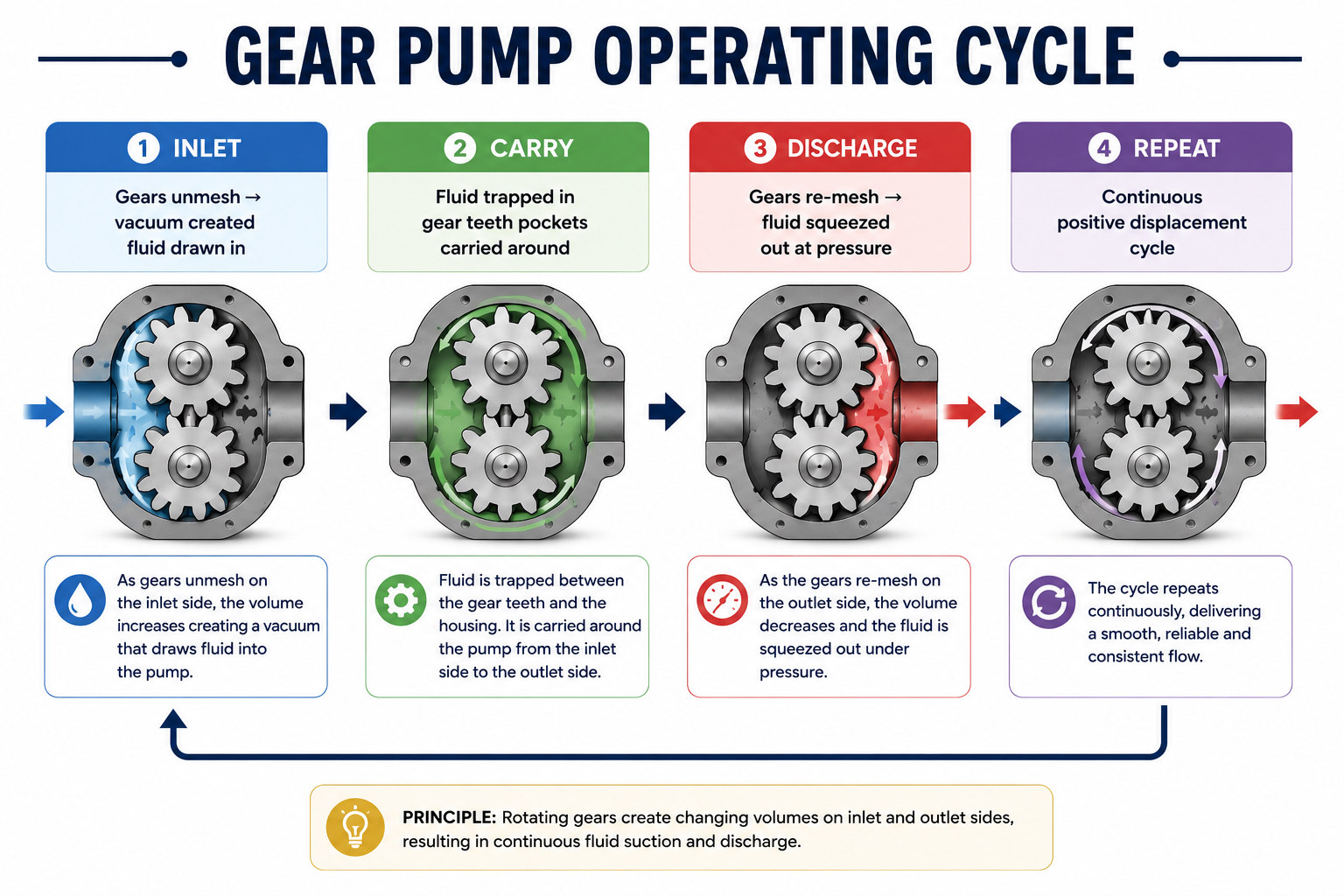
Correct operation is the first line of defence against premature failure. The following best practices apply to all gear pump types — external, internal, spur, helical, or gerotor.
| Parameter | Recommended Range | Action if Exceeded |
|---|---|---|
| Operating Pressure | Per rated spec (UA Series: up to 70 kg/cm²) | Check relief valve; inspect for blockage |
| Fluid Temperature | −10°C to +120°C (fluid-dependent) | Check viscosity; add cooling if needed |
| Fluid Viscosity | 1 to 100,000 CST | Consult engineering team above 100K CST |
| Suction Lift | Max 4–5 metres (fluid dependent) | Reduce suction line length/bends |
| Shaft Alignment | < 0.05 mm radial runout | Re-align motor and pump immediately |
| Gear Clearance (new) | 0.005" – 0.007" | Replace bearings if exceeded |
A structured preventive maintenance (PM) program is the single most cost-effective investment for any gear pump installation. The following framework is built around industry standard intervals and our field experience with UA Series gear pumps across Indian industrial facilities.
Bearings are the most wear-prone component in a gear pump. Their failure causes shaft misalignment, increased internal clearances, and catastrophic gear-to-housing contact.
| Seal Type | Inspection Frequency | Signs of Failure | Recommended Action |
|---|---|---|---|
| Mechanical Seal | Monthly visual + annual replacement | Fluid drips at shaft; crystalline deposits | Replace seal faces and O-rings |
| Shaft Oil Seal | Monthly visual | Oil film around seal OD; rubber cracking | Replace seal; check shaft surface |
| Body Gaskets | At every disassembly | Fluid seeping at flange joints | Always replace — never reuse |
| O-Rings | At every disassembly | Flat, cracked, or extruded profile | Replace with correct grade elastomer |
| Task | Daily | Weekly | Monthly | 6 Monthly | Annual |
|---|---|---|---|---|---|
| Check fluid level | ✔ | ✔ | ✔ | ✔ | ✔ |
| Monitor discharge pressure | ✔ | ✔ | ✔ | ✔ | ✔ |
| Listen for abnormal noise | ✔ | ✔ | ✔ | – | – |
| Inspect for external leaks | ✔ | ✔ | ✔ | ✔ | ✔ |
| Clean/replace suction filter | – | Inspect | Clean | Replace | Replace |
| Sample fluid for contamination | – | – | ✔ | ✔ | ✔ |
| Bearing clearance check | – | – | ✔ | ✔ | ✔ |
| Shaft alignment check | – | – | – | ✔ | ✔ |
| Mechanical seal inspection | – | Visual | Visual | Inspect | Replace |
| Full disassembly and overhaul | – | – | – | – | As needed / every 2 years |
| Update maintenance log | ✔ | ✔ | ✔ | ✔ | ✔ |
Experienced maintenance teams treat performance data as the most valuable tool in their toolkit. A well-maintained gear pump logbook allows you to identify degradation trends before they become failures.
The UA Series gear pumps from Unique Pump Systems are engineered for India's demanding industrial environments. Here are the key specifications that inform your maintenance program:
| Specification | UA Series Value | Maintenance Implication |
|---|---|---|
| Max Pressure | Up to 70 kg/cm² | Verify relief valve is set at ≤ 5% above rated pressure |
| Viscosity Range | Up to 100,000 CST | Monitor fluid temp — viscosity drops sharply with heat |
| Gear Material | Carbon steel / hardened stainless steel | Inspect for pitting or micro-cracks annually |
| Casing Material | Cast iron, SS, gun metal, bronze | Match seal material to casing for compatibility |
| Bearing Type | Precision roller or bush bearings | Check clearance every 500 hours or monthly |
Gear pump bearings should be checked frequently — ideally every 500 operating hours or monthly, whichever comes first. Clearance should be 0.005 to 0.007 inches in a new pump; if a sheet of paper passes through easily, bearings need replacement.
No. Gear pumps rely on the pumped fluid for internal lubrication and cooling. Running dry — even briefly — causes rapid gear expansion, heat buildup, and permanent damage to gears and the casing. Always prime the pump before startup.
A new gear pump typically has a clearance of 0.005 to 0.007 inches between gears and the housing. A simple paper test can confirm wear: if a standard sheet of paper passes between the gear and housing without resistance, the bearings likely need replacement.
Always use the manufacturer-recommended lubricant grade. Incorrect viscosity can cause dry running, overheating, or fluid contamination. For Unique Pump Systems UA Series gear pumps, refer to the product datasheet for recommended oil specifications.
Prevent overheating by ensuring proper lubrication, avoiding dry running, operating within the rated pressure range, monitoring fluid viscosity, and checking for clogged inlet filters.
UA Series gear pumps from Unique Pump Systems can handle pressures up to 70 kg/cm² with precision profile ground gears.
Yes. Because gear pumps are positive displacement, they continue building pressure if the discharge is blocked. A built-in relief valve protects the system from dangerous overpressure conditions.
A gear pump that is correctly operated and consistently maintained will deliver years — even decades — of reliable service. The key principles are straightforward: never run dry, maintain fluid cleanliness, inspect bearings regularly, replace seals proactively, and keep performance logs.