
Unique Pump Systems, Kailash Industrial Complex, Vikhroli (W)
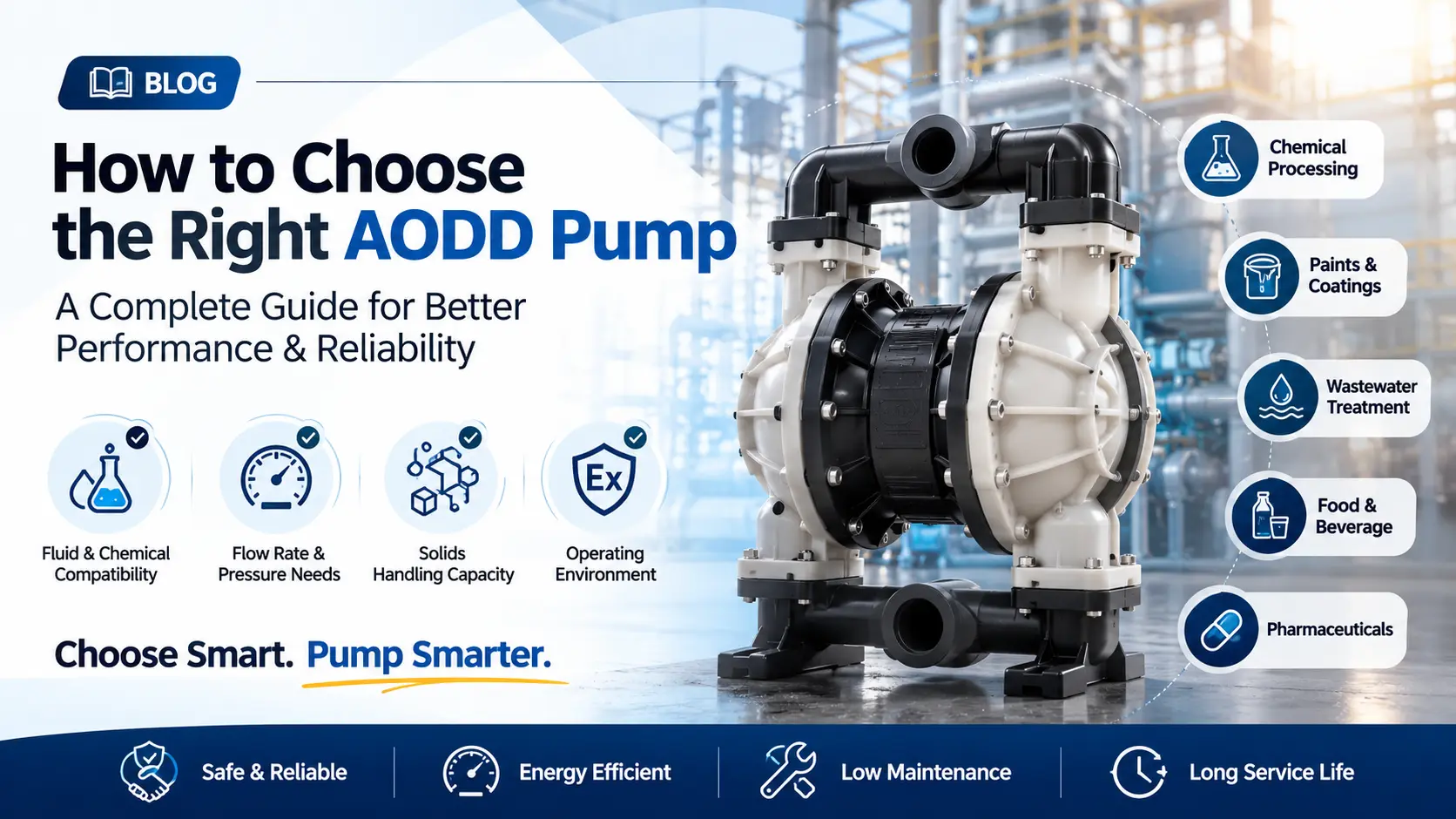
To select an AODD pump, define the fluid first — its viscosity, solids, chemistry and temperature. Then set the required flow rate and total discharge head, choose wetted materials and diaphragm elastomer for chemical compatibility, confirm available air pressure and volume, and finally pick a port size that keeps velocity below 3 m/s.
Air operated double diaphragm pumps are the workhorses of chemical plants, paint shops, food factories, mining sites and wastewater treatment. They run dry without damage, sit dead-headed against a closed valve all day, self-prime from an empty line and handle solids that would destroy most rotary pumps.
That versatility is exactly why selection goes wrong so often. Because an AODD pump will "sort of work" on almost anything, buyers grab a catalogue, pick a port size that matches their pipe, and order. Six months later they are replacing diaphragms every few weeks, wondering why their compressor cannot keep up, or watching the pump stall halfway up a lift.
Selection is not complicated, but it is specific. There are seven decisions that matter, and if you make all seven correctly the pump will run for years with nothing more than routine diaphragm changes.
This guide explains:
An AODD pump uses compressed air to move two flexible diaphragms back and forth. As one diaphragm pulls fluid into its chamber, the other pushes fluid out. An air distribution valve shuttles air between the two sides, and four check balls control the direction of flow.
There is no rotating shaft in the fluid, no close-running clearance and no seal to leak. That gives the pump a very specific set of strengths.
Choose an AODD pump when you need:
Look elsewhere when you need:
A dependable aodd pump is often the safest option precisely because it fails gracefully. A torn diaphragm reduces performance and vents to atmosphere rather than destroying the machine.
| # | Factor | Key Question | What It Determines |
| 1 | Fluid | What am I pumping? | Everything else |
| 2 | Flow rate | How much per hour? | Pump size |
| 3 | Total head | How hard must it push? | Air pressure needed |
| 4 | Wetted materials | Will the body survive? | Casing metallurgy or plastic |
| 5 | Elastomers | Will the diaphragm survive? | Diaphragm and ball material |
| 6 | Air supply | Do I have enough air? | Compressor and line sizing |
| 7 | Port size | How do I connect it? | Velocity and NPSH |
Work through them in this order. Each answer narrows the next choice.
Everything begins here. Write down all of the following before you look at a single catalogue page.
| Fluid Property | Why It Matters | Typical Impact |
| Chemical name and concentration | Determines material compatibility | Body and elastomer choice |
| Viscosity (cP or cSt) | Affects flow capability and suction | Derate pump above 1,000 cP |
| Specific gravity | Affects head calculation | Higher SG needs more air pressure |
| Temperature (min and max) | Limits elastomer choice | PTFE and EPDM have very different ranges |
| Solids size and percentage | Determines ball and seat sizing | Solids must be smaller than ball |
| Abrasiveness | Drives wear rate | May need special seats |
| Shear sensitivity | Some products degrade | AODD is generally gentle |
| Flammability | Grounding and ATEX requirements | Conductive materials needed |
| Food or pharma contact | Regulatory compliance | FDA / 3-A / EHEDG designs |
AODD pumps handle viscous fluids well, but flow drops as viscosity rises. Use this practical guide:
| Viscosity | Capacity Derating | Recommendation |
| Under 100 cP | None | Standard selection |
| 100–1,000 cP | 5–15% | Oversize one step |
| 1,000–5,000 cP | 20–40% | Oversize, use flooded suction, enlarge suction pipe |
| 5,000–20,000 cP | 40–70% | Use larger ports and slower cycling |
| Above 20,000 cP | Often impractical | Consider a rotary lobe or gear pump instead |
For genuinely thick products such as molasses, chocolate crumb or heavy grease, a positive displacement rotary design usually beats a diaphragm pump on both flow and energy. A gear pump handles very high viscosity smoothly and continuously, without the pulsation that comes with reciprocating diaphragms.
Do not guess. Establish the actual required flow using one of these methods:
Important: select the pump so that your duty point sits near the middle of its performance curve, not at the far right end. A pump running at maximum stroke rate all day wears diaphragms fast and consumes disproportionate air. Running a slightly larger pump at a slower cycle rate is quieter, more efficient and dramatically extends diaphragm life.
Total head has three parts:
Total Head = Static Head + Friction Loss + Terminal Pressure
Convert head in metres to bar with a simple formula:
Pressure (bar) = Head (m) × Specific Gravity ÷ 10.2
A plant needs to move 200 LPM of a chemical with SG 1.2 from a ground tank to a vessel 12 metres up, through 40 metres of 2 inch hose, into a vessel at 1 bar.
Now you can read a performance curve properly, because you know both coordinates of your duty point.
The pump body must resist the fluid chemically and survive it mechanically.
| Body Material | Best For | Avoid With | Max Temp |
| Cast Iron | Oils, fuels, non-corrosive fluids | Acids, seawater, food | 120 °C |
| Aluminium | Solvents, paints, fuels, portable duty | Strong acids, alkalis, chlorides | 120 °C |
| Stainless Steel 316 | Food, pharma, most chemicals | Hydrochloric acid, high chlorides | 120 °C |
| Polypropylene (PP) | Acids, alkalis, general chemicals | Aromatic solvents, high temp | 80 °C |
| PVDF (Kynar) | Aggressive acids, solvents, high purity | Strong alkalis at high temp | 105 °C |
| Conductive Acetal | Solvents in ATEX areas | Strong acids | 90 °C |
Rules of thumb:
The diaphragm is the single most important consumable in the pump. Get this wrong and nothing else you specified will matter.
| Elastomer | Chemical Resistance | Abrasion Resistance | Flex Life | Temp Range | Typical Use |
| Santoprene (TPE) | Good | Very good | Excellent | -40 to 107 °C | General purpose, best all-rounder |
| Buna-N (Nitrile) | Fair | Good | Good | -12 to 82 °C | Oils, fuels, hydrocarbons |
| EPDM | Very good with acids, alkalis, ketones | Good | Good | -51 to 138 °C | Aggressive chemicals, hot water |
| Neoprene | Fair | Good | Good | -18 to 93 °C | General industrial, refrigerants |
| Viton (FKM) | Excellent with hydrocarbons, acids | Fair | Fair | -40 to 176 °C | High temperature, aggressive solvents |
| PTFE | Outstanding, near universal | Fair | Lower | 4 to 104 °C | Extreme chemistry, purity, food |
| Polyurethane | Poor chemical | Outstanding | Good | -12 to 66 °C | Highly abrasive slurries |
Practical guidance:
This is the factor most often skipped, and the most common reason a correctly sized pump underperforms.
An AODD pump consumes roughly its rated flow of air, and air is expensive. Check three things:
| Check | Requirement | Consequence If Ignored |
| Air pressure | Must exceed liquid discharge pressure with margin | Pump stalls or slows |
| Air volume (CFM / m³/h) | Compressor must supply peak demand | Pump surges, other tools starve |
| Air quality | Clean, dry, correctly lubricated per design | Air valve icing, sticking, premature failure |
| Pump Size | Typical Max Flow | Air Consumption at Mid Duty | Recommended Air Line |
| 1/2 inch | 50 LPM | 6–12 CFM | 3/8 inch |
| 1 inch | 130 LPM | 15–25 CFM | 1/2 inch |
| 1.5 inch | 300 LPM | 30–45 CFM | 3/4 inch |
| 2 inch | 570 LPM | 50–80 CFM | 1 inch |
| 3 inch | 900 LPM | 80–130 CFM | 1.25 inch |
Key point: an AODD pump can never generate discharge pressure higher than the inlet air pressure. If you have 5 bar of air and need 6 bar of liquid pressure, no pump size will solve it. You need higher air pressure or a different pump technology.
Energy note: compressed air is one of the most expensive utilities in a plant. If a duty runs continuously for many hours a day, compare the five-year air cost against an electric rotary pump before committing.
Port size is not chosen to match your existing pipe. It is chosen to keep fluid velocity sensible.
| Port Size | Typical Max Flow | Max Solids | Common Applications |
| 1/4 – 1/2 inch | Up to 50 LPM | 2–3 mm | Dosing, lab, ink, adhesives |
| 3/4 – 1 inch | 50–130 LPM | 5–6 mm | Drum transfer, chemical dosing |
| 1.5 inch | 130–300 LPM | 8–10 mm | Paint, coatings, general process |
| 2 inch | 300–570 LPM | 12–14 mm | Wastewater, slurry, bulk transfer |
| 3 inch | 570–900 LPM | 18–20 mm | Mining, heavy slurry, tank emptying |
Always make the suction line at least the same diameter as the suction port, and one size larger for viscous fluid or long runs.
An AODD curve is a family of lines, not a single line. Each line represents an air inlet pressure.
To use it correctly:
If your duty point falls exactly on a curve, choose the next pump size up. Curves are generated with water at ambient temperature in ideal conditions, and real installations always cost you something.
| Condition | What to Specify |
| Suction lift over 4 m | Heavier balls, flooded suction if possible, larger suction line |
| Abrasive slurry | Polyurethane elastomers, hardened or replaceable seats, slower cycle speed |
| Hazardous / ATEX area | Conductive materials, grounding lug, ATEX certification, no aluminium in some zones |
| Food and pharmaceutical | 316L body, sanitary clamps, FDA elastomers, CIP compatibility |
| Filter press feed | Pump that stalls safely at pressure, pulsation dampener recommended |
| Shear-sensitive product | Slow cycle speed, large ports; consider a rotary displacement pump |
| Continuous 24/7 duty | Evaluate energy cost carefully against electric alternatives |
| Barrel or drum emptying | Portable trolley kit, quick-release fittings |
For high-viscosity, shear-sensitive or hygienic products running continuously, a lobe pump often delivers lower energy consumption and smoother, pulsation-free flow than a diaphragm pump — worth comparing before you commit to compressed air for a permanent installation.
| Feature | AODD Pump | Centrifugal | Gear Pump | Lobe Pump |
| Dry running | Safe, indefinite | Damaging | Damaging | Damaging |
| Dead-heading | Safe, stalls | Overheats | Bursts line | Bursts line |
| Solids handling | Excellent | Limited | Poor | Good |
| Self-priming | Excellent | Usually not | Good | Good |
| Flow pulsation | High | None | Low | Low |
| Energy efficiency | Low | High | Medium-high | High |
| Seal requirement | None | Mechanical seal | Mechanical seal or gland | Mechanical seal |
| Electricity needed | No | Yes | Yes | Yes |
| Maintenance skill | Low | Medium | Low | Medium |
| Purchase cost | Low to medium | Low | Low to medium | High |
One of the strongest arguments for diaphragm pumps is the absence of a dynamic seal. On any rotary pump handling hazardous or expensive product, sealing becomes the critical reliability item, and specifying the right mechanical seal — single, double, flushed or cartridge — is as important as selecting the pump itself.
| Myth | Fact |
| "AODD pumps can pump anything" | They handle a very wide range, but viscosity, temperature and chemistry all impose real limits |
| "Air is free" | Compressed air is typically the most expensive utility per unit of work in a plant |
| "Bigger pump means better performance" | An oversized pump cycling too slowly can lose prime and wear unevenly |
| "Diaphragm material is the only compatibility concern" | Balls, seats, O-rings and the body all contact the fluid |
| "You control flow with a discharge valve" | Correct control is via the air regulator; throttling discharge just wastes air |
| "AODD pumps don't need maintenance" | They need very little, but diaphragms are consumables with a finite life |
| "Any air line will do" | Undersized air lines are the single most common cause of poor performance |
Step 1 — Fluid data sheet. Name, concentration, viscosity at operating temperature, SG, solids size and percentage, temperature range, hazard classification.
Step 2 — Duty data. Required flow, batch or continuous, hours per day, suction lift or flooded suction, discharge height, pipe run length and size.
Step 3 — Calculate total discharge pressure. Static plus friction plus terminal.
Step 4 — Apply viscosity derating. Adjust required flow upward accordingly.
Step 5 — Select body material. Chemical compatibility first, then temperature, then abrasion.
Step 6 — Select elastomers. Cross-check chemistry, temperature and flex life.
Step 7 — Confirm air supply. Available pressure at the pump, available volume in CFM, air quality and line size.
Step 8 — Read the performance curve. Plot the duty point; confirm it sits mid-curve.
Step 9 — Choose port size by velocity. Suction under 2 m/s, discharge under 3 m/s.
Step 10 — Add accessories. Pulsation dampener, air filter regulator, flexible connectors, stroke counter or leak detection where required.
Step 11 — Verify certifications. ATEX, FDA, 3-A or industry-specific approvals.
Step 12 — Confirm with the manufacturer. Send the full duty sheet for validation before purchase.
Start with the fluid and required flow rate, calculate total discharge pressure from static head, friction loss and terminal pressure, apply a viscosity derating factor, then plot the duty point on the manufacturer's performance curve. Choose a pump where that point sits in the middle third of the curve at your available air pressure.
Most AODD pumps operate between 2 and 8.6 bar. The critical rule is that liquid discharge pressure can never exceed inlet air pressure. Allow at least 1 bar of margin above your calculated discharge pressure to keep the pump cycling comfortably rather than stalling.
Santoprene suits most general industrial duties thanks to excellent flex life and good chemical resistance. Choose PTFE for aggressive chemicals or purity requirements, Buna-N for oils and fuels, EPDM for acids, alkalis and hot water, Viton for high temperatures, and polyurethane for abrasive slurries.
Yes. Dry running causes no damage because there are no close-running metal surfaces and no seal relying on fluid lubrication. The pump simply cycles with air. This makes it ideal for tank emptying, sump duty and any process where the supply may run out unattended.
Air consumption varies with size and duty point. As a rough guide, a 1 inch pump uses 15–25 CFM at mid duty and a 2 inch pump uses 50–80 CFM. Always read consumption from the performance curve at your actual duty point and size the compressor with margin.
The usual causes are insufficient air pressure or volume, an undersized air line, a restricted or air-leaking suction line, worn balls and seats, high fluid viscosity, or a discharge pressure higher than assumed. Check air pressure at the pump inlet while running, not at the compressor.
There is no fixed interval. Life ranges from a few months on abrasive high-cycle duty to several years on gentle low-cycle applications. Establish your own interval by logging failures, then schedule planned changes at about 70 percent of observed life to avoid unplanned stoppages.
Yes, which is one of its main advantages. Solids up to roughly the ball diameter can pass through — typically 5 mm on a 1 inch pump and up to 20 mm on a 3 inch pump. For abrasive solids, specify polyurethane elastomers and run the pump at a slower cycle speed.
No. There is no rotating shaft entering the fluid, so no dynamic seal is required. This is a major advantage for hazardous, toxic or expensive fluids, and it removes the most common failure point found in centrifugal and rotary pumps.
Moisture in the compressed air expanding through the air valve cools rapidly and forms ice. Fit a proper air dryer or coalescing filter, drain the receiver regularly, and where the problem persists, use a pump with an anti-icing or externally serviceable air valve design.
It can run continuously, but compressed air is expensive. For duties running many hours a day at steady flow, compare the five-year energy cost against an electrically driven rotary pump. AODD pumps are most economical for intermittent, batch, portable, hazardous or solids-laden duties.
Regulate the air supply pressure and volume using an air filter regulator and a needle valve. Never throttle the suction line, as this causes cavitation and diaphragm damage. Discharge throttling works but simply wastes compressed air and generates unnecessary noise.
Selecting an AODD pump properly takes about twenty minutes with the right information and saves years of trouble. Fluid first, then flow, then head, then materials, then elastomers, then air, then port size. Skip any of the seven and the pump will still run — just not for as long, or as economically, as it should.