
Unique Pump Systems, Kailash Industrial Complex, Vikhroli (W)
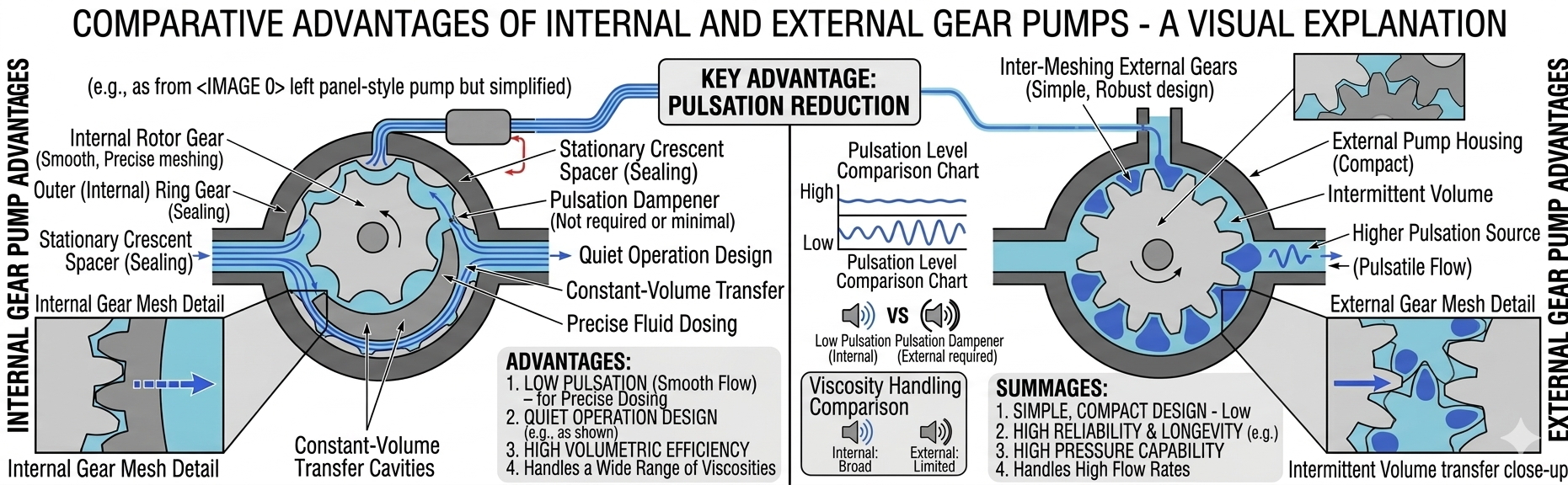
If you are evaluating a gear pump for your application, the most important decision you face is not which brand to choose — it is whether to use an internal gear pump or an external gear pump. Both are positive displacement pumps that deliver precise, consistent flow. Both handle viscous fluids that centrifugal pumps cannot. But their internal geometry, operating physics, and performance characteristics are different in ways that determine which design is right for your specific fluid, pressure, temperature, and installation conditions.
This guide covers every advantage — and every limitation — of both designs, with the engineering reasoning behind each point, quantified performance data where available, and a direct comparison across 15 application parameters. By the end, you will know exactly which type to choose, and why.
| Advantage | Internal Gear Pump Wins | External Gear Pump Wins | Both Equal |
|---|---|---|---|
| Maximum viscosity capability | ✓ Up to 100,000 cSt | Up to 100,000 cSt | |
| Maximum pressure capability | ✓ Up to 70 kg/cm² (UA Series) | ||
| Noise and vibration level | ✓ Quieter — fewer gear mesh events per rev | ||
| Smoothness of flow (pulsation) | ✓ Lower pulsation — single mesh point | ||
| Shear sensitivity (gentle on fluid) | ✓ Lower shear rate at equivalent speed | ||
| Bi-directional flow | ✓ Always bi-directional | Bi-directional (spur gears only) | |
| Compact footprint for given flow | ✓ More compact design | ||
| Capital cost | ✓ Lower — simpler machining | ||
| Maintenance simplicity | ✓ Easier to disassemble and service | ||
| High-speed operation | ✓ Can run at higher RPM | ||
| Metering and dosing precision | ✓ Both equally precise for flow | ||
| Self-priming capability | ✓ Both self-priming | ||
| Positive displacement accuracy | ✓ Both positive displacement | ||
| Ability to run dry briefly | ✓ Both tolerant for brief dry running | ||
| Steam jacket option for hot fluids | ✓ Both available with jacketing |
An external gear pump uses two identical gears mounted on parallel shafts, rotating in opposite directions and meshing at the centre of the pump. One gear (the drive gear) is connected to the motor shaft; the other (the idler gear) is driven by the first. As the gears rotate and unmesh on the inlet side, a partial vacuum forms, drawing fluid in. The fluid is carried in the spaces between the gear teeth and the pump casing as the gears rotate. When the gears mesh again on the discharge side, the enclosed volume collapses and fluid is forced out under pressure.
An internal gear pump uses a fundamentally different geometry: a smaller external gear (the rotor or idler) rotates eccentrically inside a larger internal gear (the outer rotor). The two gears rotate in the same direction — unlike external gear pumps where the gears counter-rotate. A fixed crescent-shaped divider (in crescent designs) separates the suction and discharge chambers. Because both gears rotate in the same direction and the tooth-mesh point is always the same angular position relative to the casing, the internal gear pump has only one primary gear engagement point per revolution — the fundamental reason internal gear pumps are quieter and produce lower-pulsation flow.
📖 Read More: Gear Pump Guide: How It Works, Types & How to Choose
Internal gear pumps typically produce 1–5% flow pulsation compared to 5–15% for spur-type external gear pumps. Low pulsation protects downstream equipment — flow meters give accurate readings, spray nozzles produce even patterns, and sensitive process control instruments do not see false signals from flow pulses.
Internal gear pumps run at 62–70 dB(A) vs 65–82 dB(A) for external pumps — approximately 10 dB lower, perceived as roughly half the loudness.
Internal gear pumps apply lower shear, making them the standard choice for polymer solutions, emulsions, biological materials, thixotropic fluids, and hot melt adhesives.
Internal gear pumps are inherently bi-directional — reversing motor direction reverses flow direction without modification.
Internal gear pumps allow larger displacement per unit of external body size — smaller footprint and lower weight.
At viscosities above 20,000 cSt, internal gear pumps consistently require less inlet head and run at lower noise levels.
Internal gear pumps cost 30–60% more than equivalent external gear pumps due to manufacturing complexity.
Most internal gear pump designs are rated to 40–50 bar maximum, while UA Series external gear pump is rated to 70 kg/cm².
Internal gear pumps typically max at 1450 RPM; external gear pumps can run to 1500–3000 RPM.
Internal gear pump multi-component construction requires more careful disassembly and reassembly.
UA Series external gear pump rated to 70 kg/cm² (approximately 70 bar / 1000 PSIG) in standard construction.
External gear pumps typically cost 30–60% less than internal gear pumps of equivalent flow and pressure.
External gear pumps can operate at 1500–3000 RPM, allowing direct coupling to standard motor speeds without gearbox.
Simpler two-gear design means faster disassembly and standard spare parts availability.
External gear pumps are the standard design for hydraulic power unit (HPU) charge and pressure pumps worldwide.
Spur gear external pumps produce more pulsation and higher noise levels than internal gear pumps.
External gear pumps apply higher shear — avoid for polymers, emulsions, and biological materials.
Side-by-side parallel shaft arrangement makes external pumps wider than internal pumps of equivalent displacement.
| Industry / Application | Standard Choice | Engineering Reason |
|---|---|---|
| Hydraulic power units (HPUs) | External gear pump | High pressure, high speed, clean mineral oil |
| Bitumen and asphalt transfer | Internal gear pump | Extreme viscosity, gentle suction geometry, bi-directional |
| Hot melt adhesive metering | Internal gear pump | Shear-sensitive fluid, low-pulsation flow |
| Food and beverage (chocolate, syrups, cream) | Internal gear pump | Low shear, low noise, CIP compatibility |
| Pharmaceutical API transfer | Internal gear pump | Shear-sensitive ingredients, validated smooth flow |
| Lube oil circulation systems | External gear pump | Cost-effective for clean oil at moderate pressure |
| Fuel oil burner supply | External gear pump | Handles diesel and heavy fuel oil well at moderate pressure |
| Resin and polymer transfer | Internal gear pump | High viscosity + shear sensitivity combination |
Selection Checklist:
Unique Pump Systems manufactures the UA Series gear pump range — external gear pumps covering flow rates from 2 to 6000 LPM, pressures up to 70 kg/cm², viscosity up to 100,000 cSt, connection sizes from 3/8" to 8", and temperatures up to 200°C with steam jacket option. Available in mild steel, stainless steel, cast iron, gun metal, bronze, and super alloys. For internal gear pump applications, contact our application engineering team for a recommendation matched to your specific requirements.