
Unique Pump Systems, Kailash Industrial Complex, Vikhroli (W)
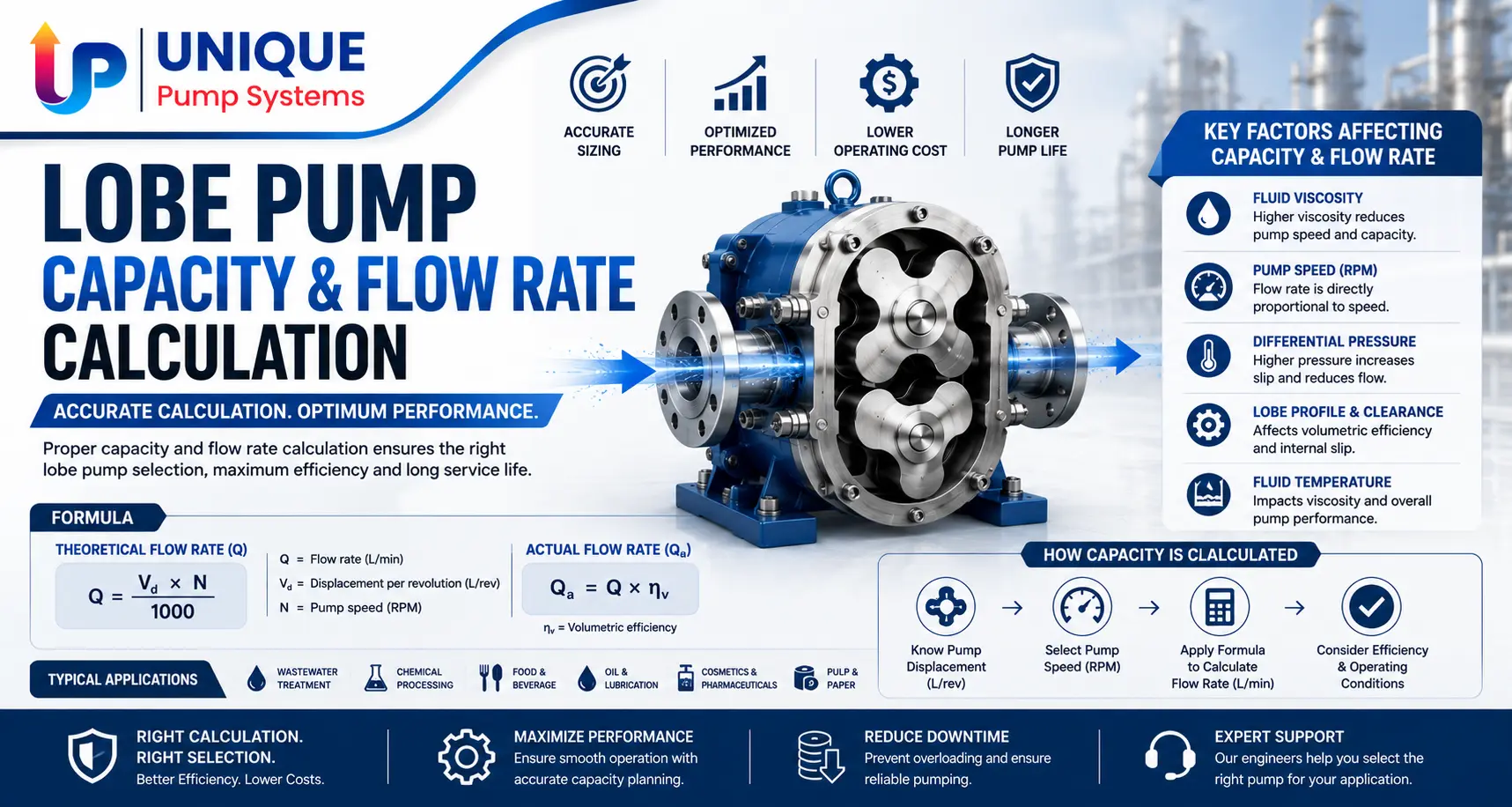
Like all positive displacement machines, a lobe pump moves a fixed volume of fluid per revolution, so its capacity is displacement per revolution multiplied by speed, minus slip. Displacement is set by rotor size and profile, and the manufacturer lists it in litres per 100 revolutions or cc per revolution on the data sheet.
The maths is the same idea used to size a gear pump, with one twist: viscous product actually seals the lobe clearances better, so lobe pumps often reach high volumetric efficiency on thick fluids.
If a pump displaces 0.5 litres per revolution and runs at 300 rpm, theoretical flow is 0.5 × 300 = 150 litres per minute. Slip then reduces this, mainly at higher differential pressure and lower viscosity.
| Condition | Effect on slip | Effect on real output |
|---|---|---|
| Thin fluid | More slip | Lower output |
| Thick fluid | Less slip | Output near theoretical |
| Higher differential pressure | More slip | Lower output |
| Worn clearances | More slip | Output falls over time |
Because thick product seals the clearances, a lobe pump rated on water-like fluid often delivers closer to theoretical on cream or syrup.
A capacity calculation is a starting point, not a purchase order. Once you have the theoretical flow and a slip allowance, add margin for future wear and for the worst-case differential pressure your system can present, so the pump still meets target after a year of service. Under-sizing to the exact number leaves no headroom, and the first clearance wear pushes you below target.
It also pays to think about turndown. If the same pump must run several products or dose to different rates, a variable frequency drive lets you trim the speed — and therefore the flow — without changing the pump, since output is proportional to speed. Confirm the motor and drive cover the full speed and pressure range, and check that low-speed running still gives enough face lubrication on the seals. Finally, record the commissioning flow, speed and pressure as a baseline; comparing against it later is the quickest way to catch creeping wear before it costs you product. Spec the pump this way and the calculated capacity translates into dependable, repeatable output on the plant floor.
Higher viscosity lowers slip, so real output rises toward the theoretical figure. Thin fluids leak across the non-contact clearances more easily and cut the delivered flow.
Use a variable frequency drive to set the speed against a calibrated dose. Because flow is proportional to speed, trimming rpm gives you repeatable metering.
Clearance wear. As the rotors and casing wear, slip increases and delivered flow falls, so periodic clearance checks and refurbishment restore capacity.
Unique Pump Systems manufactures rotary lobe pumps in Mumbai for dairy, food, beverage and chemical plants across India and export markets, with hygienic and CIP-ready configurations. Tell us your product, its viscosity, the flow you need and your cleaning regime, and our engineers will recommend the rotor profile, speed and seal that protect both the product and the pump. Call +91 98198 30689 or +91 98206 25476, or request a quote through our contact page. Standardising on one hygienic platform simplifies spares and training, and stocking a rotor and seal kit per size keeps your line running through peak season.