
Unique Pump Systems, Kailash Industrial Complex, Vikhroli (W)
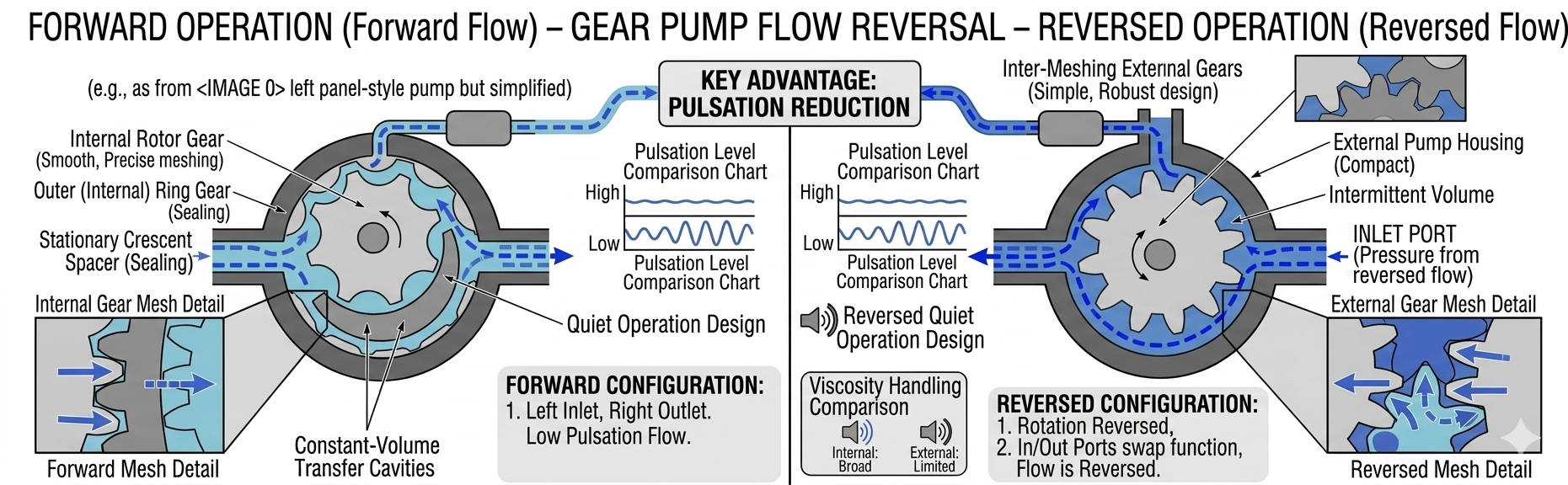
One of the most common questions plant engineers and maintenance teams ask about gear pumps is whether they can be reversed — either to change flow direction, empty a line back into a tank, or switch between two process paths. The answer depends entirely on the pump type, the gear geometry, the seal arrangement, and whether the relief valve is correctly configured for reverse operation. This guide covers everything: which gear pumps support reversal, what physically changes inside the pump when you reverse rotation, what must be modified in the pipework and valve arrangement, and the specific checks required before reversing a pump that was not originally specified for bi-directional operation.
| Pump Type | Rotation Reversible? | Flow Reversible? | What Changes |
|---|---|---|---|
| Internal gear pump (crescent or gerotor) | Yes — always bi-directional | Yes — inlet becomes outlet | Suction and discharge ports swap; relief valve must be re-piped or a dual relief valve used |
| External gear pump — spur gears | Yes — with correct seal and port configuration | Yes — inlet becomes outlet | Same as internal; check if gland plate is symmetric; re-pipe relief valve |
| External gear pump — single helical gears (UA Series) | No — rotation direction is specified | No | Helical gear axial thrust direction is fixed; running in reverse damages thrust bearings |
| External gear pump — herringbone gears | No — inherently directional | No | Double helical cancels axial thrust only in design direction; reverse causes bearing overload |
| Gear pump with fixed-port gland plate | No without modification | Only with pipework change | Non-symmetric gland plate must be replaced or rotated to swap port function |
An external gear pump works by creating a low-pressure zone where the gear teeth unmesh (suction) and a high-pressure zone where the gear teeth mesh (discharge). When rotation direction reverses, the unmeshing zone and the meshing zone exchange positions — the port that was previously at low pressure (suction) is now at high pressure (discharge), and vice versa. The fluid path through the pump body stays the same, but the direction of fluid movement through it reverses.
An internal gear pump works identically in principle. The rotor and idler rotate in the same direction as each other regardless of CW or CCW drive direction — reversing the drive shaft direction simply reverses both rotors together, swapping the expanding and contracting cavities and therefore swapping suction and discharge.
📖 Read More: Gear Pump Guide: How It Works, Types & How to Choose
Three solutions, in order of preference:
When a symmetric pump is reversed, the physical ports remain in the same location on the pump body — but their function changes. Any labels, direction arrows, or pipework annotations must be updated.
Single coil spring mechanical seals (Type 41, DIN EN 12756) are rotation-direction-dependent. Check the seal hand marking before reversing. Multi-spring seals and bellows seals are rotation-independent — these require no change on reversal.
Some gear pump designs incorporate an integral bypass port. When the pump is reversed, verify that the bypass port remains connected to the correct system line.
📖 Read More: Gear Pump Maintenance Guide
The internal gear pump is inherently bi-directional — both the rotor and idler reverse together when shaft rotation reverses, and the eccentric geometry creates identical pumping action in both directions. This makes it the preferred choice for applications requiring regular flow reversal without mechanical modification each time.
| Mistake | Consequence | How to Prevent |
|---|---|---|
| Reversing a helical or herringbone external gear pump | Bearing overload — failure within hours to days | Check gear type before reversing; helical/herringbone pumps must not be reversed |
| Not moving the relief valve to new discharge side | No overpressure protection in reverse — pipe or seal failure if discharge blocks | Install dual relief valve or move single valve before reversing |
| Not changing single coil spring seal hand | Spring unwinds — reduced face closing force — seal leak within hours to days | Confirm seal type; change to correct hand or replace with rotation-independent design |
| Assuming all gear pumps can be reversed | Damage to directional pump design | Always confirm with manufacturer's documentation or engineering team |
| Swapping motor phases without checking rotation direction | Pump runs in wrong direction — no flow or cavitation | Verify rotation direction arrow after phase swap; test with isolation valves open |
No. Internal gear pumps and spur-tooth external gear pumps can be reversed with appropriate modifications (relief valve, seal hand). Single helical and herringbone external gear pumps must never be reversed — the gear geometry creates axial thrust in one direction only, and reverse operation causes bearing failure.
For correctly reversed bi-directional pumps, performance is identical in both directions — the displacement, pressure capability, and efficiency are the same. The pump produces the same flow at the same RPM regardless of rotation direction.
Never reverse a gear pump while it is running. The mechanical impact of reversing rotation while the gears are moving under load causes immediate gear and bearing damage. Always stop the pump completely, make all necessary modifications (relief valve, seal), and then restart in the new direction.
The internal gear pump is the best choice for applications requiring frequent or regular flow reversal. Its symmetric geometry requires no mechanical changes between directions (other than the one-time installation of a rotation-independent seal and a dual relief valve arrangement). Contact Unique Pump Systems for bi-directional internal gear pump specifications.
Unique Pump Systems manufactures rotary gear pumps across the full UA Series range. For bi-directional application advice, relief valve specification, and rotation direction confirmation for your specific pump model, contact our application engineering team.