
Unique Pump Systems, Kailash Industrial Complex, Vikhroli (W)
A gear pump is a type of positive displacement pump that moves fluid by trapping a fixed volume between rotating gear teeth and the pump casing. This comprehensive guide covers all 5 major types of gear pumps — external, internal, gerotor, lobe, and screw — with working principles, applications, advantages, and selection criteria.
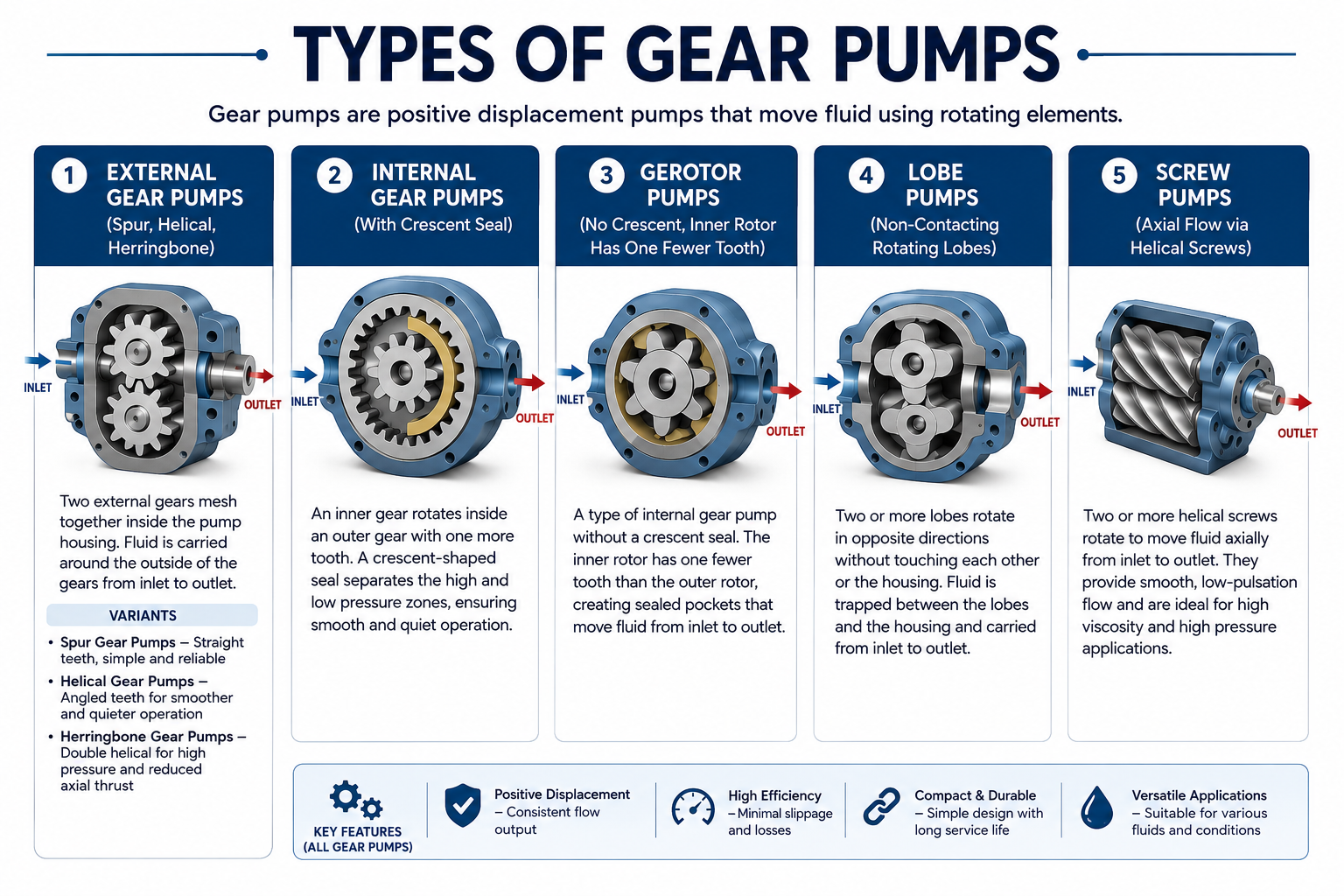
A gear pump is a positive displacement rotary pump that uses meshing gears to pump fluid by displacement. They are one of the most common types of pumps for hydraulic fluid power applications and are widely used in chemical installations to pump high-viscosity fluids. All gear pumps operate on the same fundamental principle: as gears rotate and separate on the inlet side, a low-pressure area draws fluid in. Fluid fills cavities between gear teeth and the casing wall, carried to the discharge side where meshing gears force fluid out under pressure.
| # | Pump Type | Configuration | Viscosity Range | Pressure Rating | Best For |
|---|---|---|---|---|---|
| 1 | External Gear Pump | Two identical external meshing gears | Low to medium viscosity | Up to 250 bar | Hydraulics, fuel transfer, lubrication |
| 2 | Internal Gear Pump | Inner rotor inside larger outer gear + crescent seal | Very high (up to 100,000 CST) | Up to 175 bar | Asphalt, resins, polymers, chocolate |
| 3 | Gerotor Pump | Inner rotor (N teeth) + outer rotor (N+1 teeth), no crescent | Low to medium viscosity | Up to 150 bar | Automotive oil, compact hydraulics |
| 4 | Lobe Pump | Non-contacting lobes + external timing gears | Wide range | Up to 15 bar | Food, pharmaceutical, sanitary |
| 5 | Screw Pump | Two or three helical screws | Low to high viscosity | Up to 350 bar | Fuel injection, marine, hydraulics |
External gear pumps are the most widely used gear pump variant in industrial and hydraulic applications. The design consists of two identical gears — a driver gear (connected to the prime mover) and a driven or idler gear — both externally toothed and meshing together inside a close-tolerance housing.
| Advantages | Limitations |
|---|---|
| Self-priming capability | Not suitable for abrasive fluids |
| High pressure capability (up to 250 bar) | More pulsation than internal designs |
| Compact and cost-effective construction | Sensitive to contamination |
| Bidirectional flow possible | Higher noise level than helical designs |
| Suitable for wide viscosity range | Requires clean fluid with proper filtration |
Sub-types of External Gear Pumps: Spur gear pumps (straight-cut teeth, simple and economical), Helical gear pumps (angled teeth for quieter operation), and Herringbone gear pumps (double-helical V-pattern that cancels axial thrust).
Internal gear pumps differ fundamentally from external designs: one gear (the inner rotor or pinion) rotates inside a larger outer gear (ring gear or annulus). A fixed crescent-shaped seal sits between them, separating suction and discharge ports. Internal gear pumps are inherently self-priming, produce smoother flow, and are especially well-suited for high-viscosity and shear-sensitive fluids.
| Advantages | Limitations |
|---|---|
| Handles very high viscosities (up to 100,000 CST) | Higher manufacturing cost |
| Smooth, low-pulsation flow | Not suitable for abrasive solids |
| Gentle on shear-sensitive fluids | Limited to moderate pressures |
| Reversible operation | More complex design than external pumps |
| Quiet operation | Requires precision machining for efficiency |
A Gerotor (Generated Rotor) pump is a specialized internal gear pump that eliminates the crescent seal. The inner rotor has one fewer tooth than the outer rotor, and the two rotors are offset. The trochoidal tooth profile ensures continuous contact, forming sealed chambers that expand on the intake side and contract on the discharge side.
| Advantages | Limitations |
|---|---|
| Very compact and lightweight | Lower pressure capability |
| Quiet, vibration-free operation | Not for high-viscosity fluids |
| No crescent seal — fewer parts | Sensitive to contamination |
| Excellent volumetric efficiency | Close tolerances required |
| Low manufacturing cost for high volume | Limited to clean, low-viscosity fluids |
Lobe pumps are rotary positive displacement pumps that resemble external gear pumps, but the lobes never directly contact each other. Synchronization is achieved through external timing gears, keeping the lobes in precise relationship without metal-to-metal contact. This makes them ideal for sanitary and solids-laden applications.
| Advantages | Limitations |
|---|---|
| No metal-to-metal contact | Limited pressure range (up to ~15 bar) |
| Handles solids-laden fluids | External timing gears add complexity |
| Easy to clean (CIP/SIP compatible) | Higher pulsation than internal gear pumps |
| Low shear on fluids | More expensive than basic gear pumps |
| Hygienic designs available (FDA compliant) | Requires precise timing gear alignment |
Screw pumps use one, two, or three helical screws to move fluid axially along the screw axis. Unlike conventional gear pumps that move fluid radially, screw pumps provide axial flow — meaning the fluid travels in a straight line from suction to discharge, resulting in virtually pulsation-free flow and very quiet operation.
| Advantages | Limitations |
|---|---|
| Virtually pulsation-free flow | Higher manufacturing precision required |
| Extremely quiet operation | Higher initial cost |
| Handles gas-entrained fluids | Sensitive to fluid contamination |
| Very high pressure capability (up to 350 bar) | Complex maintenance |
| High efficiency at high speeds | Not suitable for abrasive fluids |
| Parameter | External Gear | Internal Gear | Gerotor | Lobe Pump | Screw Pump |
|---|---|---|---|---|---|
| Flow Type | Pulsating | Smooth | Smooth | Slight pulsation | Nearly pulse-free |
| Self-Priming | Yes | Yes | Yes | Yes | Yes |
| Max Viscosity | ~5,000 CST | ~100,000 CST | ~3,000 CST | ~100,000 CST | ~10,000 CST |
| Max Pressure | 250 bar | 175 bar | 150 bar | 15 bar | 350 bar |
| Noise Level | Moderate-High | Low | Very Low | Low | Very Low |
| Handles Solids | No | No | No | Yes (soft) | No |
| Sanitary Use | No | Limited | No | Yes (FDA) | No |
| Relative Cost | Low | Medium | Low-Medium | High | High |
| Industry | Typical Application | Recommended Type |
|---|---|---|
| Oil & Gas | Crude oil transfer, lube oil systems, fuel injection | External, Screw |
| Chemical Processing | Solvent transfer, resin handling, chemical dosing | Internal, External |
| Food & Beverage | Chocolate, dairy, sauces, edible oils | Lobe, Internal |
| Pharmaceutical | Sterile fluid transfer, creams, gels | Lobe (sanitary) |
| Hydraulics | Mobile & industrial hydraulic circuits | External Spur/Helical |
| Automotive | Engine oil pump, power steering, transmission | Gerotor |
| Marine | Fuel oil transfer, lube systems, bilge | Screw, External |
| Power Generation | Turbine lube oil, heavy fuel oil supply | Internal, Herringbone |
Selection Checklist: Answer these questions before selecting a gear pump:
Also Read: Gear Pump Guide: Working, Types & Selection | Gear Pump Maintenance Best Practices
The 5 main types are: External Gear Pumps (spur, helical, herringbone), Internal Gear Pumps (crescent type), Gerotor Pumps, Lobe Pumps, and Screw Pumps. Each type suits different fluid viscosities, pressures, and applications.
External gear pumps use two identical external meshing gears side-by-side; they excel at low-viscosity fluids and high-pressure hydraulic applications. Internal gear pumps have an inner drive gear rotating inside a larger outer gear with a crescent seal, making them ideal for high-viscosity fluids like asphalt, resins, and polymers.
Internal gear pumps are best for high-viscosity applications (up to 100,000 CST) like asphalt, tar, resins, polymers, and chocolate. Their design creates a gentle, smooth flow that avoids degrading thick or shear-sensitive fluids.
Gerotor pumps are used for automotive engine oil circulation, automatic transmission fluid, compact hydraulic systems, pharmaceutical metering, and small fuel transfer applications. They are compact, quiet, and highly reliable.
No. Standard gear pumps are not recommended for abrasive slurries or fluids containing solids because tight internal clearances accelerate wear on gear teeth and bearings. For abrasive applications, lobe pumps with wider clearances or progressive cavity pumps are preferred.
Standard industrial gear pumps operate up to 200–250 bar. Unique Pump Systems' UA Series precision-ground gear pumps can handle pressures up to 70 kg/cm² with highly accurate profile ground gears. Screw pumps can achieve even higher pressures up to 350 bar.