
Unique Pump Systems, Kailash Industrial Complex, Vikhroli (W)
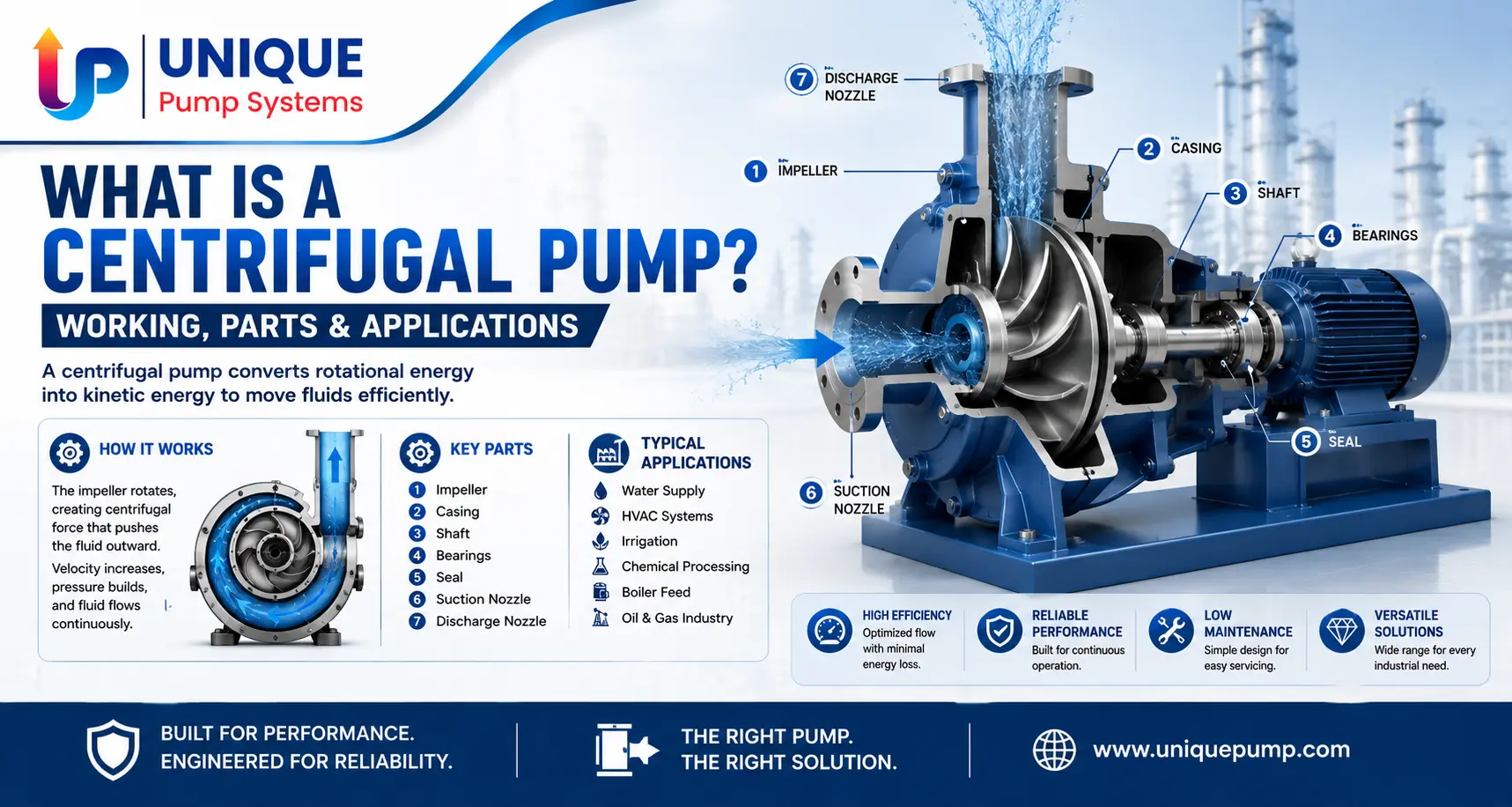
A centrifugal pump moves liquid by spinning it. A rotating impeller flings the liquid outward, converting the motor’s rotational energy into velocity, and the casing then turns that velocity into pressure that pushes the liquid out. It is the most common pump type in industry for clean, low-viscosity liquids at moderate-to-high flow.
Where the fluid is thick, delicate or must be dosed precisely, a positive displacement machine such as a gear pump takes over, because a centrifugal pump loses efficiency quickly as viscosity climbs. Understanding that boundary is the key to picking the right pump.
Impeller diameter and speed set the head; impeller width sets the flow.
Because it relies on velocity, a centrifugal pump must be primed — it cannot pull air like a positive displacement pump.
| Sector | Typical duty |
|---|---|
| Water supply | Boosting and distribution |
| HVAC | Chilled and cooling water |
| Firefighting | High-flow hydrant and sprinkler feed |
| Effluent | Clarified and treated water |
| Light chemicals | Thin, clean, low-viscosity fluids |
It shines on thin fluids at high flow but loses efficiency fast as viscosity rises.
Knowing what a centrifugal pump is makes it easier to see where it stops being the right tool. Its efficiency and simplicity are unbeatable on clean, thin liquids at moderate-to-high flow and modest head per stage, which covers most water, cooling and utility duties. But as viscosity climbs, more of the impeller’s energy goes into churning the fluid rather than moving it, so efficiency collapses and a positive displacement pump becomes the sensible choice.
Use a simple rule of thumb: thin and high-flow points to centrifugal, while thick, delicate, or precisely dosed points to gear, lobe or diaphragm pumps. Head is the other axis — a single-stage centrifugal pump gives modest head, and multi-stage designs reach higher pressures for boosting and boiler feed. When you scope a new duty, write down the flow, head, viscosity and fluid character first, then match the pump family to those numbers rather than to habit. Getting the family right at the start saves far more energy and maintenance than optimising the wrong type later, and it is the first question worth answering on any pumping project.
Standard centrifugal pumps do not; they must be primed first, because they cannot evacuate air from the suction line. Self-priming variants exist but add complexity and cost.
Poorly. Efficiency drops sharply as viscosity rises, so for viscous oils a positive displacement pump such as a gear or lobe pump is far more efficient.
Impeller width sets the flow, while impeller diameter and rotational speed set the head. Trimming the impeller or changing speed shifts the pump’s operating point.
Unique Pump Systems manufactures and supplies centrifugal pumps and spares in Mumbai for water, utility and light-chemical duties across India and export markets. Give us your flow, head, fluid character and any suction constraints, and our engineers will help you pick the right impeller type and material, confirm the NPSH margin, and set the duty point near the best efficiency point to save energy. Call +91 98198 30689 or +91 98206 25476, or request a quote through our contact page, and keep a seal kit and bearing set on the shelf so a diagnosed fault becomes a planned change-out.