
Unique Pump Systems, Kailash Industrial Complex, Vikhroli (W)
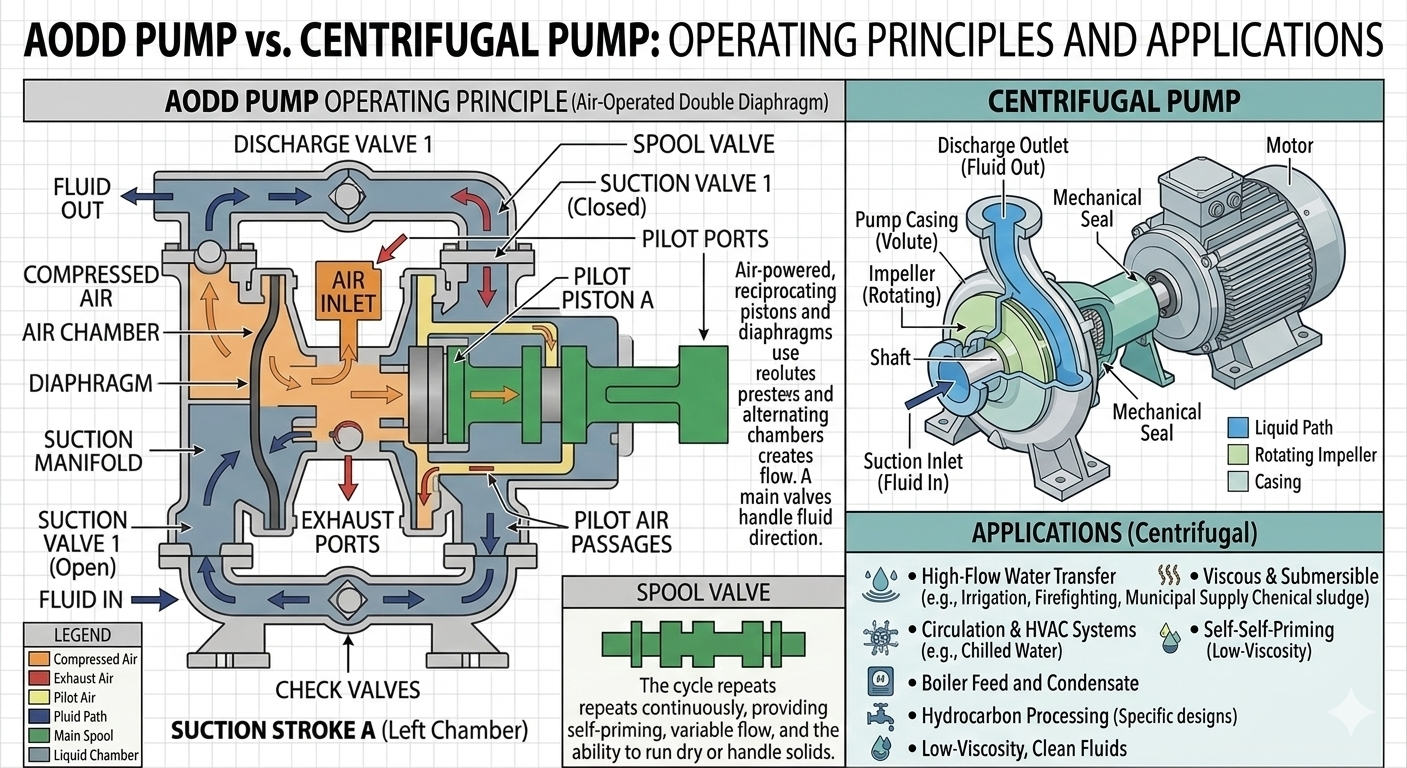
AODD (Air Operated Double Diaphragm) pumps and centrifugal pumps are the two most widely used pump types in Indian industrial plants — and they are frequently considered as alternatives for the same application. On the surface, both move fluid and both are available in comparable flow rate ranges. Below the surface, their operating principles, performance curves, viscosity tolerances, suction requirements, solids handling, seal arrangements, and failure modes are fundamentally different. Choosing the wrong type for a given application does not just reduce efficiency — it creates a predictable, recurring failure pattern that gets misdiagnosed as a maintenance problem rather than a design problem. This guide covers the complete technical and economic comparison, including the pump curve physics that most engineers are not explicitly taught, the viscosity correction mathematics that determine when a centrifugal pump becomes economically unviable, and a structured decision framework that maps application parameters to the correct pump type. For product specifications, see the AODD pump and centrifugal pump ranges from Unique Pump Systems.
Also Read: AODD Pumps vs EODD Pumps | How Does an AODD Pump Work
The most important difference between AODD and centrifugal pumps is not a feature or a specification — it is the physics of how each converts energy into fluid movement. This physics difference determines everything else: flow stability, pressure capability, suction behaviour, viscosity sensitivity, and failure mode.
A centrifugal pump uses a rotating impeller to impart kinetic energy (velocity) to the fluid. The impeller accelerates the fluid outward from its centre to its periphery through centrifugal force. This high-velocity fluid then enters the volute casing — a spiral-shaped passage that progressively widens, slowing the fluid and converting its kinetic energy into pressure energy. The resulting pressure difference between inlet and outlet drives the fluid through the system.
The critical implication of this velocity-to-pressure conversion mechanism: centrifugal pump performance depends entirely on the fluid's ability to accelerate to the required velocity in the impeller. This creates two fundamental sensitivities:
An AODD pump uses compressed air pressure to alternately push two flexible diaphragms, which physically displace a fixed volume of fluid on each stroke. There is no impeller, no rotating component in the fluid, and no velocity-to-pressure conversion. The pump simply pushes a defined volume of fluid through check valves on each stroke — regardless of how viscous the fluid is, how high the system pressure is (up to the air supply pressure limit), or whether suction conditions are stable.
The critical implication: AODD pump flow rate is primarily determined by stroke rate (controlled by air supply pressure) and is nearly independent of discharge pressure within the pump's rated range. This fixed-displacement characteristic makes the AODD pump fundamentally different from the centrifugal pump in how it responds to system changes.
Every centrifugal pump has a characteristic H-Q curve (head vs flow rate curve) that defines its performance at a given shaft speed. Understanding this curve — and the equivalent characteristic of an AODD pump — is the foundation of correct pump selection.
A centrifugal pump's H-Q curve starts at maximum head (shutoff head) when flow is zero, and drops as flow increases. The pump operates at the point where this curve intersects the system curve (which rises as flow increases, due to increasing friction losses in the pipework).
An AODD pump does not have an H-Q curve in the centrifugal sense. Its flow-pressure characteristic is much flatter — flow remains nearly constant across a wide pressure range until it approaches the supply air pressure limit, at which point it stalls (rather than continuing to run at reduced flow as a centrifugal pump would).
The practical result: AODD pump flow is much more stable across changing system conditions than centrifugal pump flow. For applications where system resistance varies (intermittent demand, varying tank levels, partially open valves), AODD maintains more consistent delivery without operator intervention.
Net Positive Suction Head (NPSH) is one of the most important — and most frequently misunderstood — parameters in centrifugal pump selection. It is the primary reason centrifugal pumps fail in applications where AODD pumps would work reliably.
NPSH describes the pressure available at the pump suction inlet relative to the vapour pressure of the fluid. If the suction pressure drops below the fluid's vapour pressure at any point inside the pump (typically at the low-pressure zone at the impeller eye), the fluid vaporises — forming vapour bubbles. These bubbles collapse violently as they reach the higher-pressure regions of the impeller, causing:
There are two NPSH values that must be understood:
For reliable operation: NPSHa must exceed NPSHr by a minimum margin (typically 0.5–1.0 metres for clean water; more for volatile liquids and abrasive fluids). If NPSHa drops below NPSHr — due to high suction lift, long suction lines, hot fluid, high altitude, or fluctuating tank level — cavitation occurs.
AODD pumps are positive displacement pumps — they do not rely on velocity to draw fluid into the pump. The diaphragm mechanically expands the suction chamber, creating a partial vacuum that draws fluid in purely through pressure differential. This mechanism is inherently more robust to poor suction conditions:
Fluid viscosity is the single parameter where the performance difference between AODD and centrifugal pumps is most quantifiable and most decisive. Understanding the viscosity correction mathematics eliminates any ambiguity about which pump type is right for viscous fluid applications.
When a centrifugal pump handles a fluid more viscous than water, three things happen simultaneously:
The Hydraulic Institute (HI) correction factors for centrifugal pumps handling viscous fluids quantify this degradation. Representative values:
| Fluid Viscosity (cSt) | Flow Correction Factor (CQ) | Head Correction Factor (CH) | Efficiency Correction Factor (Cη) | Practical Implication |
|---|---|---|---|---|
| 1 (water) | 1.00 | 1.00 | 1.00 | Baseline — pump operates at rated specification |
| 50 cSt (light oil) | 0.95 | 0.96 | 0.90 | Minor degradation — pump usually acceptable |
| 100 cSt (medium oil) | 0.90 | 0.92 | 0.81 | Noticeable degradation — check motor sizing |
| 200 cSt (heavy oil) | 0.82 | 0.87 | 0.71 | Significant — pump may be marginal for application |
| 500 cSt (gear oil) | 0.70 | 0.76 | 0.54 | Major degradation — pump power consumption very high, efficiency poor |
| 1000 cSt (thick process fluid) | 0.57 | 0.65 | 0.37 | Severe — centrifugal pump likely unsuitable |
| 5000+ cSt (resins, bitumen) | <0.40 | <0.50 | <0.20 | Centrifugal pump not viable — positive displacement required |
AODD pump performance is affected by viscosity primarily through the check valve opening and closing response. As viscosity increases:
These effects are significant but manageable: running the pump at reduced speed (lower air pressure) and using a larger pump model for a given flow rate compensates for viscosity effects. AODD pumps are routinely used for fluids up to 50,000 cSt with appropriate sizing and reduced speed operation.
The ability to handle solids, slurries, and particle-laden fluids is another decisive differentiator.
Centrifugal pumps can handle solids, but the impeller clearances and the velocity-based pumping mechanism create significant limitations:
AODD pumps handle solids through the ball check valve mechanism and the straight-through flow path. Solids pass through the pump without contacting any rotating components:
| Solids Type | Centrifugal Pump | AODD Pump |
|---|---|---|
| Soft solids (food, rubber, sludge flocs) | Acceptable with open impeller; some shear damage to soft solids | Preferred — low shear, no impeller contact |
| Hard abrasive particles (sand, minerals) | Poor — impeller erosion rapid; high maintenance cost | Acceptable — wear to replaceable check valve components only |
| Particle size up to 10 mm | Limited — depends on impeller passage width | Suitable — standard for 2" and 3" AODD pumps |
| Fibrous materials (rags, fibre) | Poor — wraps around shaft and impeller; seal failures | Acceptable with flap valve design; avoid ball check for heavy fibre |
| High solids concentration (>10% w/v) | Poor — impeller becomes abrasive and centrifugal action reduces | Suitable — positive displacement is solid-concentration-independent |
| Characteristic | Centrifugal Pump | AODD Pump |
|---|---|---|
| Self-priming capability | Standard centrifugal pumps are NOT self-priming — casing must be flooded with fluid before starting. Self-priming centrifugal pumps available but more expensive. | Yes — can prime against a suction lift of 4–7 m with air in the line; resumes priming after losing prime automatically |
| Dry-run tolerance | Very poor — running dry for even 30–60 seconds overheats mechanical seal, destroying it. Dry-run protection (flow switch) is mandatory. | Good — can run dry for extended periods without damage (though not ideal at high speed for prolonged periods) |
| Intermittent operation | Acceptable — but restarts require prime to be intact. If the pump stands for hours and loses prime, restart requires re-priming. | Excellent — starts reliably from zero flow, including after extended standby periods |
| Air ingestion during operation | Serious — even small amounts of air in the fluid cause cavitation, vibration, and immediate performance loss | Tolerant — pump continues to cycle; flow returns to normal when fluid fills the chamber again |
| Variable liquid level in source tank | Problematic when level drops below the NPSHa threshold for the pump's NPSHr requirement | Tolerant — continues to pump until the tank is empty and the pump runs dry |
One practical difference that affects downstream process equipment is flow pulsation.
A correctly sized centrifugal pump operating at or near its BEP delivers smooth, continuous, non-pulsating flow. This is one of the centrifugal pump's most valuable characteristics for applications requiring steady flow — heat exchangers, flow meters, filtration systems, spray systems, and any process where flow variation causes quality or measurement problems.
AODD pumps produce pulsating flow — one pressure pulse per diaphragm stroke. At typical operating conditions (40–80 cycles/min), the pulse frequency is 0.7–1.3 Hz per diaphragm, producing a rhythmic pressure variation in the discharge line. Without a pulsation damper, the peak-to-trough pressure variation is 30–50% of mean pressure.
| Safety Factor | Centrifugal Pump | AODD Pump |
|---|---|---|
| ATEX Zone 0 (continuous explosive atmosphere) | Not suitable — electric motor required | Fully suitable — no electrical component in the hazardous zone |
| ATEX Zone 1 / Zone 2 | Available with ATEX-rated motor at significant cost premium | Standard design is fully suitable — air supply carries no ignition risk |
| Mechanical seal failure risk | Seal failure allows process fluid to leak to atmosphere — serious risk for toxic or flammable fluids | No mechanical shaft seal — the diaphragm IS the seal; leakage only if diaphragm fails |
| Toxic fluid handling | Seal leakage to atmosphere is the primary containment risk | Sealless positive displacement — fluid contained unless diaphragm fails; magnetically coupled designs available for zero-leak |
| Corrosive fluid compatibility | Requires compatible impeller and casing material; seal selection critical | Wide material selection (PP, PTFE, Al, SS); wetted parts fully compatible with aggressive chemicals |
| Overheating risk | Significant if run near shutoff or dead-head — fluid temperature rises rapidly | None — AODD stalls safely at dead-head without heat buildup |
Centrifugal pumps are significantly more energy-efficient than AODD pumps when operating at or near their design point with clean, low-viscosity fluids:
However, this comparison only applies when the centrifugal pump is operating at its BEP with a suitable fluid. For viscous fluids, abrasive slurries, or applications where the centrifugal pump must operate away from BEP, the centrifugal pump's effective efficiency drops — sometimes to a level comparable with or even below the AODD pump.
The following comparison covers a medium-duty fluid transfer application (water-like fluid, 8 bar, 20 LPM, 8 hours/day, 300 days/year, non-hazardous area):
| Cost Factor | Centrifugal Pump | AODD Pump |
|---|---|---|
| Capital cost (pump + motor) | ₹30,000 – ₹80,000 | ₹45,000 – ₹90,000 |
| Installation (electrical connection + pipework) | ₹15,000 – ₹40,000 | ₹10,000 – ₹25,000 (air hose + pipework) |
| Annual energy cost (₹8/kWh or ₹3/Nm³ air) | ₹8,000 – ₹18,000/yr | ₹45,000 – ₹90,000/yr |
| Annual maintenance (seals, bearings) | ₹5,000 – ₹15,000/yr | ₹4,000 – ₹10,000/yr (diaphragms, check valves) |
| Downtime cost (1–2 events/yr estimated) | ₹20,000 – ₹60,000/yr (seal failures, prime loss) | ₹5,000 – ₹15,000/yr (diaphragm change — fast) |
| Approximate 5-year total (all-in) | ₹2,50,000 – ₹5,50,000 | ₹4,80,000 – ₹10,00,000 |
| Maintenance Item | Centrifugal Pump | AODD Pump |
|---|---|---|
| Primary wear component | Mechanical shaft seal — requires skilled installation, correct materials, alignment-sensitive | Diaphragms and check valve balls/seats — simple, fast replacement by any technician |
| Bearing replacement | Required — bearings carry shaft load and wear over time | Not applicable — no rotating shaft bearings |
| Impeller/body wear | Erosion wear with abrasive fluids — requires pump replacement or refurbishment | No impeller — body wear not typically an issue |
| Re-priming after downtime | Required if pump has lost prime during standby | Not required — pump self-primes on restart |
| Alignment check | Required after every overhaul — misalignment is primary cause of seal failure | Not required — no shaft coupling to align |
| Maintenance skill level required | Moderate-high — seal installation, alignment, and pump curve understanding needed | Low — diaphragm and check valve replacement requires basic mechanical skill only |
| Planned maintenance interval | Typically annual seal inspection; bearing replacement every 2–4 years | Diaphragm inspection every 6 months; replacement every 12–18 months in continuous service |
| Unplanned failure consequence | Seal failure — can cause process fluid leakage to atmosphere; pump shutdown required | Diaphragm failure — fluid appears in air exhaust; pump can often continue briefly; diaphragm replacement in-situ |
| Parameter | Centrifugal Pump | AODD Pump |
|---|---|---|
| Operating principle | Velocity (kinetic energy) → pressure via impeller and volute | Positive displacement via reciprocating diaphragms |
| Flow type | Continuous, smooth, non-pulsating (at BEP) | Pulsating — smoothed with damper |
| Flow vs pressure relationship | Variable — flow reduces as back-pressure increases (H-Q curve) | Stable — flow nearly constant across pressure range until stall |
| Self-priming | No (standard); yes with self-priming design (extra cost) | Yes — inherently self-priming |
| Dry-run tolerance | None — seal fails within seconds to minutes | Good — tolerant for short to medium periods |
| Max viscosity (practical) | ~300 cSt before significant efficiency loss | 50,000+ cSt with appropriate sizing and speed |
| Solids handling | Limited — erosion of impeller; max particle size ~6 mm | Good — up to 10 mm particles; wear to replaceable components |
| ATEX Zone 0 | Not suitable | Fully suitable — no electrical component at pump |
| No mechanical shaft seal | No — mechanical seal required | Yes — diaphragm IS the seal; no shaft seal needed |
| Energy efficiency | High: 60–80% at BEP | Low: 5–15% overall (compressed air system losses) |
| Flow control method | Throttle valve or VFD on motor | Air supply regulator — non-linear; VFD not applicable |
| Dead-head behaviour | Continues to run — fluid recirculates and heats up; relief valve mandatory | Stalls safely — no damage, no overpressure |
| Noise level | Moderate: 60–75 dB(A) | Higher: 75–90 dB(A) — exhaust noise; silencer reduces by 10–15 dB |
| Capital cost (typical) | Lower — ₹30k–₹80k for standard stainless pump | Moderate — ₹45k–₹90k including FRL |
| 5-year energy cost (continuous) | Low — ₹40k–₹90k | High — ₹2.25L–₹4.5L |
| Hazardous fluid containment | Depends on seal integrity — seal failure = leakage | High — no shaft seal; diaphragm failure is the only leakage path |
| Portability | Fixed installation | Portable — air hose connection only |
| Maintenance skill required | Moderate-high (seal, alignment) | Low (diaphragm, check valves) |
| Best application | Clean, low-viscosity fluid; continuous duty; stable suction; non-hazardous; energy cost matters | Viscous/abrasive/toxic fluid; intermittent; variable suction; hazardous zone; portability needed |
Work through these questions in order. The first question that produces a definitive answer determines the pump type:
| Question | If YES → Choose | If NO → Continue |
|---|---|---|
| Is the installation location ATEX Zone 0 or Zone 1? | AODD — only viable option without expensive ATEX motor | Next question |
| Does the fluid contain abrasive solids >6 mm, or is it a slurry with >5% solids? | AODD — centrifugal impeller wear is unacceptable | Next question |
| Is the fluid viscosity above 300 cSt at operating temperature? | AODD — centrifugal efficiency is prohibitively poor | Next question |
| Is the pump installation portable, mobile, or temporary? | AODD — electrical installation is impractical | Next question |
| Is suction intermittent, variable, or prone to air ingestion? | AODD — self-priming and air tolerance essential | Next question |
| Is the fluid toxic, carcinogenic, or regulated for zero atmospheric emission? | AODD (sealless) or AODD with double containment — no shaft seal leakage path | Next question |
| Is the pump running more than 8 hours/day at rated conditions? | Centrifugal — energy cost advantage is compelling | AODD may be acceptable — evaluate total cost at actual duty cycle |
| Is precise, pulsation-free flow required for in-line instrumentation or sensitive processes? | Centrifugal — smooth flow without damper cost | AODD with pulsation damper is acceptable for most applications |
In terms of port connections and flow rate range — often yes. In terms of performance characteristics — no. An AODD pump installed in place of a centrifugal pump will provide stable flow under poor suction conditions and tolerate dead-head safely, but will consume significantly more energy in continuous service. The decision must be based on the application requirements, not just flow and pressure matching.
Centrifugal pump performance declines as the impeller wears (erosion in abrasive service) or as the mechanical seal wears and causes increased axial shaft movement. AODD pump performance is maintained by replacing diaphragms and check valves — consumable components that are easy to replace and return the pump to full performance. In abrasive or chemically aggressive service, AODD pump maintenance cost-of-ownership is often lower despite higher energy cost.
A centrifugal pump does not need a pressure relief valve in the same way a positive displacement pump does — it will not overpressure the system because its pressure output is limited by its shutoff head. However, running a centrifugal pump at shutoff (closed discharge) is damaging — the fluid recirculates and heats up rapidly. An AODD pump stalls harmlessly at dead-head with no heat buildup.
Unique Pump Systems manufactures both AODD pumps (Polypropylene, PTFE, Aluminium, and Stainless Steel, ½" to 3", up to 1000 LPM) and centrifugal pumps (SS 304/316, 12 mm to 100 mm, up to 1890 LPM) for the full range of Indian industrial applications. For guidance on which pump type is right for your specific fluid, flow, pressure, and installation conditions, contact our application engineering team.
AODD pumps and centrifugal pumps differ fundamentally in operating principle: centrifugal pumps convert kinetic energy to pressure through an impeller (variable output, viscosity-sensitive, suction-dependent), while AODD pumps displace a fixed fluid volume on each stroke (stable output, viscosity-tolerant, self-priming). Centrifugal pumps are more energy-efficient for continuous clean-fluid service at their design point; AODD pumps are more reliable for viscous, abrasive, toxic, or intermittent-duty applications and wherever suction conditions are variable or poor.
The most common misapplication errors are: specifying a centrifugal pump for a variable-suction or abrasive-fluid application (leads to chronic seal failures and cavitation damage), and specifying an AODD pump for high-flow continuous clean-fluid service (leads to excessive energy cost). Use the decision framework in this guide to match pump type to application systematically rather than defaulting to either type based on familiarity.