
Unique Pump Systems, Kailash Industrial Complex, Vikhroli (W)
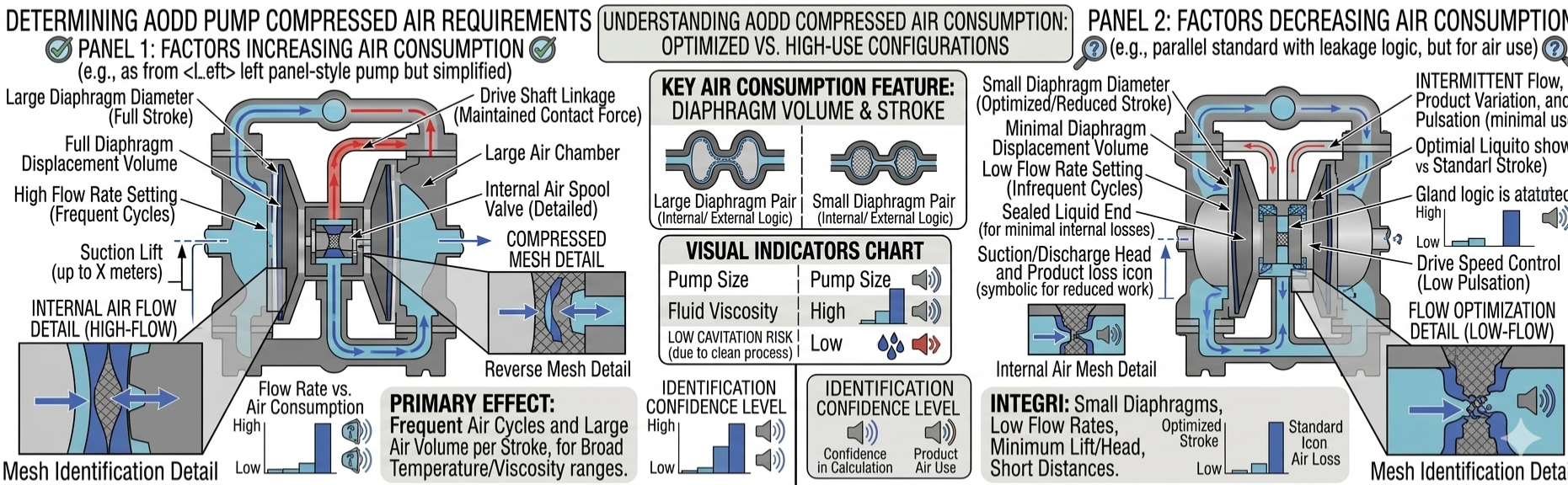
Getting the compressed air supply right for an AODD pump is one of the most commonly overlooked aspects of pump installation. Undersupply causes the pump to stall, cycle erratically, or fail to reach required flow rates. Oversupply wastes energy and increases operating cost. Knowing exactly how much air your specific pump needs — at your specific operating pressure and flow rate — lets you right-size the compressor, correctly size the air supply line, and calculate the true operating cost before committing to the technology. This guide covers the complete air consumption calculation method, with worked examples and reference tables for the most common pump sizes.
| Variable | Symbol | What It Means | How It Affects Air Consumption |
|---|---|---|---|
| Stroke volume | Vs | The volume of the air chamber per diaphragm stroke — equal to the liquid stroke volume. Fixed by the pump size. | Larger pump = larger stroke volume = more air per stroke |
| Stroke rate (cycles per minute) | N | How many times per minute each diaphragm completes one stroke. Controlled by supply air pressure and back-pressure. | Higher stroke rate = more strokes per minute = more air consumed per minute |
| Supply air pressure | P_supply | The absolute air pressure supplied to the pump. Higher pressure means more air mass is consumed per stroke even at the same volumetric stroke size. | Higher pressure = more air mass per stroke = higher air consumption (even at same Nm3 volumetric measurement) |
Simplified: Q_air (Nm³/hr) ≈ Stroke Volume (litres) × Strokes/min × 120 × (Supply bar gauge + 1) / 1000
A 1-inch AODD pump with 0.12-litre stroke volume, running at 60 cycles/min on 5 bar gauge supply air:
At an industrial compressed air cost of Rs. 2.50 per Nm³ (typical Indian plant, including compressor capital amortisation), this pump operating 8 hours/day, 300 days/year consumes:
📖 Read More: AODD Pump vs Centrifugal Pump
| Pump Size | Stroke Volume | Typical Stroke Rate | Air Consumption (Nm³/hr) | Approx. Annual Air Cost (Rs. 2.50/Nm³, 16hr/day, 300 days) |
|---|---|---|---|---|
| ½ inch | ~0.02 L | 40–60 cycles/min | 0.5 – 0.7 | Rs. 6,000 – 8,400 |
| 1 inch | ~0.12 L | 40–70 cycles/min | 2.4 – 4.2 | Rs. 28,800 – 50,400 |
| 1.5 inch | ~0.40 L | 30–60 cycles/min | 6.0 – 12.0 | Rs. 72,000 – 1,44,000 |
| 2 inch | ~0.90 L | 25–50 cycles/min | 11.3 – 22.5 | Rs. 1,35,600 – 2,70,000 |
| 3 inch | ~2.80 L | 20–40 cycles/min | 28.0 – 56.0 | Rs. 3,36,000 – 6,72,000 |
| Pump Size | Stroke Volume | Typical Stroke Rate | Air Consumption (Nm³/hr) | Approx. Annual Air Cost (Rs. 2.50/Nm³, 16hr/day, 300 days) |
|---|---|---|---|---|
| ½ inch | ~0.02 L | 50–80 cycles/min | 0.8 – 1.3 | Rs. 9,600 – 15,600 |
| 1 inch | ~0.12 L | 50–90 cycles/min | 4.2 – 7.6 | Rs. 50,400 – 91,200 |
| 1.5 inch | ~0.40 L | 40–80 cycles/min | 11.2 – 22.4 | Rs. 1,34,400 – 2,68,800 |
| 2 inch | ~0.90 L | 35–70 cycles/min | 22.1 – 44.1 | Rs. 2,65,200 – 5,29,200 |
| 3 inch | ~2.80 L | 25–55 cycles/min | 49.0 – 107.8 | Rs. 5,88,000 – 12,93,600 |
These tables highlight the economic case for EODD pumps in large, continuously-running applications. A 3-inch AODD pump running 16 hours/day on 6 bar air can cost Rs. 5–13 lakh per year in compressed air alone. For the same duty with an EODD pump, electrical energy costs are typically Rs. 60,000–1,20,000 per year — a saving of Rs. 4–12 lakh annually.
| Back-Pressure (fraction of supply air pressure) | Effect on Stroke Rate | Effect on Flow Rate | Effect on Air Consumption |
|---|---|---|---|
| Low back-pressure (10–20% of supply) | Highest stroke rate — fast cycling | Maximum flow | Highest air consumption/hr — least efficient operating point |
| Moderate back-pressure (40–60% of supply) | Moderate stroke rate | Moderate flow | Moderate air consumption — best efficiency points for most AODD pumps |
| High back-pressure (70–85% of supply) | Low stroke rate — slow cycling | Low flow | Lower air consumption/hr, but low output — poor system design |
| Back-pressure = supply pressure (stall) | Zero — pump stops | Zero | Minimal air consumption (air valve may hunt) — safe dead-head condition |
| Pump Size | Max Air Consumption (Nm³/hr) | Minimum Pipe Bore (ID) | Recommended Pipe Specification |
|---|---|---|---|
| ½ inch AODD | 1.5 Nm³/hr | 10 mm ID | ½" BSP / DN15 pipe |
| 1 inch AODD | 8 Nm³/hr | 15 mm ID | ¾" BSP / DN20 pipe |
| 1.5 inch AODD | 25 Nm³/hr | 20 mm ID | 1" BSP / DN25 pipe |
| 2 inch AODD | 50 Nm³/hr | 25 mm ID | 1.25" BSP / DN32 pipe |
| 3 inch AODD | 120 Nm³/hr | 40 mm ID | 1.5" BSP / DN40 pipe |
Calculate the air consumption of all AODD pumps that may run simultaneously (not just the largest pump, but the peak simultaneous demand). Add 20% margin for compressor wear and other system air consumers. The compressor rated delivery (Nm³/hr or LPM at rated pressure) must meet this total. Ensure the compressor pressure rating exceeds the maximum required AODD pump supply pressure by at least 1 bar.
Yes — larger pump body means larger stroke volume, which means more air per stroke. However, flow rate per Nm³ of air consumed (specific air consumption) can be better for larger pumps at their optimal operating point. The most energy-efficient air use is achieved when the pump runs at moderate stroke rate against moderate back-pressure — not at maximum speed or minimum back-pressure.
Yes, provided the compressor's rated air delivery (at operating pressure) equals or exceeds the total simultaneous air consumption of all pumps plus margin. Size the header and branch pipework to avoid excessive pressure drop at any pump. If pumps operate at different times rather than simultaneously, design for the highest peak demand. For detailed selection, contact Unique Pump Systems for application engineering support.
📖 Read More: AODD Pumps vs EODD Pumps
Unique Pump Systems AODD Pump Suppliers PP, PTFE, Aluminium, and SS316 construction, 1/2" to 3" sizes, up to 1000 LPM. For compressed air supply sizing and FRL specification advice for your application, contact our technical team.