
Unique Pump Systems, Kailash Industrial Complex, Vikhroli (W)
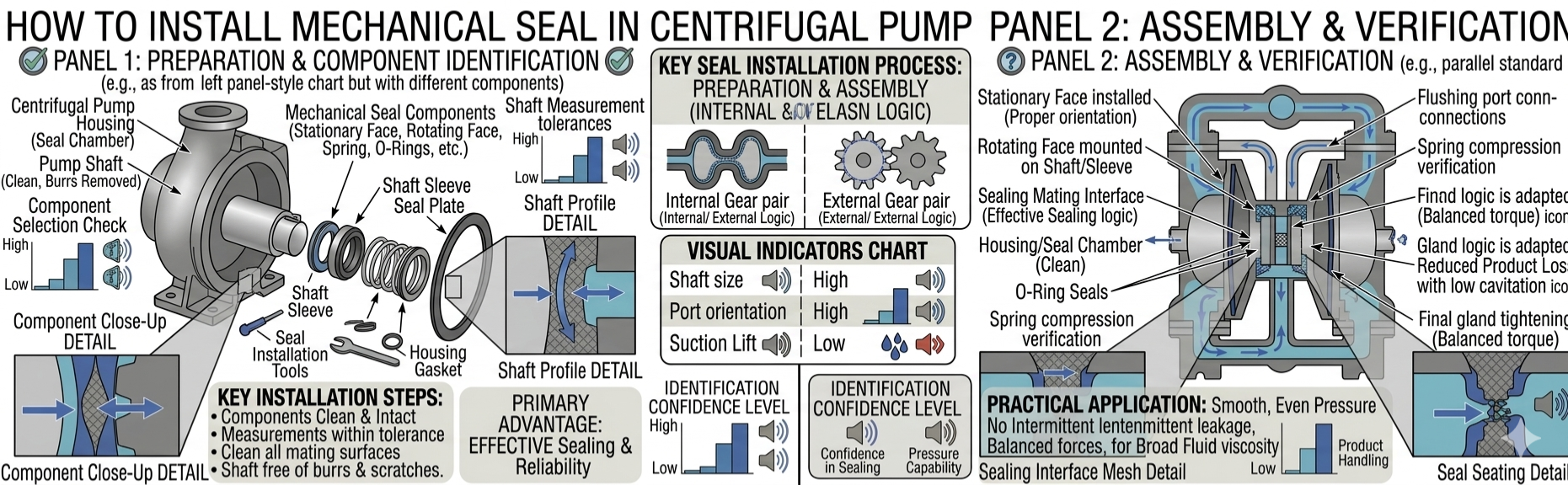
Installing a mechanical seal in a centrifugal pump is one of the most common — and most frequently done incorrectly — maintenance tasks in industrial plants. The majority of premature seal failures are not caused by a defective seal: they are caused by installation errors. Contamination of the seal faces during fitting, incorrect spring compression, wrong rotation direction for a single coil spring seal, shaft runout that was not checked, or a stuffing box bore that was not cleaned — all of these produce a seal failure within days or weeks that gets misattributed to seal quality. This guide gives you the complete, correct installation procedure for a component mechanical seal in a centrifugal pump, with every step that the competitors skip.
📖 Read More: How to Measure a Mechanical Seal
| Item | Specification | Purpose |
|---|---|---|
| Vernier calliper | 0.02 mm resolution, 150 mm jaw | Verify shaft diameter, check stuffing box bore |
| Dial test indicator + magnetic stand | 0.001 mm graduation, rigid stand | Measure shaft runout TIR before installation |
| Clean lint-free cloths | Non-shedding — cotton or microfibre | Clean all components; never use workshop rags |
| Isopropyl alcohol (IPA) | 99% purity, spray bottle | Final cleaning of seal faces before assembly |
| Thin film of compatible lubricant | Petroleum jelly for NBR; silicone grease for EPDM | O-ring and shaft lubrication during installation |
| Installation sleeve (nylon or rubber) | Thin-walled tube matching shaft diameter | Slide rotating assembly over shaft keyway without O-ring damage |
| Torque wrench | 0–25 Nm range; appropriate socket for drive collar set screws | Correct and equal torque on set screws |
| Manufacturer installation dimension sheet | Specific to the seal model being installed | Confirms correct working length (spring compression distance) |
📖 Read More: Types of Mechanical Seals
| Mistake | Consequence | Prevention |
|---|---|---|
| Touching seal faces with bare fingers | Skin oil contaminates lapped surface — creates leak point | Always handle faces at periphery only; use clean nitrile gloves |
| Not using installation sleeve over shaft | O-ring cuts on keyway or thread — immediate leakage | Always use a thin-walled installation sleeve matching shaft diameter |
| Setting drive collar at wrong position | Wrong spring compression — faces open or overheat | Always use manufacturer's installation dimension; measure after tightening |
| Not checking shaft runout before installation | Seal fails in days from face misalignment | Measure TIR with DTI before every seal installation |
| Reusing old O-rings from removed seal | O-rings have permanent compression set — no longer seal reliably | Always replace all elastomers with new seal kit components |
| Starting pump dry (no liquid in casing) | Seal face destroyed within seconds | Always flood casing through vent plug before first start |
| Wrong spring hand for rotation direction | Spring unwinds — reduced closing force — seal leaks within hours | Confirm rotation direction and spring hand before installation |
| Not cleaning stuffing box bore | Old scale or pitting creates leak path around seat O-ring | Clean and inspect bore; repair pitting before fitting seat |
A new mechanical seal typically beds in within the first 30–60 minutes of operation. During this period, a slight weeping (1–3 drops per minute) is normal as the faces lap to each other. After bedding-in, leakage should reduce to near-zero vapour emission. If heavy leakage persists after 60 minutes of operation, stop and investigate.
Use petroleum jelly (Vaseline) for NBR (Buna-N) O-rings. Use silicone grease for EPDM O-rings — petroleum products cause EPDM to swell. For PTFE secondary seals, no lubrication is needed — PTFE is self-lubricating. For water-service seals in food or pharmaceutical applications, use only clean process water. Never use oil-based lubricants in food-grade installations.
Yes — cartridge seals eliminate the most common installation errors by pre-setting the spring compression at the factory. The complete unit slides onto the shaft and is retained by set screws into the shaft sleeve — no working length measurement is required. For plants where seal installation errors are a recurring problem, cartridge seals are strongly recommended. See the Types of Mechanical Seals guide for details.
Inspect the sleeve for wear grooves in the O-ring contact zone. Any circumferential groove deeper than 0.1 mm should result in sleeve replacement — a groove creates a leak path the O-ring cannot bridge. If the sleeve surface is smooth and within dimensional tolerance, it can be reused with the new seal.
Unique Pump Systems supplies mechanical seals in Type 41 and Type 42 DIN EN 12756 designs, covering shaft diameters 10–100 mm with carbon, SiC, and TC face materials. For seal selection advice matched to your pump and fluid conditions, contact our technical team.