Maintenance Tips for Lobe Pumps
To maximize service life:
- Inspect seals regularly
- Maintain proper lubrication
- Monitor timing gear alignment
- Avoid dry running
- Use proper cleaning procedures
- Check clearances periodically
Unique Pump Systems, Kailash Industrial Complex, Vikhroli (W)

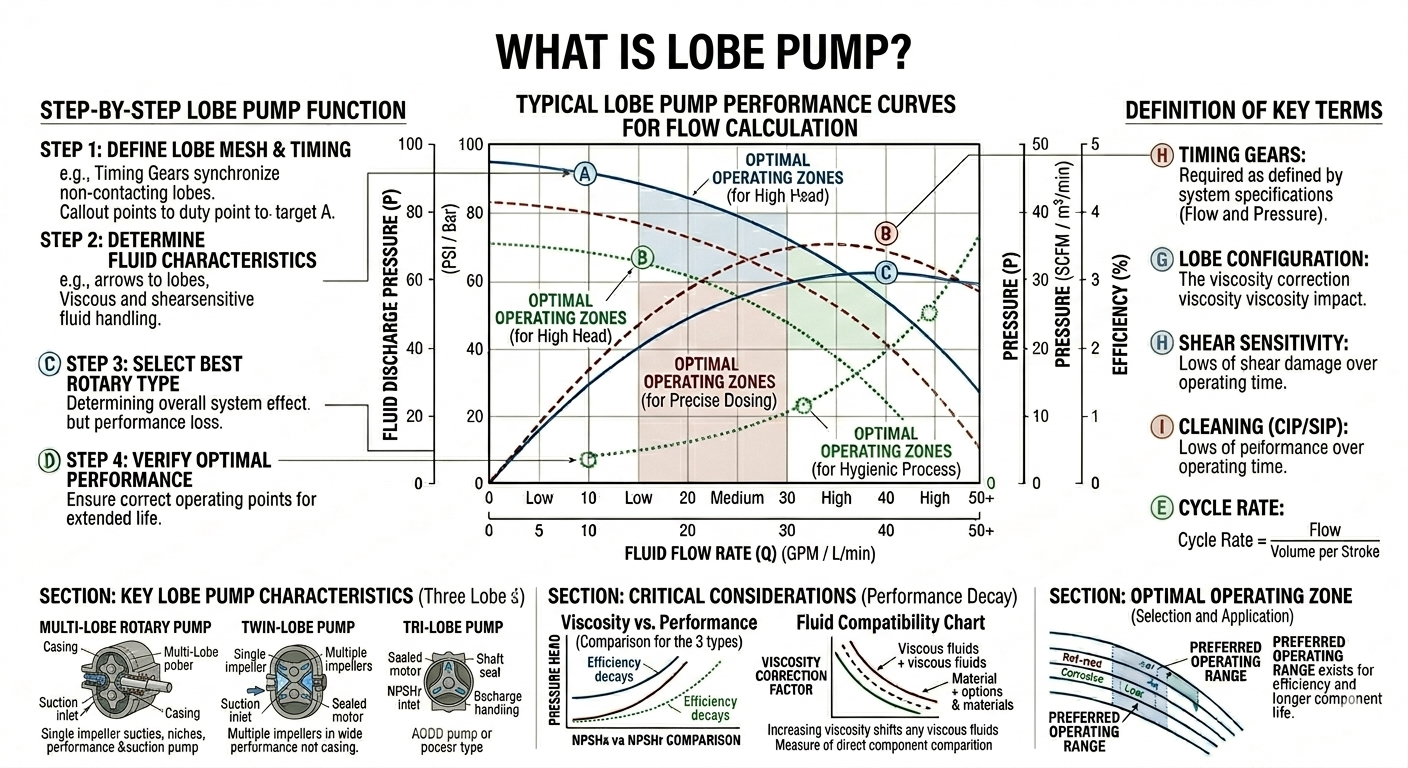
A lobe pump is a type of positive displacement pump that uses rotating lobes to move fluids through the pump chamber. It is widely used in industries that require gentle fluid handling, hygienic processing, and precise flow control, especially for viscous, shear-sensitive, or solid-containing fluids.
Unlike traditional pumps that rely on high-speed impellers, lobe pumps transfer fluid smoothly with minimal product damage, making them ideal for food processing, pharmaceuticals, chemicals, cosmetics, and wastewater treatment applications.
A lobe pump is a rotary positive displacement pump where two or more lobes rotate inside a casing without touching each other. As the lobes rotate:
This pumping action delivers:
The working principle of a lobe pump is based on synchronized rotating lobes.
Because the lobes do not make direct contact, wear is reduced and sensitive products remain protected.
A typical lobe pump consists of:
The non-contacting lobe design improves durability and hygiene.
Used in specialized low-flow applications
Most commonly used design for industrial fluid transfer
Provides smoother flow with reduced pulsation
Used for higher efficiency and sanitary processing applications
Syrups, Chocolate, Dairy products, Sauces, Juices
Creams, Lotions, Medicines, Hygienic fluids
Resins, Polymers, Paints, Adhesives
Sludge transfer, Thick waste fluids
Lobe pumps are often compared with diaphragm, centrifugal, and gear pumps.
An AODD pump is preferred for abrasive and air-operated applications, while lobe pumps are typically selected for hygienic and low-shear fluid transfer.
An air operated double diaphragm pump handles solids and corrosive chemicals effectively, whereas lobe pumps provide smoother flow and superior sanitary performance.
Industries working with hygienic processing systems often consult experienced AODD pump manufacturers and lobe pump suppliers to determine the most suitable technology for their application.
Modern air operated double diaphragm pump manufacturers also provide specialized diaphragm solutions for chemical and wastewater handling where compressed air operation is required.
When selecting a lobe pump, consider:
Proper sizing improves pump efficiency and operational reliability.
To maximize service life:
Lobe pumps are used for hygienic, viscous, and shear-sensitive fluid transfer applications.
Yes. A lobe pump is a rotary positive displacement pump.
Yes. Lobe pumps can handle soft solids and semi-solid materials.
Because they provide sanitary operation and gentle product handling.
Lobe pumps provide positive displacement flow, while centrifugal pumps rely on velocity and are better for low-viscosity fluids.
A lobe pump is a highly efficient positive displacement pump designed for gentle, hygienic, and precise fluid transfer. Its ability to handle viscous, sensitive, and semi-solid materials makes it a preferred choice across food processing, pharmaceutical, chemical, and industrial applications.
Understanding what a lobe pump is, how it works, and where it is used helps industries choose the right pumping technology for long-term reliability, product safety, and operational efficiency.