
Unique Pump Systems, Kailash Industrial Complex, Vikhroli (W)
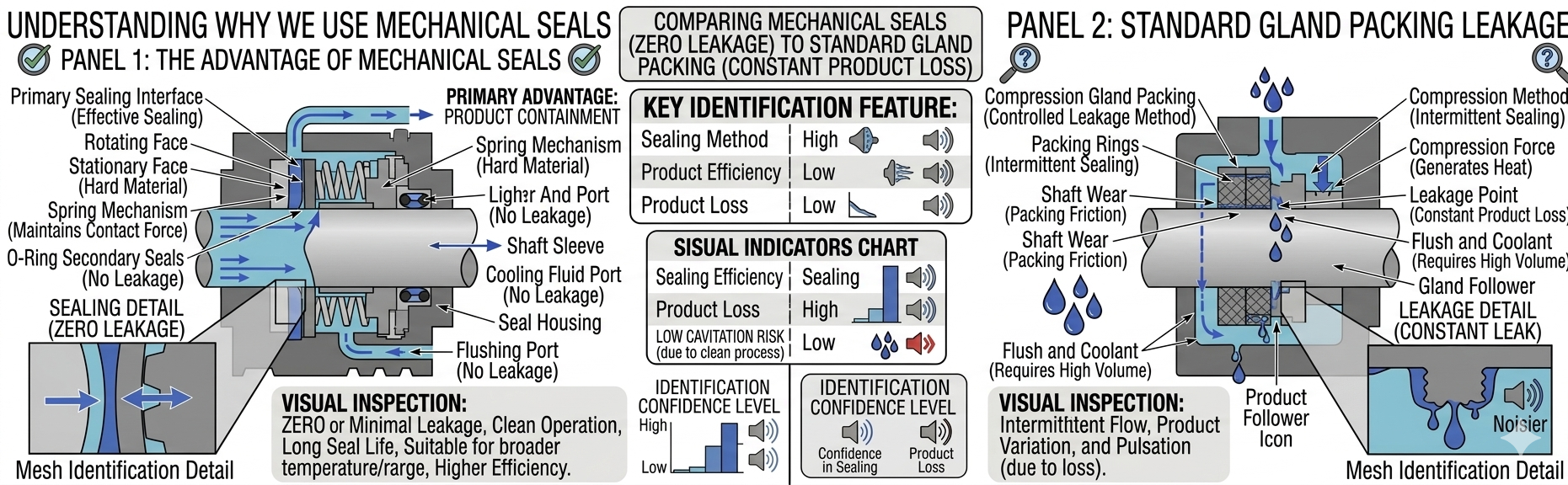
Every pump with a rotating shaft needs a sealing solution where the shaft passes through the casing. For most of industrial history, that solution was gland packing — braided material compressed around the shaft to reduce leakage. Mechanical seals were developed to solve the limitations of packing, and they now dominate industrial pump sealing globally. But packing still exists, and the question 'why use a mechanical seal instead of packing?' is one that plant engineers, procurement managers, and maintenance supervisors ask regularly. This guide answers it with engineering data, not marketing claims — including the cases where packing is actually still the right answer.
📖 Read More: How to Replace a Mechanical Seal on a Water Pump
| Sealing Method | Typical Leakage Rate | Acceptable For | Not Acceptable For |
|---|---|---|---|
| Gland packing (correctly adjusted) | 40–60 drops/min (2–3 L/day per pump) | Clean water, cooling water, non-hazardous utilities | Any hazardous, toxic, or regulated fluid; food and pharmaceutical service |
| Mechanical seal (single) | Near-zero — microscopic vapour emission | Most industrial fluids including hazardous, viscous, and high-pressure | Extreme hazard requiring double seal (zero atmospheric emission) |
| Double mechanical seal (pressurised barrier) | Zero process fluid to atmosphere — only non-hazardous barrier fluid can reach atmosphere | Toxic, carcinogenic, zero-emission applications | Not required for standard service |
| Cost Element | Gland Packing | Mechanical Seal | Notes |
|---|---|---|---|
| Initial cost | Rs. 500 – 2,000 | Rs. 3,000 – 15,000 | Seal costs 5–10x more upfront |
| Annual energy cost difference | Baseline (higher friction) | Save Rs. 30,000–60,000/year (per pump, continuous service) | Based on 1 kW friction saving at Rs. 8/kWh, 8000 hr/yr |
| Annual maintenance labour | 12–24 adjustments + 1–2 repacking events/year; ~16–24 hr labour | 0 adjustments; 1 seal replacement/2 years; ~4 hr labour | Packing needs ongoing attention; seal is 'fit and forget' |
| Shaft sleeve replacement | Every 2–3 years (packing wears sleeve) | Every 5–8 years (no rotational shaft contact) | Seal significantly extends sleeve life |
| 5-year total cost (medium pump, hazardous fluid) | Rs. 1,80,000 – 3,50,000 | Rs. 80,000 – 1,50,000 | Seal wins significantly in continuous service; packing cheaper for occasional-use pumps |
For continuous industrial service with any hazardous, high-pressure, high-speed, or hygiene-regulated fluid — yes. For low-pressure clean water pumps in intermittent service, fire pumps, or very large-diameter shaft applications — packing may still be the more practical choice. The decision is application-specific.
A correctly installed and operating mechanical seal produces near-zero visible leakage — microscopic vapour emission only. In the first 30–60 minutes after installation (bedding-in period), 1–3 drops per minute is acceptable and normal. After bedding-in, there should be no drip. Any visible dripping after the bedding-in period indicates an installation problem, incorrect specification, or seal failure.
Packing failure is gradual and visible — increasing leakage. Mechanical seal failure is often sudden. However, 'seal failure' is frequently premature seal failure caused by incorrect installation, wrong seal specification, excessive shaft runout, or operating the pump outside its design range. A correctly specified, correctly installed seal in a correctly operated pump should last 1–3 years in standard service. Recurring seal failures almost always indicate a solvable system problem, not a problem with mechanical seals as a technology.
📖 Read More: Types of Mechanical Seals
Unique Pump Systems supplies mechanical seals in Type 41 and Type 42 DIN EN 12756 configurations, covering shaft diameters from 10 to 100 mm. Contact our team for seal selection recommendations matched to your fluid, pressure, speed, and shaft conditions.