
Unique Pump Systems, Kailash Industrial Complex, Vikhroli (W)
Reviewed by the Unique Pump Systems engineering team | Updated October 2026
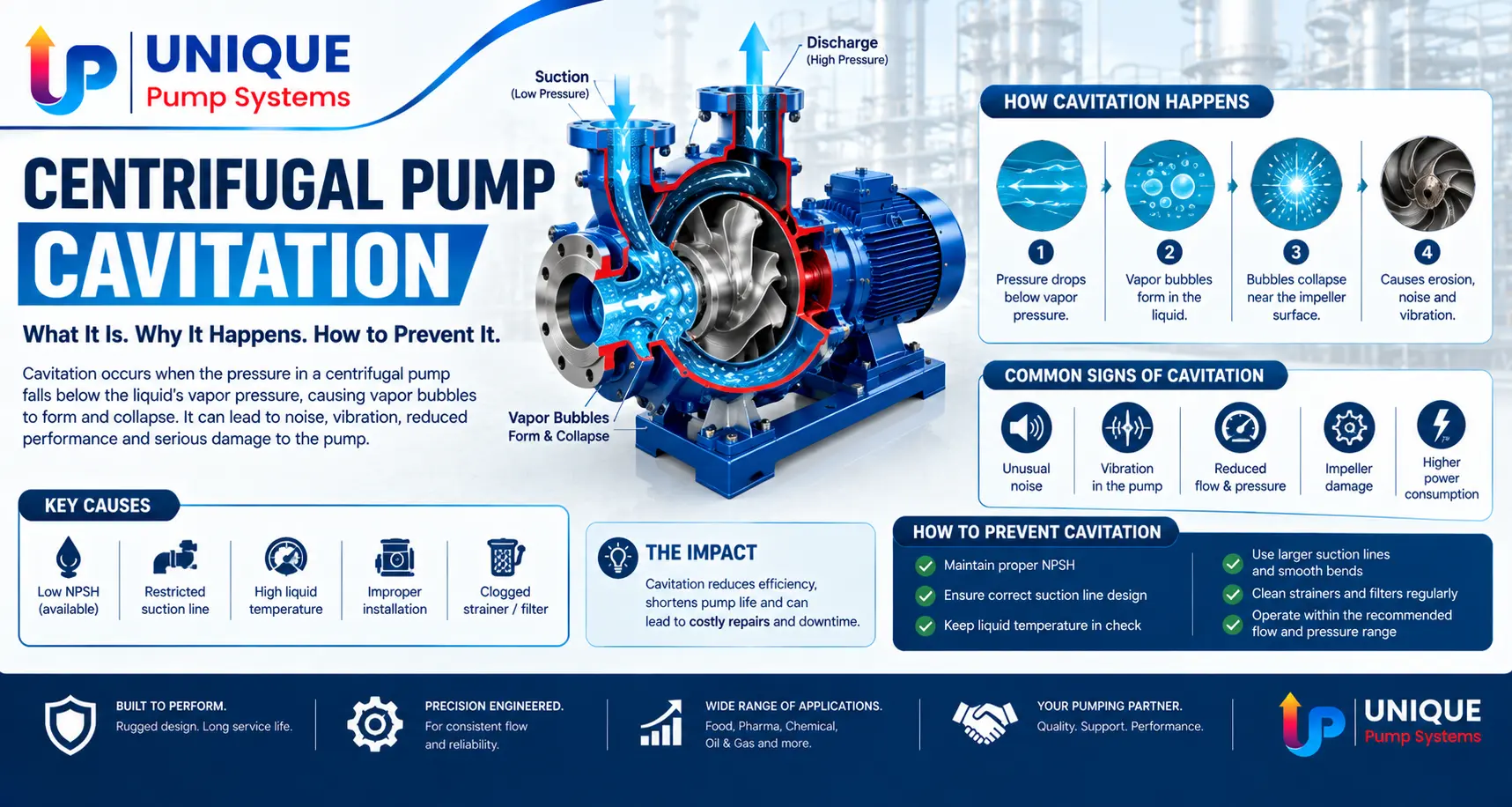
Quick Answer: Cavitation in a centrifugal pump happens when pressure at the impeller eye drops below the liquid's vapour pressure. The liquid boils into vapour bubbles, which then collapse violently as they move into higher-pressure areas, pitting the impeller and causing noise, vibration and loss of flow. It is prevented by keeping NPSH available (NPSHa) safely above NPSH required (NPSHr): raise the suction level, shorten and enlarge the suction pipe, lower the liquid temperature, avoid throttling the suction valve and run the pump close to its best efficiency point.
If your Centrifugal Pump sounds like it is pumping gravel, cavitation is the likely cause. It is one of the most common reasons for damaged impellers, early seal failure and unexplained drops in flow. The good news is that cavitation is almost always a system problem you can measure and fix. This guide explains what causes it, how to spot it, how to calculate NPSH, and the practical steps that stop it.
Every liquid has a vapour pressure: the pressure at which it starts to boil at a given temperature. Water at 100°C boils at normal atmospheric pressure, but at lower pressure it boils at much lower temperatures.
As liquid enters the eye of the impeller, it speeds up and its pressure drops. If that local pressure falls below the vapour pressure, small vapour bubbles form. The impeller then carries these bubbles outward into the higher-pressure zone, where they collapse (implode) in microseconds. Each collapse sends a tiny, powerful jet of liquid into the metal surface. Millions of these impacts remove metal, leaving the sponge-like pitting typical of cavitation damage.
| Symptom | What you notice |
|---|---|
| Noise | Crackling, popping or a sound like gravel or marbles passing through the pump |
| Vibration | Higher vibration, especially at the pump casing and bearings |
| Performance loss | Drop in discharge pressure (head), flow or both |
| Unstable readings | Discharge pressure gauge needle fluctuates |
| Power changes | Motor current drops or becomes erratic |
| Impeller damage | Pitting on the vane inlet edges and near the impeller eye, usually on the low-pressure side of the vanes |
| Seal and bearing failure | Vibration shortens the life of the mechanical seal and bearings |
Cavitation and vibration are among the leading causes of early mechanical seal failure. If seals keep failing on one pump, check the suction conditions first.
NPSH stands for Net Positive Suction Head. It is the margin of pressure, expressed in metres of liquid, above the liquid's vapour pressure at the pump suction.
Rule: NPSHa must be greater than NPSHr. A common minimum margin is 0.5 to 1 m above NPSHr, or a ratio of about 1.1 to 1.5 (NPSHa ÷ NPSHr), depending on the liquid, temperature and pump energy level. Use more margin for hot water, hydrocarbons and high-speed pumps.
NPSHa = Ha ± Hz − Hf − Hvp
Ha = absolute pressure on the liquid surface (as head, m)
Hz = static height of liquid surface above (+) or below (−) the pump centreline (m)
Hf = friction loss in the suction pipe, valves and fittings (m)
Hvp = vapour pressure of the liquid at pumping temperature (as head, m)
To convert pressure to head: head (m) = pressure (Pa) ÷ (density (kg/m³) × 9.81). Atmospheric pressure at sea level (101.3 kPa) equals about 10.3 m of cold water.
A pump draws water from an open tank at sea level. The water surface is 3 m below the pump centreline (suction lift). Suction pipe friction is 1 m. The pump's NPSHr at duty flow is 4 m.
| Item | Water at 30°C | Water at 70°C |
|---|---|---|
| Atmospheric head, Ha | 10.37 m | 10.56 m |
| Static lift, Hz | −3.0 m | −3.0 m |
| Friction, Hf | −1.0 m | −1.0 m |
| Vapour pressure head, Hvp | −0.44 m | −3.25 m |
| NPSHa | 5.93 m | 3.31 m |
| Compared with NPSHr 4 m | Safe (margin about 1.9 m) | Cavitation |
The same pump and pipework work well with cool water and cavitate with hot water. Moving the pump below the tank (flooded suction) would add head instead of subtracting it and solve the problem.
| Water temperature | Vapour pressure | Approx. vapour pressure head |
|---|---|---|
| 20°C | 2.34 kPa | 0.24 m |
| 40°C | 7.38 kPa | 0.76 m |
| 60°C | 19.9 kPa | 2.06 m |
| 80°C | 47.4 kPa | 4.97 m |
| 90°C | 70.1 kPa | 7.40 m |
| 100°C | 101.3 kPa | 10.78 m |
| Site altitude | Atmospheric pressure | Approx. head of cold water |
|---|---|---|
| Sea level | 101.3 kPa | 10.3 m |
| 500 m | 95.5 kPa | 9.8 m |
| 1,000 m | 89.9 kPa | 9.2 m |
| 1,500 m | 84.6 kPa | 8.6 m |
| 2,000 m | 79.5 kPa | 8.1 m |
| Cause | Why it causes cavitation | Fix |
|---|---|---|
| High suction lift | Reduces NPSHa | Lower the pump, raise the tank level, or use flooded suction |
| Long or narrow suction pipe | High friction loss | Use a shorter, larger suction pipe; keep velocity low (about 1 to 2 m/s) |
| Throttled or partly closed suction valve | Adds friction at the worst point | Keep suction valves fully open; control flow on the discharge side |
| Clogged strainer or foot valve | Adds friction | Clean strainers regularly; fit a differential pressure gauge |
| Hot liquid | Raises vapour pressure | Cool the liquid, increase suction head or pressurise the tank |
| Too many bends close to suction | Turbulent, uneven flow into the eye | Provide a straight run of about 5 to 10 pipe diameters before the suction flange |
| Wrong reducer type | Air pockets at the suction | Use an eccentric reducer with the flat side on top |
| Running far right on the curve (too much flow) | NPSHr rises sharply at high flow | Add discharge resistance, trim the impeller or reduce speed |
| Running far left on the curve (too little flow) | Recirculation cavitation | Operate nearer BEP, add a bypass or select a smaller pump |
| Pump speed too high | NPSHr increases with speed | Reduce speed with a VFD or select a lower-speed pump |
| Check | Cavitation | Air entrainment |
|---|---|---|
| Cause | Pressure below vapour pressure | Air leaking or drawn into suction |
| Effect of lowering temperature | Improves | No change |
| Effect of raising suction pressure | Improves | May improve slightly |
| Visible signs | Pitting on impeller | Vortex in tank, bubbles in sight glass, leaking joints |
| Typical fix | Increase NPSHa | Seal leaks, raise tank level, add anti-vortex baffle |
Yes. Positive displacement pumps also need enough suction pressure. A gear pump handling thick oil can cavitate if it runs too fast for the liquid to fill the gear teeth. A lobe pump can do the same on viscous food products. For difficult suction conditions, such as emptying drums or pits with high suction lift, an aodd pump is often a practical choice because it self-primes and can run dry without damage.
Unique Pump Systems can review your suction conditions and pump selection, and recommend changes or a better-suited centrifugal pump.
Cavitation is the formation and violent collapse of vapour bubbles inside the pump. It happens when pressure at the impeller eye drops below the liquid's vapour pressure. The collapsing bubbles damage the impeller and cause noise, vibration and loss of flow.
Cavitation usually sounds like gravel, marbles or crackling inside the pump casing, often with increased vibration.
The main causes are high suction lift, long or narrow suction pipes, clogged strainers, throttled suction valves, hot liquids with high vapour pressure, running at too high a flow, and running at very low flow, which causes recirculation.
NPSHa equals the absolute pressure head on the liquid surface, plus or minus the static height of liquid above or below the pump, minus suction friction losses, minus the vapour pressure head of the liquid at pumping temperature. All values are in metres of liquid.
NPSHa is the suction head your system provides. NPSHr is the minimum the pump needs, taken from the manufacturer's curve. To avoid cavitation, NPSHa must be higher than NPSHr with a safety margin, typically at least 0.5 to 1 m.
Increase NPSHa by raising the liquid level, lowering the pump, enlarging and shortening the suction pipe, cleaning strainers and cooling the liquid. Keep suction valves fully open and run the pump near its best efficiency point.
Yes. Cavitation causes vibration and pressure fluctuations that can chip seal faces, open the faces momentarily and run them dry, which shortens seal life.
No. Cavitation is vapour formed from the liquid itself at low pressure. Air entrainment is outside air drawn into the suction through leaks or vortices. The symptoms are similar, but the fixes are different.
Centrifugal pump cavitation is a suction problem in almost every case. Calculate NPSH available at the worst operating condition, compare it with the pump's NPSH required, and keep a safe margin. Fix the suction side first: liquid level, pipe size, strainers, valves and temperature. Then make sure the pump runs close to its best efficiency point.
If your pump is noisy, vibrating or losing flow, contact Unique Pump Systems. Our engineers can check your suction conditions and recommend the right fix or the right pump.