
Unique Pump Systems, Kailash Industrial Complex, Vikhroli (W)
Reviewed by the Unique Pump Systems engineering team | Updated September 2026
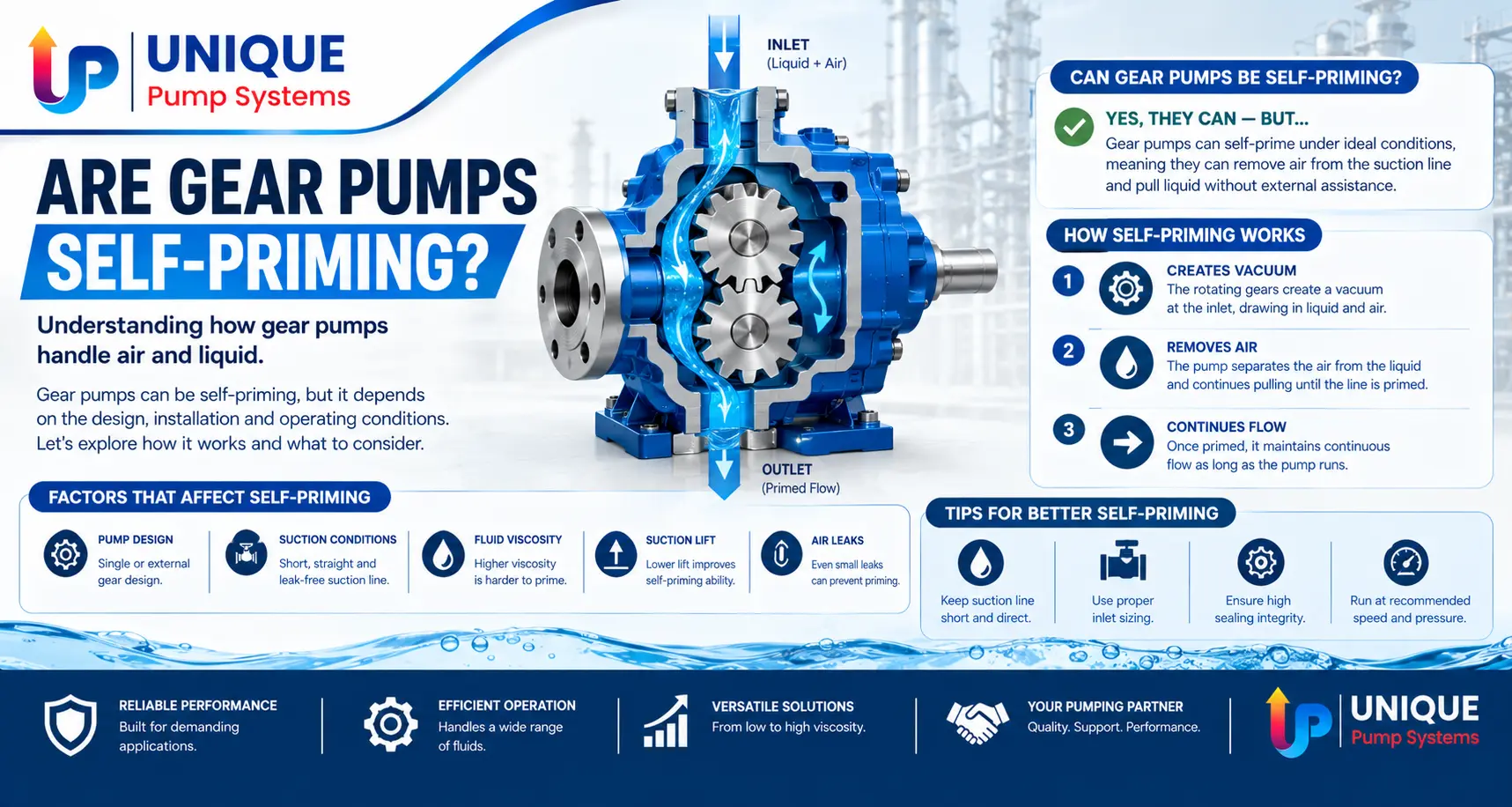
Quick Answer: Yes. Gear pumps are self-priming. As positive displacement pumps, their meshing gears pull air out of the suction line and create a vacuum that draws liquid into the pump, so you do not need to fill the whole suction line before starting. There is one condition: the gears and clearances must be wet. A completely dry gear pump primes poorly and can be damaged. Wet the pump first, keep the suction lift within about 4 to 5 metres for water-like liquids, keep the suction line airtight, and a gear pump will prime reliably.
If you are choosing a gear pump for tank unloading, transfer from an underground tank, or a drum or sump, the first question is usually "Will it prime by itself?" The short answer is yes, with limits. This guide explains how far a gear pump can lift, what stops it from priming, how to prime it correctly the first time, and when to choose another pump.
Our advice comes from more than 35 years of designing, manufacturing and servicing gear pumps in India since 1988, for oils, fuels, resins, chemicals, syrups, paints and other viscous liquids.
A pump is self-priming when it can clear air from its suction line and start pumping liquid without someone first filling the suction pipe. The pump sits above the liquid level (a "suction lift" installation), and when it starts it:
Self-priming does not mean the pump can run dry forever, lift liquid any height, or pump heavy volumes of air mixed with liquid. It means the pump can evacuate its own suction line within reasonable limits.
The opposite is a standard centrifugal pump. It cannot move air, so it must be completely filled with liquid, usually with a foot valve and a priming funnel, before it will pump.
A rotary gear pump moves liquid in the spaces between the gear teeth and the casing. On the suction side the teeth separate and open a cavity. On the discharge side they mesh again and push the contents out. Because this displacement is positive and fixed, the pump moves air as well as liquid.
When the pump starts on an empty suction line:
The key is the clearance between the gear tips, gear faces and casing. Air is thin and slips easily through these small gaps. A film of liquid seals the gaps, so a wet gear pump builds far more vacuum than a dry one. This is why manufacturers call gear pumps self-priming but always advise filling or wetting the pump before the first start.
| Condition | What happens | Priming ability | Our advice |
|---|---|---|---|
| Wet pump (casing has liquid, clearances sealed) | Gears seal against casing and build strong vacuum | Good. Lifts thin liquids about 4 to 5 m, often more for oils | Standard way to start any gear pump |
| Dry pump, new or long idle | Air slips through clearances; seals and bushings run without lubrication | Poor. Vacuum is weak and priming is slow or fails | Fill casing with liquid before starting |
| Dry pump, worn gears or bushings | Clearances are larger, so slip is higher | Very poor, may not prime at all | Inspect and repair; see maintenance section |
Practical rule: if the pump does not deliver liquid within about 30 to 60 seconds of starting, stop it. Check the pump is wet and the suction line is airtight, then try again. Running longer only heats and wears the pump.
A pump does not "suck" liquid. It lowers the pressure in the suction pipe, and the atmosphere pushes the liquid up. So the limit comes from atmospheric pressure, not from the pump.
| Factor | Effect on lift | Practical tip |
|---|---|---|
| Altitude | Atmospheric pressure drops about 1.1 to 1.2 m of water per 1,000 m of altitude | Reduce lift at hilly or high-altitude sites |
| Liquid temperature | Hot liquids have higher vapour pressure and boil at lower vacuum. Water at 80 °C has vapour pressure of about 4.8 m | Use flooded suction for hot liquids |
| Specific gravity | Heavier liquids need more vacuum per metre of lift | Divide lift by specific gravity when estimating |
| Viscosity | Thick liquids cause high friction in the suction pipe | Use larger suction pipe and lower speed |
| Pipe friction | Long, narrow or bent suction pipes waste vacuum | Short, straight suction line at least equal to the pump inlet size |
NPSH available (NPSHa) tells you how much pressure margin the liquid has at the pump inlet before it boils. The pump manufacturer's datasheet gives NPSH required (NPSHr). You need NPSHa comfortably above NPSHr.
Formula: NPSHa = Atmospheric head − Vapour pressure head − Static suction lift − Suction pipe friction loss
Example: water at 25 °C, sea level, pump 3 m above the liquid, suction friction loss 1 m.
If the pump needs 3 m NPSHr, you have a healthy 3 m margin. Raise the lift to 6 m and NPSHa falls to about 3 m. The pump now sits on the edge of cavitation. This is why we recommend staying at about 4 to 5 m lift for thin liquids.
Yes, and it also creates new limits.
The table shows general industry guidance for good filling of the gear cavities. Always confirm the exact speed with the pump manufacturer for your model and liquid.
| Liquid viscosity (cSt) | Example liquids | Typical maximum speed |
|---|---|---|
| Up to 100 | Diesel, light oils | Full rated speed (about 1,440 rpm on a 4-pole motor) |
| 100 to 1,000 | Lube oil, furnace oil | About 750 to 1,000 rpm |
| 1,000 to 10,000 | Heavy oils, syrups, resins | About 300 to 600 rpm |
| 10,000 to 100,000 | Molasses, bitumen, adhesives | About 100 to 300 rpm |
Both main types are self-priming, but they behave differently at the suction side.
An internal gear pump uses a small idler gear running inside a larger rotor gear, with a crescent separating them. The large, slow-moving cavities fill gently. This gives good suction performance on viscous liquids and low NPSH needs.
An external gear pump uses two equal gears meshing side by side. Very tight clearances give strong vacuum and high pressure on clean thin-to-medium liquids, and the pump is compact and economical.
| Feature | Internal gear pump | External gear pump |
|---|---|---|
| Self-priming | Yes, when wet | Yes, when wet |
| Best viscosity range for priming | Medium to very high | Thin to medium |
| Suction and NPSH performance | Very good, gentle filling at low speed | Good on clean liquids at rated speed |
| Pressure capability | Low to medium | Medium to high |
| Handling of fine solids | Tolerates more | Best with clean, filtered liquids |
| Typical uses | Molasses, bitumen, resins, paints, chocolate | Lube oil, diesel, hydraulic oil, fuel transfer |
Read More: Internal vs External Gear Pump Advantages
Follow these steps before the first start, after maintenance, or after the pump has been idle and drained.
Tip for regular suction-lift duty: fit a foot valve or a suction-side check valve so the line stays full between starts. The pump then restarts almost instantly.
In our service experience, most "pump won't prime" calls are piping problems, not pump problems. Build the suction line right and priming takes care of itself.
Read More: Gear Pump Installation: Step-by-Step Guide
Priming is about getting air out of the suction line. Cavitation happens after the pump is primed, when pressure at the inlet drops so low that the liquid boils into vapour bubbles. These bubbles collapse on the discharge side and erode the gears and casing.
Signs of cavitation:
Fixes: reduce suction lift, increase suction pipe size, clean the strainer, lower the pump speed for viscous liquids, or cool hot liquids. Use flooded suction if possible.
| Symptom | Likely cause | Fix |
|---|---|---|
| No flow, no vacuum on suction gauge | Pump dry, or suction line leaks air | Fill casing with liquid, tighten joints, check gaskets and seal |
| No flow, pump turning | Wrong direction of rotation | Swap two motor phases or correct the drive; check the casing arrow |
| Some vacuum but no liquid arrives | Suction lift too high or pipe too long | Lower the pump, shorten the line, or use flooded suction |
| High vacuum, little or no flow | Clogged strainer, closed suction valve, or liquid too thick for the speed | Clean strainer, open valves, reduce speed, enlarge suction pipe |
| Pump primes then loses prime | Air leak, low tank level, or vortex at suction inlet | Seal leaks, keep inlet submerged, fit a foot valve |
| Primes slowly, pump is old | Worn gears, bushings or wear plates | Measure clearances and replace worn parts |
| Air cannot escape, pump runs but does not deliver | Discharge closed, check valve holding line pressure | Open discharge, fit air-release valve near pump outlet |
| Noisy, rattling, low output | Cavitation | Reduce lift, lower speed, cool the liquid, enlarge suction pipe |
Read More: Reversing a Gear Pump: Complete Guide
Only for a few seconds during start-up. Gear pump bushings, bearings in the pumped liquid, and mechanical seals all rely on the process liquid for lubrication and cooling. Dry running causes:
If your process has frequent dry-running risk, such as emptying tanks completely, fit a dry-run protection device (a flow switch, level switch, or motor power monitor) to stop the pump automatically.
A pump that primed well when new but struggles today almost always has wear. As gears, bushings and side plates wear, the internal clearances open up. More air slips back to the suction side, and the pump cannot build enough vacuum.
Warning signs: longer priming time, lower flow at the same speed, rising discharge temperature, and leakage at the seal. Measuring clearances during planned maintenance and replacing worn parts early restores suction performance and prevents a breakdown.
| Pump type | Self-priming? | Typical practical lift | Best for |
|---|---|---|---|
| Gear pump | Yes, when wet | About 4 to 5 m for thin liquids | Oils, fuels, viscous liquids, steady flow at pressure |
| Standard centrifugal pump | No | Needs a flooded suction or manual priming | Large volumes of water and thin liquids |
| Self-priming centrifugal pump | Yes, after first fill | About 6 to 7.5 m for water | Water, dewatering, liquids with some air |
| Air-operated double diaphragm (AODD) pump | Yes, including dry priming | About 5 to 7 m dry (model dependent) | Slurries, shear-sensitive liquids, portable transfer |
Choose a gear pump when you need a steady, pulse-free flow of oils or viscous liquids at pressure with good suction ability. For frequent dry starts or liquids with heavy solids, discuss an AODD pump with our team.
Illustrative scenario: a plant needs to transfer furnace oil from an underground storage tank to a day tank. The pump sits 3 m above the lowest oil level, with a 12 m suction pipe.
Share these details with your pump supplier so they can confirm suction performance before you buy:
Need help sizing a gear pump for your suction conditions? Unique Pump Systems has manufactured gear pumps in India since 1988. Share your application details and our engineers will recommend the right model, speed and suction arrangement.
Yes. Gear pumps are positive displacement pumps, so their gears move air out of the suction line and create a vacuum that draws liquid in. They prime reliably when the pump casing is wet, and poorly when completely dry.
All gear pumps have self-priming ability, but how well they prime depends on the design, clearances, speed, liquid and condition. A worn pump or one with large clearances may not prime on thin liquids.
For thin liquids at sea level, a practical suction lift is about 4 to 5 m (13 to 16 ft). The theoretical limit for water is about 10.3 m, but friction, vapour pressure and safety margin reduce the usable lift.
You do not need to fill the whole suction line, but you should fill the pump casing with the process liquid before the first start. This wets the gears, seals the clearances, and protects the seal and bushings.
Only for a few seconds during priming. Longer dry running damages mechanical seals, bushings and gears because they depend on the pumped liquid for lubrication.
The most common causes are air leaks in the suction line, a dry pump, wrong rotation, a clogged strainer, too much suction lift, or air that cannot escape from a closed or pressurised discharge line.
Usually within 30 to 60 seconds, depending on the length of suction line and liquid. If it has not primed by then, stop the pump and check for leaks and a dry casing.
Both self-prime when wet. Internal gear pumps usually perform better on viscous liquids and low NPSH conditions. External gear pumps give strong suction on clean, thin to medium liquids.
Yes. Thicker liquids seal the clearances and help priming, but they flow slowly into the gears. Reduce speed and use a larger suction pipe for high-viscosity liquids.
It can pump small amounts of entrained air, and that is how it primes. Large, continuous amounts of air or gas reduce flow, raise noise and wear the pump faster.
Not always, but a foot valve or suction check valve keeps the suction line full between starts. It is recommended for thin liquids and high suction lifts.
Priming removes air from the suction line so the pump can start pumping. Cavitation happens after priming, when inlet pressure drops so low that the liquid boils and forms damaging vapour bubbles.
Yes, if the pump is designed for reversible operation and the relief valve is set up for the new direction. Many gear pumps can run both ways, but the suction and discharge ports swap.
Yes. A standard centrifugal pump is not self-priming and needs manual priming or flooded suction. A gear pump can lift liquid from below the pump, especially viscous liquids.
Gear pumps are self-priming, and they do it well when you respect a few rules: wet the pump before starting, keep the suction lift within about 4 to 5 m for thin liquids, keep the suction line short, large and airtight, and give air a way out on the discharge side. Viscous liquids prime even better, provided you slow the pump down.
When a gear pump will not prime, the fault is usually in the suction line, not the pump. Check for air leaks, rotation, the strainer and a closed discharge before assuming the pump has failed. For long-term priming performance, keep clearances in check through planned maintenance.
Planning a new transfer or dosing line? Talk to Unique Pump Systems. We will help you choose the right gear pump and suction layout for your liquid, so it primes every time.