
Unique Pump Systems, Kailash Industrial Complex, Vikhroli (W)
Reviewed by the Unique Pump Systems engineering team | Updated September 2026
Quick Answer: Gear pumps and screw pumps are both positive displacement pumps that handle oils and viscous liquids. A gear pump is compact, simple and lower in cost, and is the usual choice for small to medium flows, higher pressure on modest flows, metering and very thick liquids at low speed. A screw pump is quieter, almost pulse-free and better at very large flows, long suction lines and, in twin-screw designs, liquids with solids or gas. For most transfer, dosing and lube duties up to medium flow, a gear pump gives the best value.
Both a gear pump and a screw pump can move fuel oil, lube oil, bitumen or resin reliably. So which should you buy? The answer depends on your flow rate, noise limits, liquid condition and budget. This guide breaks the choice down in plain language, with tables you can use in a buying decision.
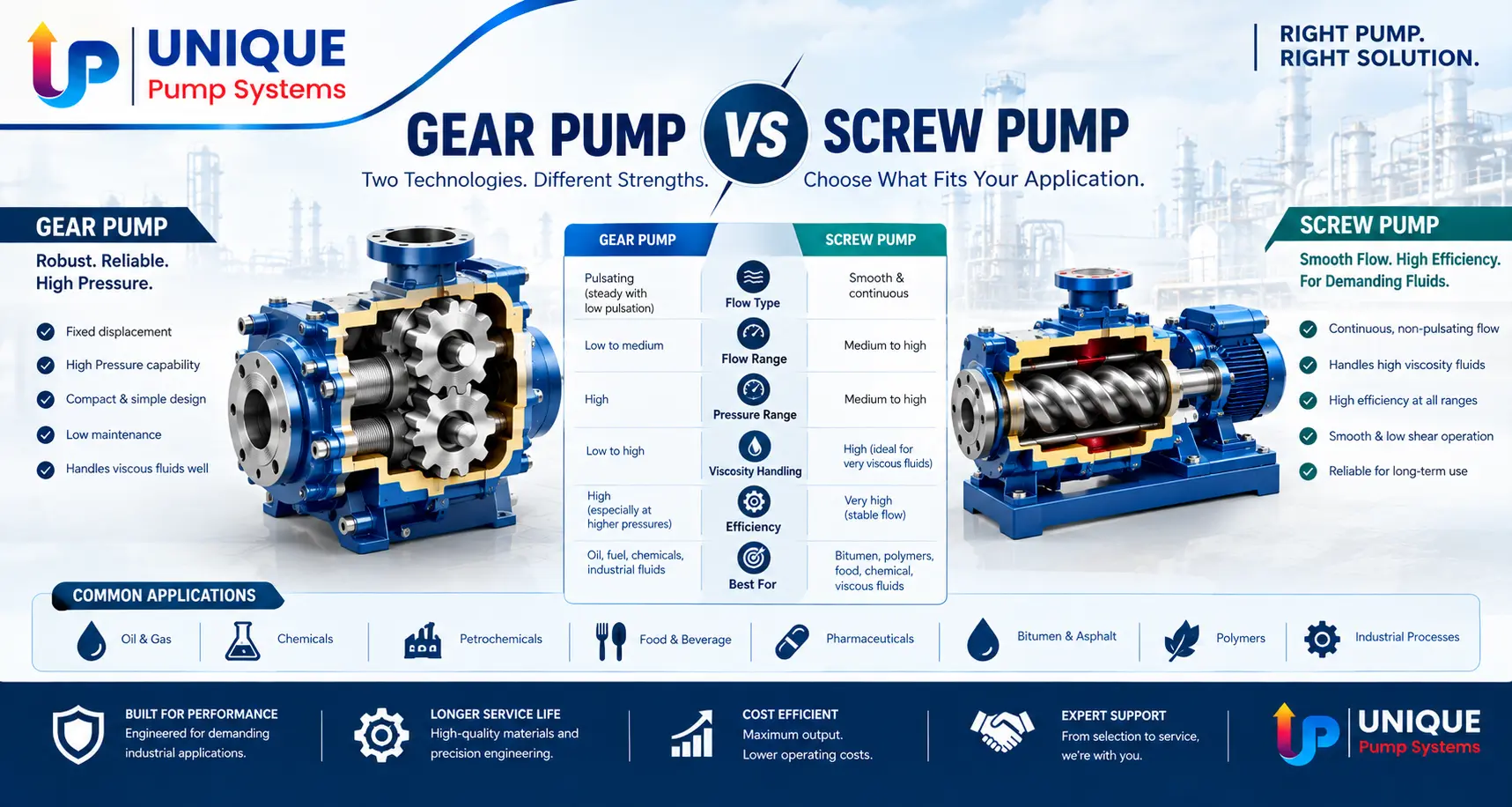
Two gears mesh together inside a close-fitting casing. Liquid is trapped between the gear teeth and the casing and carried from the inlet to the outlet. External gear pumps use two gears side by side. Internal gear pumps use a small gear inside a larger one. Read more on how a gear pump works.
One or more screws (like long threaded shafts) turn inside a close-fitting casing. Liquid is trapped in the spaces between the screw threads and moved smoothly along the length of the screw, from inlet to outlet. Because the liquid moves in a steady axial stream, flow is very smooth.
The three main types are:
| Screw pump type | How it works | Typical liquids |
|---|---|---|
| Three-screw | One central power screw drives two idler screws; no timing gears | Clean lubricating liquids: lube oil, fuel oil, hydraulic oil |
| Twin-screw | Two screws kept apart by external timing gears; screws do not touch | Crude oil, bitumen, multiphase (liquid plus gas), liquids with some solids, non-lubricating liquids |
| Single-screw (progressive cavity) | A metal rotor turns inside a rubber stator | Slurries, sludge, shear-sensitive liquids, liquids with solids |
Note: a progressive cavity pump is technically a single-screw pump, but it behaves very differently from twin and three-screw pumps. In this guide, "screw pump" mainly means twin and three-screw pumps.
The comparisons below are typical for industrial pumps. Actual limits depend on the model and manufacturer.
| Factor | Gear pump | Screw pump (twin and three-screw) |
|---|---|---|
| Working principle | Meshing gears carry liquid around the casing | Screws carry liquid along the axis |
| Flow range sweet spot | Small to medium flows | Medium to very large flows |
| Pressure | Medium to high on modest flows | Medium to very high (three-screw); low to high (twin-screw) |
| Pulsation | Low | Very low, almost pulse-free |
| Noise and vibration | Moderate | Low |
| Speed | Low to medium, reduced for thick liquids | Can run at high speed on thin oils |
| Viscosity range | Thin oils to very thick liquids | Thin oils to very thick liquids |
| Suction performance | Good | Very good, low NPSH needs, good for long suction lines |
| Solids | Poor, needs clean liquid | Three-screw: poor. Twin-screw: tolerates some soft solids |
| Gas or air in the liquid | Fair | Twin-screw handles multiphase flow well |
| Non-lubricating liquids | Possible with suitable materials | Twin-screw preferred (timing gears keep screws apart) |
| Size and footprint | Very compact at small flows | Compact at large flows; long body at small flows |
| Construction | Simple, few parts | More complex, precision screws, timing gears on twin-screw |
| Purchase cost | Lower | Higher |
| Spare parts cost | Low | High; screws are often replaced as a matched set |
| Maintenance skill | Basic | Higher, especially for twin-screw timing |
| Metering and dosing | Very good | Less common |
Screw pumps move liquid in a continuous axial stream, so they are among the quietest and smoothest positive displacement pumps. This matters in places like ships, hydraulic lifts and buildings.
Gear pumps also have low pulsation compared with piston or diaphragm pumps. For most process plants, dosing lines and transfer duties, gear pump noise and pulsation are well within acceptable limits. Internal gear pumps running at low speed on viscous liquids are particularly quiet.
Both pump families handle a wide range of viscosities.
| Point | Gear pump | Screw pump |
|---|---|---|
| Parts count | Low | Higher |
| Main wear parts | Gears, bushings, shaft seal | Screws, liner, bearings, timing gears (twin-screw), seals |
| Repair | Simple, often done on site | Often needs specialist workshop |
| Spare parts | Low cost, easy to stock | Expensive; screws usually replaced as a set |
| Purchase price | Lower | Higher, especially twin-screw |
For small and medium duties, the lower purchase price and lower spares cost of a gear pump usually give a lower total cost of ownership. For very large, continuous-duty systems, a screw pump's quiet, efficient running at high flow can pay back its higher price.
| Application | Better choice | Why |
|---|---|---|
| Fuel oil burner feed | Gear pump | Small, steady flow at pressure; low cost |
| Chemical dosing and metering | Gear pump | Accurate, repeatable flow |
| Resin, adhesive and paint transfer | Gear pump (internal) | Viscous liquids, compact, affordable |
| Molasses, glucose, chocolate | Gear pump (internal) | Very thick liquids at low speed |
| Bitumen and asphalt transfer | Gear pump for small to medium flow; twin-screw for very large flow | Heated, viscous liquid |
| Small lube oil systems | Gear pump | Compact and economical |
| Large ship and power plant lube or fuel systems | Three-screw pump | Quiet, high flow, continuous duty |
| Hydraulic elevators and lifts | Three-screw pump | Very low noise |
| Crude oil and multiphase transfer | Twin-screw pump | Handles gas and some solids |
| Sludge, slurry, wastewater | Progressive cavity pump | Handles solids and shear-sensitive liquids |
Choose a gear pump if:
Choose a screw pump if:
Share these details with your gear pump manufacturer or pump supplier:
Unique Pump Systems has manufactured gear pumps in India since 1988. If your flow and liquid suit a gear pump, we will help you pick the right model. If a screw pump would serve you better, we will tell you that too.
A gear pump moves liquid around the casing using meshing gears. A screw pump moves liquid along the length of one or more screws. Gear pumps are compact and cost-effective for small to medium flows. Screw pumps are quieter, smoother and better for very large flows.
It depends on the duty. A gear pump is better for small to medium flows, dosing and a lower budget. A screw pump is better for very large flows, quiet running and, in twin-screw designs, liquids with gas or solids.
Yes. Screw pumps have almost no pulsation and run very quietly, which is why they are used on ships and in hydraulic lifts. Gear pumps are also low-pulsation but make more noise.
Usually yes. Gear pumps have fewer, simpler parts, so both the purchase price and spare parts cost are generally lower.
Yes. Internal gear pumps handle very thick liquids such as molasses, bitumen and resins very well at low speed. Screw pumps also handle high viscosity, often at larger flows and higher cost.
For small burner feed and transfer systems, a gear pump is the usual choice. For large fuel systems on ships or power plants, three-screw pumps are common.
Twin-screw and progressive cavity pumps can handle some solids. Three-screw pumps, like gear pumps, need clean liquid.
Yes. Like gear pumps, screw pumps are positive displacement pumps and self-prime when wetted. Screw pumps are known for very good suction performance.
Both last many years when correctly selected and maintained. Gear pumps are cheaper and easier to repair. Screw pumps often run longer between overhauls in large, clean, continuous-duty systems.
Yes. Both are positive displacement pumps, so pressure will keep rising if the discharge is blocked. A relief valve protects the pump and system.
The gear pump vs screw pump decision comes down to flow size, noise, liquid condition and budget. For small to medium flows, dosing, and clean or viscous liquids, a gear pump gives reliable service at a lower cost and is easy to maintain. For very large flows, very quiet running, or liquids with gas or solids, a screw pump earns its higher price.
Share your application with Unique Pump Systems and we will help you choose the pump that fits your job and your budget.