
Unique Pump Systems, Kailash Industrial Complex, Vikhroli (W)
Reviewed by the Unique Pump Systems engineering team | Updated October 2026
Quick Answer: To select a centrifugal pump: (1) define the liquid, temperature, viscosity and solids; (2) fix the required flow; (3) calculate total dynamic head (static head + friction losses + pressure difference); (4) check NPSH available; (5) choose a pump whose curve meets your flow and head close to its best efficiency point (BEP), ideally within 80% to 110% of BEP flow; (6) pick the right impeller, materials and shaft seal; and (7) size the motor using kW = ρ × g × Q × H ÷ (1000 × η) plus a margin. If the liquid is thicker than a few hundred cP, consider a positive displacement pump instead.
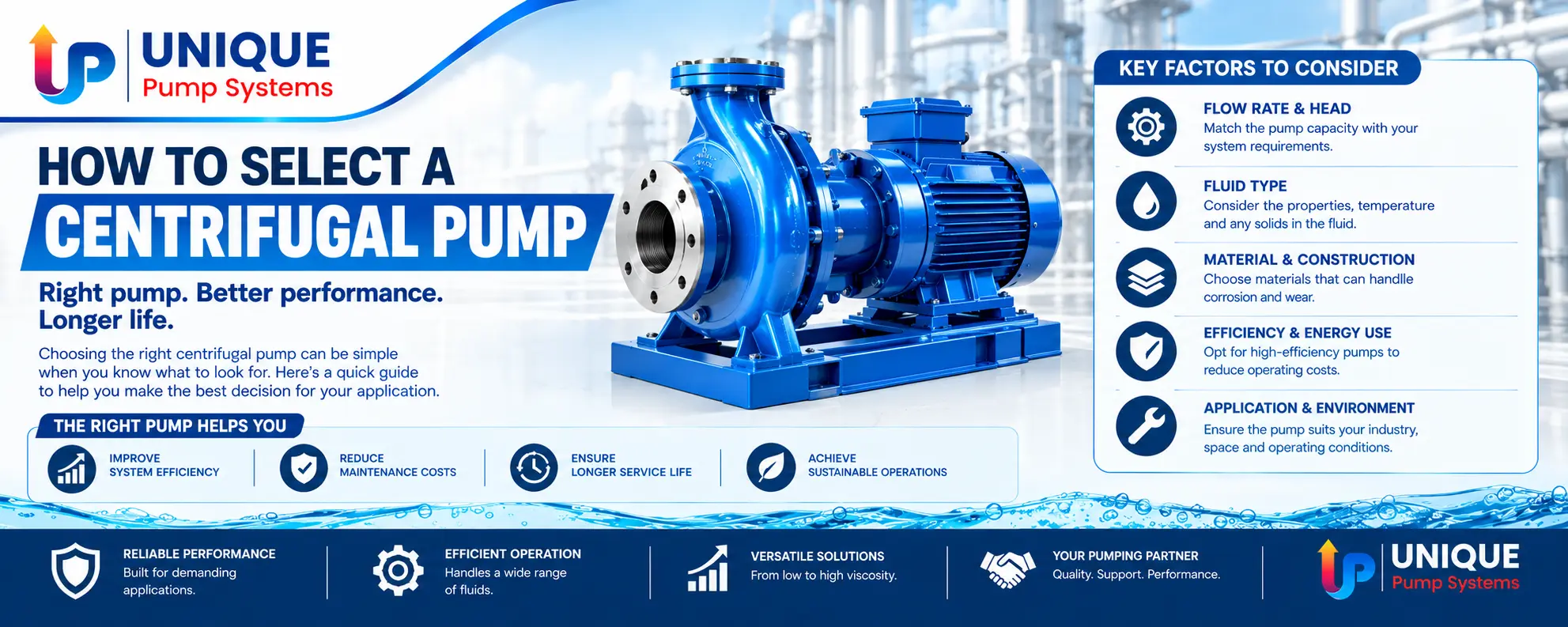
Most centrifugal pump problems, from high power bills to repeated seal failures, start at selection. A pump that is too large runs throttled and far from its best efficiency point. A pump that is too small never reaches the required flow. This step-by-step guide shows how engineers select a Centrifugal Pump correctly, with simple formulas, a worked example and a checklist you can send to any supplier.
Write down everything about the liquid you will pump. Each item affects pump type, material or seal.
| Property | Why it matters |
|---|---|
| Name and composition | Decides materials of construction and seal faces |
| Temperature (min, normal, max) | Affects vapour pressure, NPSH, material and seal choice |
| Specific gravity | Affects pressure and motor power |
| Viscosity | Centrifugal performance falls as viscosity rises |
| Solids (size, % and hardness) | Decides impeller type and wear materials |
| pH and corrosiveness | Decides casing and impeller material |
| Hazard (flammable, toxic) | May need double seals or a sealless design |
Use the actual process requirement: for example, fill a 20,000 litre tank in one hour, or circulate 50 m³/hr through a heat exchanger. Note the minimum, normal and maximum flow. Avoid stacking safety margins at every stage, which is the most common cause of oversized pumps.
Head is the energy the pump must add to the liquid, expressed in metres of liquid column. Using metres rather than bar keeps the pump curve valid for any liquid density.
Total Dynamic Head (TDH) = Static head + Friction head + Pressure head difference + Velocity head
Static head: height difference between the liquid surfaces of the source and the destination (m)
Friction head: losses in pipes, bends, valves, strainers and equipment (m)
Pressure head difference: (Pdischarge vessel − Psuction vessel) ÷ (ρ × g)
Velocity head: usually small; often ignored for short calculations
Conversion: 1 bar = 10.2 m of water. For other liquids, divide by specific gravity: head (m) = pressure (bar) × 10.2 ÷ SG.
NPSH available (NPSHa) is the suction pressure margin your system offers above the liquid's vapour pressure. It must be higher than the pump's NPSH required (NPSHr), with a margin of at least 0.5 to 1 m. Hot liquids, suction lift and long suction lines reduce NPSHa.
A centrifugal pump curve shows how head, efficiency, power and NPSHr change with flow. Plot your duty point (flow and TDH) on the curve.
Avoid oversizing: a pump selected with too much margin runs far left of its BEP. This causes recirculation, vibration, heat, higher seal and bearing loads, and wasted energy. Select close to the real duty and use a VFD or impeller trim for flexibility.
| Pump type | Best for |
|---|---|
| End suction (back pull-out) | General industrial transfer and circulation; easy maintenance |
| Monoblock | Compact water and light chemical duties; lower cost |
| Inline | Space-saving installation in pipelines, HVAC and circulation |
| Multistage | High head at moderate flow, boiler feed, high-rise water supply |
| Split case | Very high flow, water supply and cooling water |
| Self-priming centrifugal | Suction lift duties such as sumps and tankers |
| Vertical / submersible | Pits, sumps and deep tanks |
| Impeller type | Characteristics | Typical liquids |
|---|---|---|
| Closed | Highest efficiency; low solids tolerance | Clean water, thin chemicals |
| Semi-open | Handles some solids and fibres; easier to clean | Process liquids, light slurries |
| Open | Handles solids and stringy material; lower efficiency | Slurries, pulp, effluent |
| Vortex (recessed) | Passes large solids with minimal clogging | Wastewater, sludge, food waste |
For a deeper look at designs, read What Are the Three Types of Centrifugal Pumps?.
| Material | Typical use |
|---|---|
| Cast iron | Clean water, cooling water, non-corrosive liquids |
| Bronze impeller / cast iron casing | Water and mildly corrosive duties |
| SS 304 | Food, potable water, mild chemicals |
| SS 316 / 316L | Chemicals, pharma, dairy, chloride-bearing liquids |
| Duplex stainless (e.g. CD4MCu) | Corrosive and abrasive liquids, seawater |
| Alloy 20, Hastelloy, plastics | Strong acids and specialty chemicals |
The shaft seal stops liquid leaking where the shaft leaves the casing. Gland packing is simple and cheap but needs a small controlled leak and regular adjustment. A mechanical seal gives near-zero leakage, lower maintenance and is the standard for chemicals, hot liquids and hygienic duties. Single seals suit most applications; double seals with a barrier fluid are used for toxic, flammable or crystallising liquids.
Read More: Why Use Mechanical Seals?
Hydraulic power (kW) = ρ × g × Q × H ÷ 1000
Shaft power (kW) = Hydraulic power ÷ pump efficiency
ρ = density (kg/m³), g = 9.81 m/s², Q = flow (m³/s), H = head (m)
Shortcut for water: kW = Q (m³/hr) × H (m) ÷ (367 × η)
Transfer water from a ground tank to an overhead tank. Required flow 20 m³/hr. Static head 22 m, friction losses 6 m, both tanks open to atmosphere. Take TDH as 28 m and round up to 30 m for selection. Pump efficiency at the duty point is 65%.
Affinity laws predict how a centrifugal pump responds when you change speed (with a VFD) or trim the impeller (for small changes):
| Change | Flow (Q) | Head (H) | Power (P) |
|---|---|---|---|
| Speed or diameter ratio N2/N1 | Changes in direct proportion | Changes with the square | Changes with the cube |
| Example: speed cut from 2900 to 1450 RPM | Half | One quarter | One eighth |
This is why a VFD is so effective for energy saving: a small speed reduction cuts power significantly.
| Situation | Better option |
|---|---|
| Viscous liquids (above about 200 to 500 cP), oils, resins | gear pump |
| Shear-sensitive food products or soft solids | lobe pump |
| Abrasive slurries, dry-running risk, portable or drum transfer | aodd pump |
| Accurate, pressure-independent flow for dosing | Positive displacement pump (gear or lobe) |
Centrifugal pump performance must be derated for viscosity, starting from fairly low values (roughly above 20 cSt the effect becomes measurable). For thick liquids, a positive displacement pump usually costs less to run.
Read More: Gear Pump vs Centrifugal Pump
Send these details to your centrifugal pump supplier for an accurate quotation:
Unique Pump Systems will check your data, plot the duty on the curve and recommend the right centrifugal pump, materials and seal.
Define the liquid, fix the required flow, calculate total dynamic head, check NPSH available, then choose a pump whose curve meets your duty point near its best efficiency point. Finally, select materials, impeller type, shaft seal and motor power.
Total dynamic head is the total energy the pump must add, in metres of liquid. It is the sum of static head, friction losses in pipes and fittings, the pressure difference between the vessels and a small velocity head.
The BEP is the flow at which the pump runs at peak efficiency. Operating at about 80% to 110% of BEP flow gives the lowest vibration, longest seal and bearing life and lowest energy use.
Hydraulic power in kW equals density times 9.81 times flow in m3/s times head in m, divided by 1000. Divide by pump efficiency for shaft power. For water, a shortcut is kW = flow in m3/hr times head in m divided by (367 times efficiency).
An oversized pump runs throttled and far from its BEP. This wastes energy and causes recirculation, vibration, heat and early seal and bearing failure.
Only to a limited extent. Performance falls as viscosity rises, and centrifugal pumps are usually unsuitable above about 200 to 500 cP. Gear and lobe pumps are better for viscous liquids.
A closed impeller has shrouds on both sides of the vanes and gives the highest efficiency on clean liquids. An open impeller has no shrouds and handles solids and fibres better, with lower efficiency.
Mechanical seals give near-zero leakage and lower maintenance, and are preferred for chemicals, hot liquids and clean environments. Gland packing is cheaper and simpler but needs a controlled leak and regular adjustment.
Centrifugal pump selection is a sequence: liquid, flow, head, NPSH, curve, materials, seal and motor. Get each step right and the pump will run close to its best efficiency point, use less energy and need less maintenance. Skip steps or add excessive margins and you will pay for it in power bills and repairs.
Share your duty details with Unique Pump Systems and we will recommend the right centrifugal pump for your application, or tell you if a gear, lobe or AODD pump would serve you better.