
Unique Pump Systems, Kailash Industrial Complex, Vikhroli (W)
Reviewed by the Unique Pump Systems engineering team | Updated October 2026
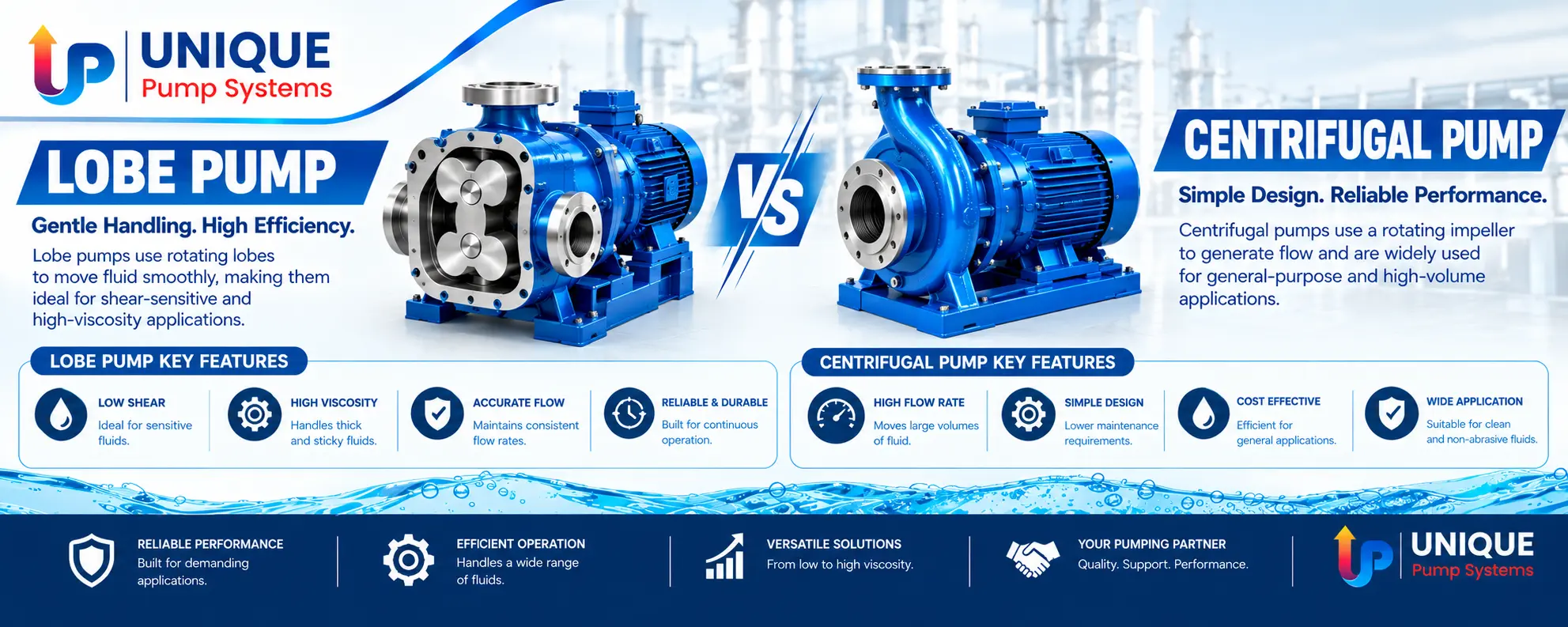
Quick Answer: A lobe pump is a positive displacement pump: two rotors trap and push a fixed volume of liquid each turn, so flow stays steady even as pressure or viscosity changes. A centrifugal pump uses a spinning impeller to throw liquid outward, so its flow falls as pressure (head) rises and as viscosity increases. Choose a lobe pump for thick, shear-sensitive or solids-laden liquids and accurate flow. Choose a centrifugal pump for thin, water-like liquids at high flow and lower cost.
Food, dairy, pharma and chemical plants often use both pump types side by side. The question is which one belongs on your line. A lobe pump and a Centrifugal Pump can look similar on a skid, but they behave very differently once the liquid gets thick, the pressure changes or the product is delicate. This guide compares them point by point so you can make a confident buying decision.
Two lobed rotors turn in opposite directions inside a casing. They are driven by external timing gears, so the rotors never touch each other. As the rotors separate at the inlet, they create a cavity that fills with liquid. The liquid is carried around the outside of the rotors, between the rotor and the casing, and pushed out at the discharge as the lobes mesh again. Learn more in our guide: What Is a Lobe Pump?.
An impeller spins at high speed inside a volute casing. Liquid enters at the centre (the eye) and is flung outward by the vanes, gaining velocity. The volute then converts that velocity into pressure. Flow depends on the system resistance: the higher the head the pump must overcome, the less it delivers. See What Is a Centrifugal Pump? for parts and working.
Values are typical for industrial pumps. Actual limits depend on model, size and manufacturer.
| Factor | Lobe pump | Centrifugal pump |
|---|---|---|
| Pump family | Positive displacement (rotary) | Kinetic / dynamic |
| Flow vs pressure | Almost constant flow as pressure changes | Flow drops as head rises |
| Flow control | Change speed (VFD or gearbox) | Throttle valve, VFD or impeller trim |
| Viscosity range | Thin liquids to very thick pastes (up to around 1,000,000 cP in suitable designs) | Best below about 100 to 200 cP; poor above about 500 cP |
| Shear on product | Low, gentle handling | High at the impeller |
| Soft solids (fruit pieces, curd, meat chunks) | Passes them with little damage | Damages or blocks; needs special impellers |
| Self-priming | Yes, when wetted (moderate lift) | No, for standard designs; needs priming |
| Running speed | Low to medium | High (typically 1440 or 2880 RPM) |
| Pulsation | Low to moderate (depends on rotor type) | Very smooth |
| Efficiency on water-thin liquids | Lower (internal slip) | High near best efficiency point |
| Reversible flow | Yes, by reversing rotation | No |
| Closed discharge valve | Dangerous: pressure builds; needs relief valve | Short periods only; overheats if prolonged |
| Hygienic / CIP designs | Widely available | Widely available |
| Purchase cost | Higher | Lower |
| Maintenance | Rotors, seals, timing gears, bearings | Impeller, seal, bearings; usually simpler |
Viscosity is where the two pumps separate most clearly. As a liquid thickens, a centrifugal pump suffers from friction losses on the impeller and casing. Its head, flow and efficiency all fall, and the motor power rises. By the time a liquid is as thick as a light syrup, a centrifugal pump is usually the wrong choice.
A lobe pump works the other way. Thicker liquids actually seal the small clearances better, so slip falls and volumetric efficiency rises. The pump simply runs slower to give the liquid time to fill the rotor cavities.
| Liquid | Typical viscosity | Better choice |
|---|---|---|
| Water, CIP solutions, milk | 1 to 5 cP | Centrifugal pump |
| Light oils, thin juices | 10 to 100 cP | Centrifugal or lobe (check duty) |
| Cream, liquid detergent, thin syrup | 100 to 1,000 cP | Lobe pump |
| Honey, molasses, ketchup, yoghurt | 1,000 to 50,000 cP | Lobe pump |
| Pastes, fillings, thick creams, gels | 50,000 cP and above | Lobe pump (slow speed, large ports) |
Read More: Lobe Pump Capacity & Flow Rate Calculation
Some products change when they are pumped too hard. Yoghurt loses body, cream can churn, emulsions can split, and fruit pieces or cheese curds break up. The high-speed impeller of a centrifugal pump applies strong shear. A lobe pump turns slowly and moves the product in large pockets, so it is the standard choice for shear-sensitive food, cosmetic and pharma liquids.
With a lobe pump, flow is roughly proportional to speed. A VFD gives simple, repeatable flow control, which makes lobe pumps useful for batching, filling and transfer where you need to know how much has moved.
With a centrifugal pump, flow changes with system resistance. A partly blocked filter or a rising tank level will reduce flow. That self-adjusting behaviour is useful for water circulation and cooling systems, but it makes accurate dosing harder.
Safety note: Never run a lobe pump against a closed discharge valve. Pressure keeps rising until something fails. Fit a pressure relief valve (built-in or in-line) on every positive displacement pump.
| Application | Better choice | Why |
|---|---|---|
| Water transfer, cooling water, utilities | Centrifugal pump | Thin liquid, high flow, low cost |
| CIP supply | Centrifugal pump | High flow of thin cleaning solutions |
| Milk reception and transfer | Centrifugal pump (lobe for gentle handling) | Thin liquid; lobe if shear matters |
| Yoghurt, cream, curd, cheese | Lobe pump | Shear-sensitive and viscous |
| Chocolate, honey, glucose, molasses | Lobe pump | High viscosity |
| Fruit preparations with pieces | Lobe pump | Passes soft solids intact |
| Sauces, ketchup, mayonnaise | Lobe pump | Viscous and shear-sensitive |
| Cosmetic creams, lotions, gels | Lobe pump | Viscous, needs gentle handling |
| Thin chemicals and solvents (large flow) | Centrifugal pump | Efficient and economical |
| Polymer solutions, slurries with soft solids | Lobe pump | Viscous, low shear |
| Clean, viscous oils at high pressure | Gear pump | Compact and economical for oils |
For clean oils and lubricating liquids, a gear pump is often the most economical positive displacement option. For abrasive slurries, sludge or liquids that may run dry, an aodd pump is worth considering.
Read More: Gear Pump vs Lobe Pump Applications
Unique Pump Systems manufactures both lobe pumps and centrifugal pumps. Share your liquid and duty with our engineers and we will recommend the pump that fits, not just the one that is easier to sell.
A lobe pump is a positive displacement pump that moves a fixed volume per revolution, so flow stays steady as pressure changes. A centrifugal pump uses an impeller to add velocity to the liquid, so its flow falls as head rises and as the liquid gets thicker.
A lobe pump. Centrifugal pumps lose flow and efficiency quickly as viscosity rises and are usually unsuitable above about 500 cP. Lobe pumps handle liquids from thin to very thick pastes by running at lower speeds.
Yes. A lobe pump is self-priming when the rotors are wetted, and can lift liquid a moderate height. A standard centrifugal pump is not self-priming and must be filled with liquid before starting.
Yes, lobe pumps can pass soft solids such as fruit pieces, curds and meat chunks with little damage, because they move the product in large pockets at low speed. Bi-lobe and butterfly rotors handle the largest solids.
Lobe pumps are gentle, handle viscous products, pass soft solids intact and are available in hygienic stainless steel designs that can be cleaned in place. This makes them ideal for dairy, sauces, confectionery and fruit preparations.
Usually yes. For thin liquids at the same flow, a centrifugal pump typically has a lower purchase price and simpler maintenance.
No. A lobe pump is positive displacement, so pressure rises until something fails. Always fit a pressure relief valve. A centrifugal pump can tolerate a closed valve briefly, but will overheat if run that way for long.
On thin, water-like liquids at high flow, a centrifugal pump running near its best efficiency point is usually more efficient. On viscous liquids, a lobe pump uses much less power than a centrifugal pump would.
The lobe pump vs centrifugal pump decision usually comes down to viscosity and product care. If your liquid is thin and you need high flow at low cost, a centrifugal pump is the practical choice. If your liquid is thick, delicate, contains soft solids or needs controlled flow, a lobe pump will protect the product and keep running efficiently.
Not sure which suits your line? Send your liquid details to Unique Pump Systems and our team will help you choose the right pump and seal arrangement.