
Unique Pump Systems, Kailash Industrial Complex, Vikhroli (W)
Reviewed by the Unique Pump Systems engineering team | Updated October 2026
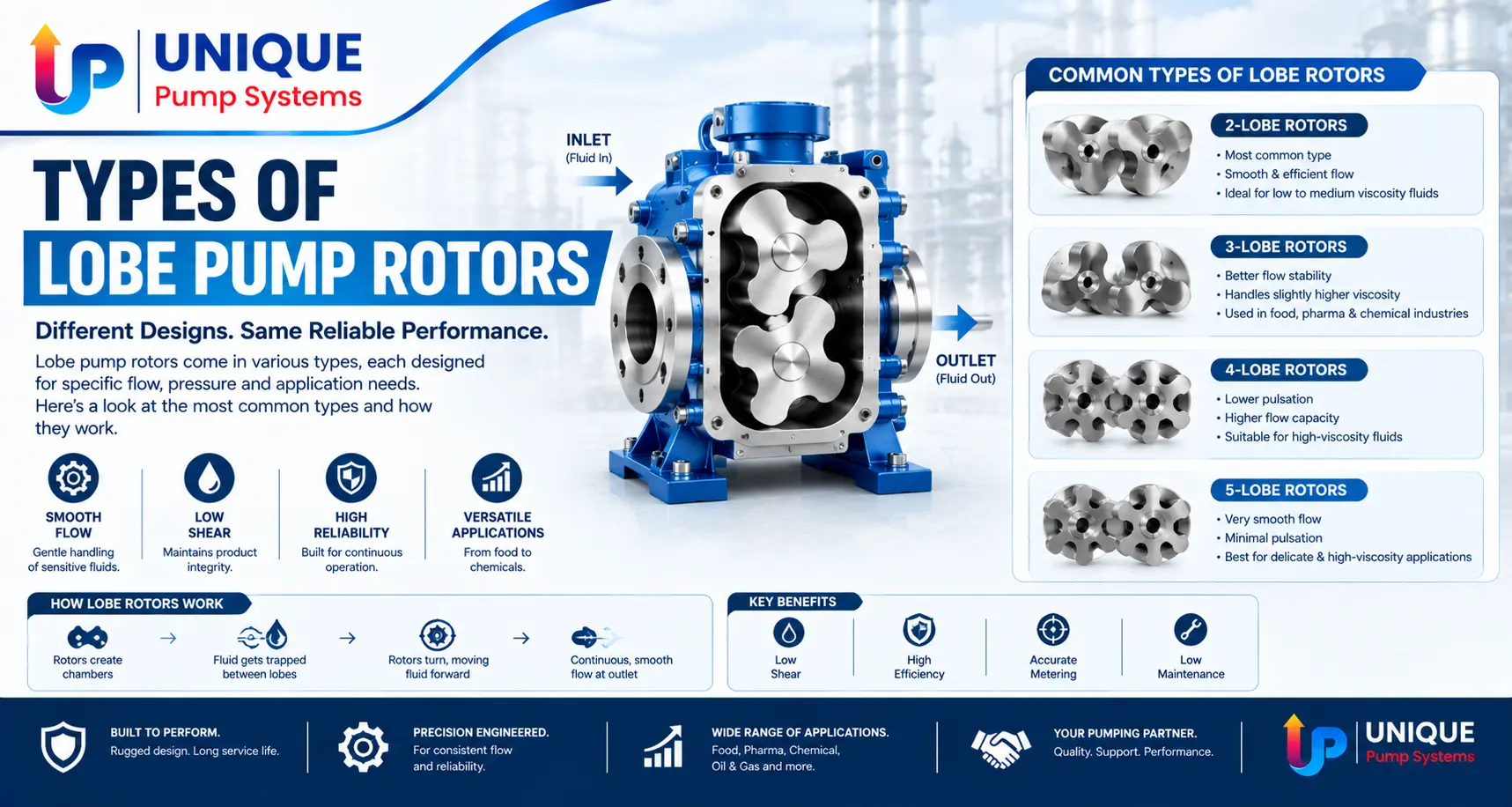
Quick Answer: The main lobe pump rotor types are bi-lobe (two lobes, largest cavities, best for big soft solids), tri-lobe (three lobes, the most common, smoother flow for general duties), multi-lobe (four or more lobes, lowest pulsation, best for thin liquids and smooth metering), bi-wing or butterfly (wide, gentle cavities for large delicate solids) and helical or twisted lobe (lowest pulsation and noise). Rotors are usually stainless steel, with non-galling alloys or elastomer-coated options for tight clearances and abrasive or thin liquids.
Two lobe pump models with the same size casing can perform very differently on the same product. The reason is usually the rotor. Rotor shape decides how large the pumping cavities are, how smooth the flow is, how well the pump handles solids and how much it slips on thin liquids. This guide explains each rotor type in plain terms and helps you choose the right one for your process.
In a lobe pump, two rotors turn in opposite directions without touching, driven by external timing gears. Liquid fills the space between each rotor and the casing and is carried from suction to discharge. The rotor profile controls four things:
New to lobe pumps? Start with What Is a Lobe Pump? for the basics of working and parts.
Each rotor has two lobes, giving the largest possible cavity in a given casing. This makes bi-lobe rotors the first choice when large soft solids must pass intact, such as fruit pieces, vegetables in sauce, meat chunks or cheese curd. The trade-off is higher pulsation, because each rotor delivers only two pulses per revolution.
Tri-lobe rotors are the industry workhorse. Three lobes per rotor give smoother flow than bi-lobe, good efficiency, and cavities large enough for small soft solids. They suit most general duties: dairy products, syrups, sauces, detergents, cosmetics, chemicals and polymers.
Rotors with four or five lobes produce smaller, more frequent pulses, so discharge flow is smoother still. The longer sealing line also reduces slip on thinner liquids. Multi-lobe rotors suit low-viscosity liquids, smooth transfer and metering duties, but are less suited to products with solids.
These rotors have two wide, wing-shaped lobes. They create large, gently shaped cavities that cradle delicate solids with minimal shear. They are popular for whole fruit, yoghurt with fruit pieces and other premium food products where appearance matters.
Instead of straight lobes, the lobes are twisted along the length of the rotor. As one part of the lobe finishes discharging, the next part has already started, so pulsation and noise fall sharply. Helical rotors are useful for filling machines, inline blending and any duty where smooth, quiet flow matters.
Circumferential piston pumps use arc-shaped rotors that run in annular channels in the casing. The long sealing path gives very low slip, so they handle thin liquids and higher pressures better than many standard lobe pumps. They are closely related to lobe pumps and are often grouped with them in hygienic pump ranges.
| Rotor type | Solids handling | Pulsation | Thin liquids | Typical applications |
|---|---|---|---|---|
| Bi-lobe | Excellent (largest cavities) | Higher | Fair | Fruit pieces, meat chunks, curd, vegetables in sauce |
| Tri-lobe | Good | Moderate | Good | Dairy, syrups, sauces, detergents, chemicals, polymers |
| Multi-lobe (4 to 5) | Limited | Low | Very good | Thin liquids, smooth transfer, metering |
| Bi-wing / butterfly | Excellent, very gentle | Higher | Fair | Whole fruit, delicate food solids |
| Helical / twisted | Good | Very low | Good | Filling, inline blending, quiet duties |
| Circumferential piston | Good | Low | Excellent | Thin liquids, higher pressure hygienic duties |
Pulsation also depends on speed, pipe layout and liquid viscosity. A pulsation dampener on the discharge can smooth flow from any rotor type if needed.
Rotor material affects corrosion resistance, wear and the clearance the pump can run with.
| Rotor material | Strengths | Best for |
|---|---|---|
| Stainless steel (SS 316 / 316L) | Corrosion resistant, hygienic, easy to clean | Food, dairy, pharma, most chemicals |
| Non-galling stainless alloys | Resist seizing if rotors contact the casing | Tight clearances, higher pressures, thin liquids |
| Elastomer-coated rotors (e.g. EPDM, NBR, FKM) | Near-zero clearance, good suction, tolerate some abrasion | Thin liquids, slurries, light abrasives, better self-priming |
| Engineering plastics (special duties) | Light, chemical resistant | Specific chemicals at low pressure |
Hot clearances: stainless steel expands as it heats. For hot duties such as chocolate, hot syrups or CIP at high temperature, rotors are machined with larger clearances so they do not rub when hot. Always tell your supplier the maximum operating and cleaning temperature.
Thin liquids and pressure: standard clearances suit viscous liquids well, because the liquid seals the gaps. On water-thin liquids at higher pressure, slip increases. Multi-lobe rotors, coated rotors or circumferential piston designs reduce this.
Read More: Lobe Pump Capacity & Flow Rate Calculation
The shaft seal sits right behind the rotor, so it sees the same product, temperature and pressure. For sticky, crystallising or abrasive products, a flushed or double mechanical seal protects the seal faces and extends service life. For hygienic duties, front-loading seals that can be cleaned in place are common. Decide the seal at the same time as the rotor.
Read More: Types of Mechanical Seals
If you are seeing these symptoms, our lobe pump troubleshooting guide walks through the checks step by step.
Lobe pumps are versatile, but other pumps can fit better in some cases:
Unique Pump Systems will recommend the right rotor profile, material, clearance and seal for your duty. Share your process details for a quick selection.
The main types are bi-lobe (two lobes), tri-lobe (three lobes), multi-lobe (four or more lobes), bi-wing or butterfly rotors, and helical or twisted lobe rotors. Circumferential piston rotors are a closely related design.
Bi-lobe and butterfly (bi-wing) rotors are best for soft solids because they create the largest cavities and handle products like fruit pieces, curd and meat chunks gently.
The tri-lobe rotor is the most common. It balances smooth flow, good efficiency and reasonable solids handling, making it suitable for most food, dairy and chemical duties.
Choose rotors with more lobes or helical (twisted) lobes, run at a suitable speed and, if needed, add a pulsation dampener on the discharge line.
No. External timing gears keep the rotors in step so they never touch each other or the casing during normal operation. This is why lobe pumps can run on non-lubricating liquids.
Most are stainless steel such as SS 316 or 316L. Non-galling alloys are used for tight clearances, and elastomer-coated rotors are used for thin liquids, light abrasives and better suction.
Stainless steel expands when heated. Hot-clearance rotors are machined with extra clearance so they do not rub against the casing at high product or CIP temperatures.
Standard lobe pumps slip more on thin liquids at higher pressure. Multi-lobe, elastomer-coated or circumferential piston rotors reduce slip. For very thin liquids at high flow, a centrifugal pump may be better.
The right lobe pump rotor depends on your product. Bi-lobe and butterfly rotors protect large solids, tri-lobe rotors handle most general duties, multi-lobe and helical rotors give the smoothest flow, and coated or circumferential piston designs help with thin liquids. Match the rotor material, clearance and seal to your temperature and hygiene needs and the pump will run efficiently for years.
Contact Unique Pump Systems with your product details and we will recommend the right lobe pump and rotor configuration.