
Unique Pump Systems, Kailash Industrial Complex, Vikhroli (W)
Reviewed by the Unique Pump Systems engineering team | Updated October 2026
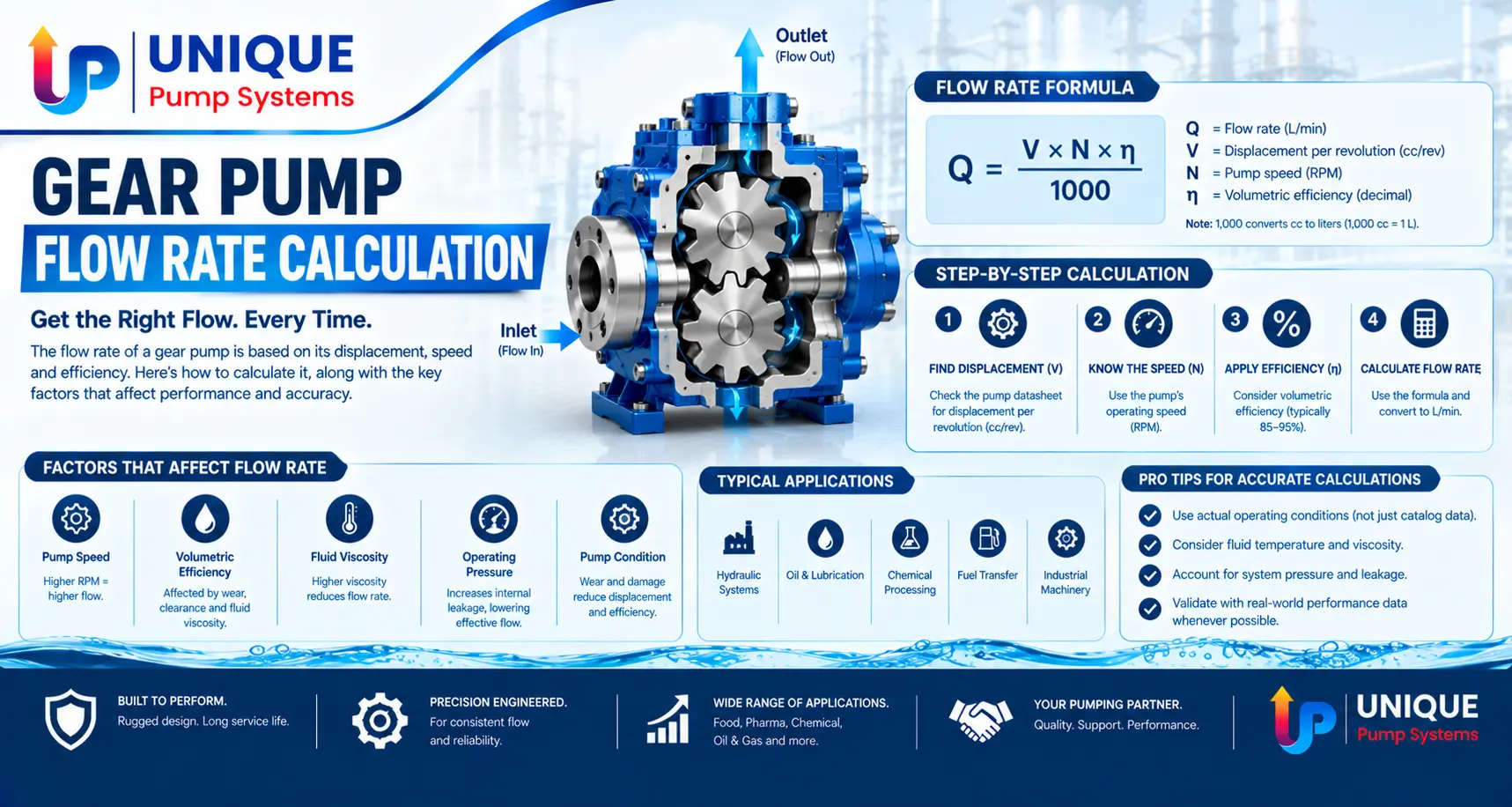
Quick Answer: Gear pump flow rate is calculated as Q (L/min) = Displacement (cc/rev) × Speed (RPM) ÷ 1000 × Volumetric efficiency. For example, a 20 cc/rev pump at 1440 RPM gives 28.8 L/min in theory, or about 26.5 L/min at 92% volumetric efficiency. Power needed is kW = L/min × bar ÷ (600 × overall efficiency). For thick liquids, lower the speed and size a larger pump instead of running a small pump fast.
Getting the size of a gear pump right saves money twice: you avoid paying for a pump that is too big, and you avoid the slow, expensive failure of a pump that is too small and running too fast. This guide shows the exact formulas plant engineers use to calculate gear pump flow rate, displacement, speed and motor power, with worked examples in Indian units (LPM, m³/hr, bar, kW and HP).
Because a gear pump traps and moves a fixed pocket of liquid every turn, flow is directly proportional to speed. Double the RPM and you double the flow, as long as the liquid can fill the gear teeth.
Theoretical flow: Qth (L/min) = V (cc/rev) × N (RPM) ÷ 1000
Actual flow: Qact = Qth × ηv
V = displacement, N = pump speed, ηv = volumetric efficiency (as a decimal)
| Term | Meaning | Typical value |
|---|---|---|
| Displacement (V) | Volume moved per revolution, in cc/rev (cm³/rev) | From pump datasheet |
| Speed (N) | Pump shaft speed in RPM | Often 1440, 960 or 720 RPM (4, 6 or 8-pole motor) or reduced by gearbox/VFD |
| Volumetric efficiency (ηv) | Actual flow ÷ theoretical flow | About 0.85 to 0.98 depending on pressure, viscosity and wear |
| Slip | Liquid that leaks back from discharge to suction through clearances | Theoretical flow minus actual flow |
A pump has a displacement of 20 cc/rev and runs at 1440 RPM on light oil at 10 bar. Volumetric efficiency is taken as 92%.
You need 3 m³/hr of a medium-viscosity oil and want to run at 960 RPM. Assume 90% volumetric efficiency.
The pump datasheet is the most accurate source of displacement. If you only have a pump in hand, you can estimate it from the gear dimensions. For a standard external gear pump with two identical gears, a common approximation is:
V (cm³/rev) ≈ 2 × π × m² × z × b
m = gear module (cm), z = number of teeth on one gear, b = gear face width (cm)
Example: module 3 mm (0.3 cm), 12 teeth, 30 mm face width (3 cm). V ≈ 2 × 3.1416 × 0.09 × 12 × 3 ≈ 20.4 cc/rev.
You can also measure it directly: run the pump at a known speed on a clean, thin oil at near-zero pressure, collect the flow for one minute, and divide by the RPM. This is the most practical method on site. For a refresher on internal parts, see our guide to the components of a gear pump.
Note: The formula above is an estimate for external spur gear pumps. Internal gear pumps, helical gears and special tooth profiles have different geometry. Always confirm displacement with the manufacturer before ordering.
No gear pump is perfectly tight. Small clearances between the gear tips and casing, and between the gear faces and side plates, let some liquid leak back from the high-pressure side to the low-pressure side. This is slip.
| Factor | Effect on slip | Effect on actual flow |
|---|---|---|
| Higher discharge pressure | More slip | Lower |
| Higher viscosity | Less slip | Closer to theoretical |
| Thin liquids (water, solvents, diesel) | More slip | Lower, especially at high pressure |
| Worn gears, bushes or side plates | More slip | Lower, gets worse over time |
| Lower speed on thin liquids | Slip is a bigger share of total flow | Lower efficiency |
A useful field check: if a pump that used to deliver its rated flow now delivers noticeably less at the same speed and pressure, wear has increased internal clearances. Our gear pump troubleshooting guide covers this in detail.
Thick liquids such as molasses, resin, bitumen or glucose flow slowly into the gaps between the gear teeth. If the pump turns too fast, the teeth move past the inlet before they fill. Flow drops, noise rises and the pump starts to cavitate. The fix is to run slower and use a larger displacement pump.
The table below is a general guide. Exact limits depend on the pump design, port size and suction conditions.
| Liquid viscosity (cSt) | Example liquids | Typical maximum pump speed |
|---|---|---|
| Up to 100 | Diesel, light oil, thin solvents | Up to 1440 RPM |
| 100 to 1,000 | Lube oil, hydraulic oil, furnace oil (heated) | About 720 to 960 RPM |
| 1,000 to 5,000 | Glycerine, heavy oil, liquid soap | About 400 to 720 RPM |
| 5,000 to 20,000 | Molasses, resins, heavy syrups | About 200 to 400 RPM |
| 20,000 to 100,000+ | Bitumen (cooler), adhesives, thick pastes | About 100 to 200 RPM, often internal gear pumps |
This is why a high-viscosity duty often needs a pump with a gearbox or a variable frequency drive (VFD). For hot, thick liquids, see our guide to the gear pump for bitumen and asphalt.
Once you know flow and pressure, you can work out the motor size.
Hydraulic power (kW) = Q (L/min) × Δp (bar) ÷ 600
Shaft power (kW) = Hydraulic power ÷ ηo (overall efficiency)
Torque (Nm) = V (cc/rev) × Δp (bar) ÷ (20 × π × ηm)
Δp = discharge pressure minus suction pressure, ηm = mechanical efficiency
Using the 20 cc/rev pump from Example 1: actual flow 26.5 L/min at 10 bar, overall efficiency 75%.
For viscous liquids, friction inside the pump adds extra power demand that the basic formula does not fully show. Always check power at the coldest (thickest) condition the liquid will see, such as start-up in winter.
| Convert from | To | Multiply by |
|---|---|---|
| m³/hr | L/min (LPM) | 16.67 |
| L/min | m³/hr | 0.06 |
| US GPM | L/min | 3.785 |
| bar | psi | 14.5 |
| bar | kg/cm² | 1.02 (approx. 1) |
| kW | HP | 1.341 |
| cP (centipoise) | cSt (centistokes) | Divide by specific gravity |
To get an accurate selection, send these details to your gear pump manufacturer:
Unique Pump Systems has manufactured gear pumps in India since 1988. Share your data and our engineers will calculate the right pump size and motor for your duty.
Multiply displacement (cc/rev) by speed (RPM) and divide by 1000 to get theoretical flow in L/min. Then multiply by volumetric efficiency, usually 0.85 to 0.98, to get actual flow. Example: 20 cc/rev at 1440 RPM = 28.8 L/min theoretical, about 26.5 L/min actual at 92% efficiency.
Displacement is the volume of liquid a gear pump moves in one full revolution, usually given in cc/rev or cm3/rev. It is fixed by the gear size, number of teeth and face width, and is listed on the pump datasheet.
Only slightly. A gear pump delivers almost the same flow as pressure rises, but internal slip increases, so actual flow drops a little. The drop is larger with thin liquids and worn pumps.
A healthy gear pump typically runs at about 85% to 98% volumetric efficiency. It is highest with viscous liquids at moderate pressure and lowest with thin liquids at high pressure or when the pump is worn.
Hydraulic power in kW equals flow in L/min times pressure in bar divided by 600. Divide that by the overall pump efficiency, then add a 15% to 25% margin and choose the next standard motor size. Check power at the highest viscosity the liquid will reach.
Thick liquids need time to fill the spaces between the gear teeth. At high speed the teeth pass the inlet before they fill, causing cavitation, noise, low flow and wear. Slower speed with a larger pump gives better results.
Multiply m3/hr by 16.67 to get litres per minute. For example, 3 m3/hr equals about 50 L/min.
Yes, flow rises in direct proportion to speed, but only within the pump's rated speed and the speed the liquid viscosity allows. Power also rises, so check the motor rating before using a VFD to speed up the pump.
Gear pump sizing comes down to three numbers: displacement, speed and volumetric efficiency. Use Q = V × RPM ÷ 1000 × ηv for flow and kW = L/min × bar ÷ 600 ÷ efficiency for power. Then adjust for viscosity, because thick liquids need slower speeds and larger pumps.
If you want the calculation checked or a pump selected for your liquid, send your duty details to Unique Pump Systems. We will recommend the right gear pump, drive and seal for your application.