
Unique Pump Systems, Kailash Industrial Complex, Vikhroli (W)
Reviewed by the Unique Pump Systems engineering team | Updated September 2026
Quick Answer: Gear pumps and vane pumps are both positive displacement pumps, but they suit different liquids. Choose a gear pump for medium to very thick liquids (oils, resins, bitumen, syrups), higher pressure, and a simple, rugged, lower-cost design. Choose a vane pump for thin, low-viscosity liquids (LPG, solvents, fuels, ammonia), where its sliding vanes adjust for wear and keep efficiency steady. In hydraulics, gear pumps are cheaper and more tolerant of dirty oil, while vane pumps are quieter and can offer variable displacement.
Picking between a gear pump and a vane pump is one of the most common questions we hear from plant engineers and buyers. Both move a fixed amount of liquid per turn, both can self-prime, and both are used for oil and fuel. Yet in the wrong application, either one can wear out fast or waste energy. This guide compares them side by side in simple terms so you can choose with confidence.
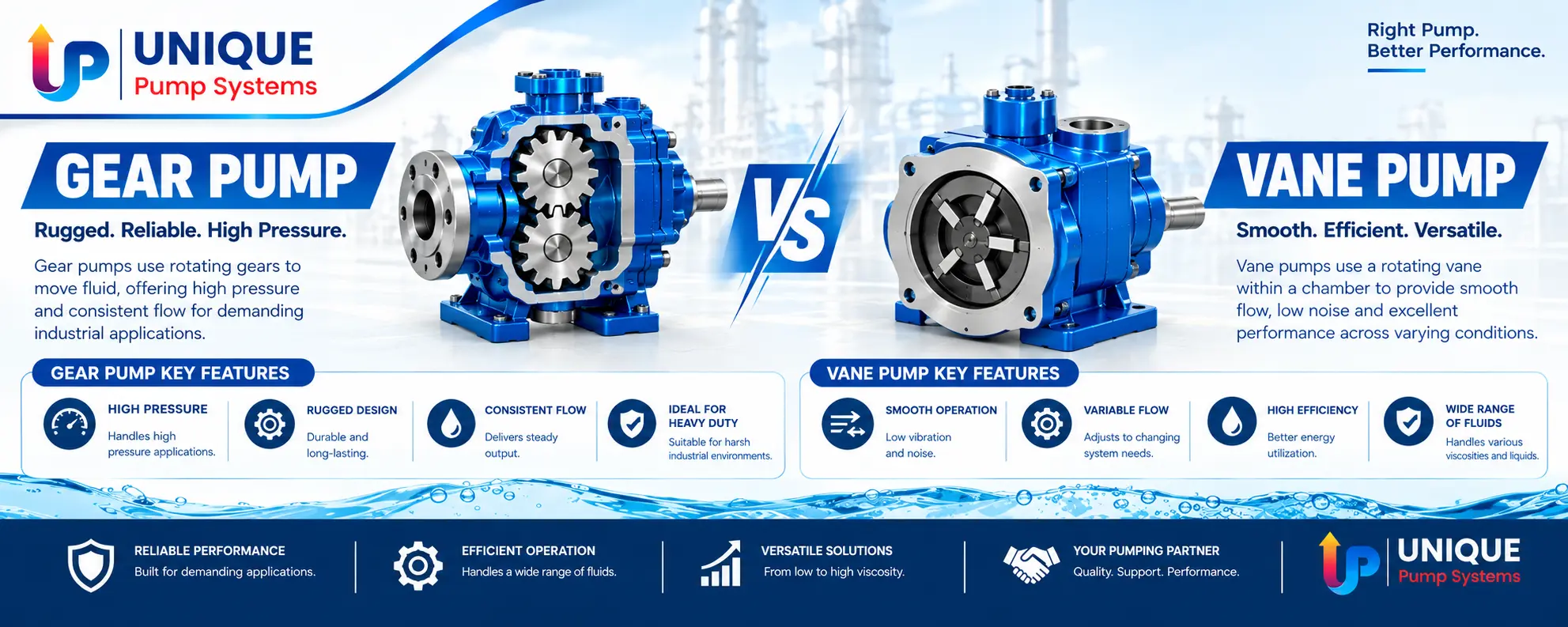
Two gears mesh together. As the teeth separate, they draw liquid in. The liquid is carried around in the spaces between the teeth and the casing, and pushed out when the teeth mesh again. There are two main types: external (two gears side by side) and internal (a small gear inside a larger one). For more detail, see how a gear pump works.
A slotted rotor sits off-centre inside a round casing (the cam ring or liner). Flat vanes slide in and out of the slots. Centrifugal force, springs or pushrods, and liquid pressure keep the vanes pressed against the casing wall. Because the rotor is off-centre, the spaces between the vanes grow on the suction side and shrink on the discharge side, moving liquid through the pump.
The key difference: gear pumps rely on fixed, tight clearances. Vane pumps rely on vanes that move outwards to stay in contact with the casing, even as they wear.
The ranges below are typical for industrial pumps. Actual limits depend on the model and manufacturer.
| Factor | Gear pump | Vane pump |
|---|---|---|
| Working principle | Meshing gears | Sliding vanes in an off-centre rotor |
| Best viscosity range | Medium to very high (oils, resins, bitumen, molasses) | Thin to medium (LPG, solvents, fuels, light oils) |
| Performance on thick liquids | Excellent at reduced speed | Falls off; vanes may not slide out fully |
| Performance on very thin liquids | Good, but slip rises as clearances wear | Very good; vanes seal well |
| Pressure capability | Medium to high | Low to medium in transfer duty; medium to high in hydraulic designs |
| Flow over time | Drops gradually as gears and bushings wear | Stays steadier; vanes self-adjust for wear |
| Handling of vapour and gas | Fair | Good (common for LPG and volatile liquids) |
| Dry running | Poor; seals and bushings need liquid | Slightly better for short periods, but still not recommended |
| Noise | Moderate | Quieter, smoother |
| Pulsation | Low | Low |
| Solids and abrasives | Poor; only clean or lightly filtered liquids | Poor; vanes wear quickly |
| Temperature range | Wide; jacketed versions for hot liquids like bitumen | Limited by vane material |
| Variable displacement option | No (fixed displacement) | Yes, in hydraulic designs |
| Construction | Simple, few moving parts, rugged | More parts (vanes, springs, pushrods) |
| Purchase cost | Lower | Usually higher |
| Main wear parts | Gears, bushings, shaft seal | Vanes, liner or cam ring, seal |
| Maintenance | Simple, infrequent | Vanes replaced periodically, but quick to change |
| Reversibility | Many internal gear pumps run in both directions | Some designs reversible |
If you remember one thing from this guide, remember this:
In between, for example diesel, light lube oil and hydraulic oil, both pumps work well. Then the decision comes down to pressure, cost, noise and maintenance.
Gear pumps are compact and strong. Their rigid gears and casing handle higher pressures well, which is why they are widely used for fuel oil burners, lube systems, dosing and transfer against long pipelines.
Vane pumps are very efficient on thin liquids at low to medium pressure. Their efficiency stays steady over their life because the vanes self-compensate. In hydraulic systems, balanced vane pumps also reach medium to high pressures and run quietly.
Efficiency over time: a new gear pump and a new vane pump can be similarly efficient. As a gear pump wears, internal clearances grow, so flow falls slowly. A vane pump holds its flow better until the vanes need replacing.
| Maintenance point | Gear pump | Vane pump |
|---|---|---|
| What wears | Gear teeth, bushings, side plates, seal | Vanes, liner or cam ring, seal |
| Sign of wear | Slow drop in flow and pressure | Noise, flow drop once vanes are worn out |
| Typical repair | Replace bushings, gears or seal | Replace vanes (fast), then liner if needed |
| Spare parts cost | Low | Moderate |
| Tolerance to poor maintenance | High; very forgiving design | Moderate; vanes are sensitive to dirt |
In our experience, a well-selected gear pump running on a suitable liquid with clean suction, a correct relief valve setting and regular seal checks gives long, low-cost service. Most early failures come from abrasive particles, running dry, or running too fast on thick liquids.
In mobile and industrial hydraulics, the comparison is a little different:
| Factor | Hydraulic gear pump | Hydraulic vane pump |
|---|---|---|
| Cost | Lowest cost hydraulic pump | Medium |
| Noise | Louder | Quieter (good for indoor machines) |
| Contamination tolerance | High | Lower; needs cleaner oil |
| Displacement | Fixed | Fixed or variable |
| Typical use | Tractors, tippers, loaders, power packs | Machine tools, injection moulding, presses |
For a detailed look at the hydraulic side, read how a hydraulic gear pump works.
| Application | Better choice | Why |
|---|---|---|
| Bitumen, asphalt, heavy fuel oil | Gear pump | High viscosity, often heated |
| Molasses, glucose, syrups | Gear pump | Very thick liquids, low speed |
| Resins, adhesives, paints, inks | Gear pump | Viscous, steady flow needed |
| Lube oil transfer and circulation | Gear pump (either works) | Medium viscosity, rugged duty |
| Fuel oil burner feed | Gear pump | Steady pressure |
| Diesel and petrol transfer | Either; vane often chosen for thin fuels | Thin liquid, both work well |
| LPG, ammonia, refrigerants | Vane pump | Thin, volatile liquids with vapour |
| Solvents and alcohols | Vane pump | Very low viscosity |
| Chemical dosing and metering | Gear pump | Precise, pulse-free flow |
| Quiet indoor hydraulic machines | Vane pump | Low noise |
Choose a gear pump if:
Choose a vane pump if:
Share these details with your gear pump manufacturer or pump supplier:
Unique Pump Systems has manufactured gear pumps in India since 1988 for oils, fuels, bitumen, chemicals, resins and food liquids. If you are unsure whether a gear pump or a vane pump suits your job, share your details and we will give you an honest recommendation.
A gear pump moves liquid with meshing gears and fixed clearances. A vane pump uses sliding vanes in an off-centre rotor that press against the casing. Gear pumps suit thick liquids and higher pressure. Vane pumps suit thin liquids and keep efficiency steady as they wear.
Neither is better in every case. A gear pump is better for viscous liquids, higher pressure and lower cost. A vane pump is better for thin, volatile liquids like LPG and solvents.
Only to a point. As viscosity rises, the vanes may not slide out fully and the pump loses performance. For very thick liquids such as bitumen or molasses, a gear pump is the usual choice.
Yes, generally. Vane pumps run more smoothly and quietly, which is why they are popular for indoor hydraulic machinery.
Both can last many years when correctly selected. Gear pumps are more forgiving of poor conditions. Vane pumps keep their flow steadier until the vanes need replacing, which is a quick job.
Usually yes. Gear pumps have a simpler design with fewer parts, so both the purchase price and spare parts cost are typically lower.
Yes. Both are positive displacement pumps and can self-prime when wetted. Neither should be run dry for long.
Both work well. Vane pumps are common for thin fuels, while gear pumps are chosen where higher pressure or a range of fuel grades, including heavier oils, must be handled.
Neither handles abrasive solids well. Use a strainer, or consider a lobe or progressive cavity pump for liquids with solids.
Yes. Both are positive displacement pumps, so pressure will keep rising if the discharge is blocked. A relief valve protects the pump, motor and pipework.
The gear pump vs vane pump choice mostly comes down to the liquid. For thick, heavy or hot liquids, higher pressure and a rugged, low-cost pump, the gear pump is the clear winner. For very thin and volatile liquids, or where a quiet hydraulic pump is needed, a vane pump is often the better fit. When your liquid sits in the middle, look at pressure, maintenance and total cost.
Still unsure? Send us your application details, and the Unique Pump Systems team will help you choose the right pump.