
Unique Pump Systems, Kailash Industrial Complex, Vikhroli (W)
Reviewed by the Unique Pump Systems engineering team | Updated October 2026
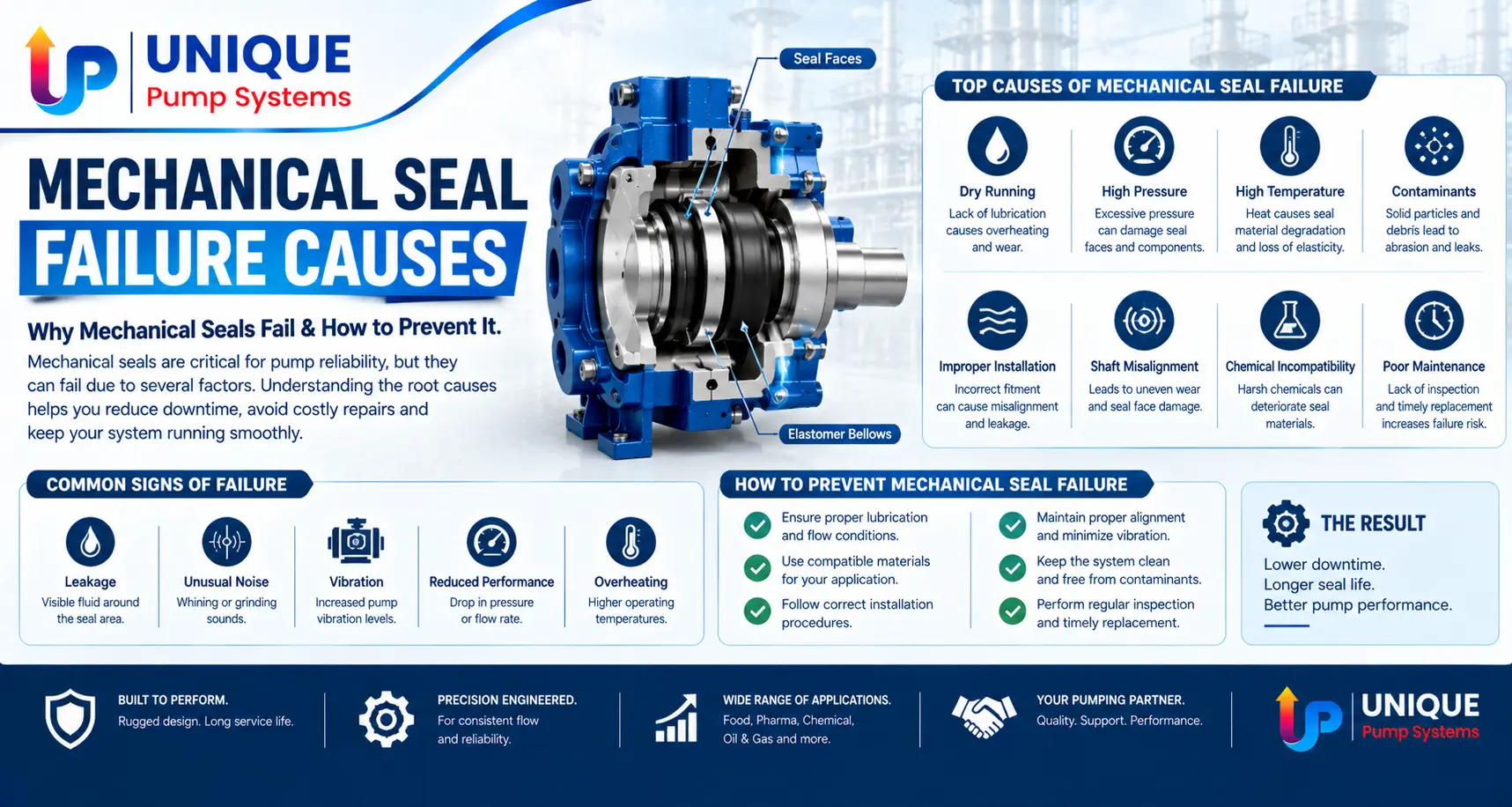
Quick Answer: Most mechanical seals fail long before their faces wear out. The most common causes are dry running, incorrect installation, shaft misalignment and vibration, wrong seal or elastomer material for the liquid, excess heat, abrasive solids, cavitation or running the pump off its best efficiency point, and missing or wrong flush arrangements. Inspecting the failed seal faces and O-rings usually tells you which cause applies, so the next seal lasts longer.
A mechanical seal is often blamed when a pump starts leaking, but the seal is usually the victim, not the cause. Replacing it with an identical seal without finding the root cause leads to the same failure a few weeks later. This guide covers the 10 most common reasons mechanical seals fail, how to read a failed seal, and the practical steps that stop repeat failures.
A mechanical seal has two flat, very smooth faces: one rotates with the shaft, the other is fixed in the gland. Springs and liquid pressure hold them together. A very thin liquid film, often just a few microns thick, separates and lubricates the faces. Secondary seals such as O-rings or bellows seal the parts to the shaft and gland.
Because that film is so thin, anything that disturbs it, such as heat, vibration, solids, vapour or lack of liquid, damages the faces quickly. Learn more in Types of Mechanical Seals.
Without liquid between the faces, friction heat rises in seconds. Faces crack, carbon faces wear rapidly and elastomers burn. Dry running happens during start-up before priming, when a tank runs empty, when a suction valve is left closed or when vapour forms at the seal. Fix: prime properly, fit low-level or dry-run protection, and keep suction valves open.
Seal faces are lapped flat to within a fraction of a micron. A fingerprint, dust particle or scratch can cause leakage. Other common errors are wrong working length (spring compression), O-rings nicked on keyways or threads, missing lubricant on O-rings, and set screws tightened before the gland is centred. Fix: follow the installation drawing, measure setting length, deburr and clean the shaft, and lubricate elastomers with a compatible lubricant. Cartridge seals reduce these errors.
If the pump and motor are not aligned, or the shaft is bent, the rotating face wobbles against the stationary face. The faces open and close every revolution, letting liquid and solids in and wearing the faces unevenly. Worn bearings and excessive shaft end play have the same effect. Fix: laser-align pump and motor, check shaft runout (typically 0.05 mm TIR or less; always check the seal maker's limit), and replace worn bearings.
Carbon against silicon carbide suits most clean liquids. Abrasive or crystallising liquids need hard faces on both sides, such as silicon carbide against silicon carbide or tungsten carbide against tungsten carbide. Some chemicals attack carbon or certain binders. Fix: select faces based on the liquid, solids and temperature.
O-rings that swell, soften, harden or crack have been attacked by the liquid, the cleaning chemicals or temperature. For example, NBR swells in many solvents, and EPDM is unsuitable for mineral oils. Fix: choose elastomers such as NBR, EPDM, FKM (Viton) or FFKM based on the liquid, cleaning agents (CIP) and temperature.
Heat comes from the liquid, from face friction and from poor cooling. It can cause flashing (liquid boiling between the faces), heat checking (fine radial cracks on hard faces), coking of hot oils and elastomer damage. Fix: provide a flush or cooling arrangement, check that the seal chamber pressure is above the liquid's vapour pressure, and select seals rated for the temperature.
Sand, catalyst fines, pigments and crystals enter the seal faces and grind them away. They can also clog springs and stop the seal from following shaft movement. Fix: use hard face combinations, a clean flush (from a cyclone separator or an external source), seals with springs out of the liquid, or a double seal.
Cavitation and running far from the pump's best efficiency point cause vibration, shaft deflection and pressure pulses at the seal. This chips face edges and opens the faces. Fix: correct the suction conditions and operate the pump near its BEP. See our guide to centrifugal pump cavitation.
Unbalanced seals can only handle limited pressure before face loading becomes too high, overheating the faces. Pressure reversal can also open the faces of some designs. Fix: use balanced seals for higher pressures, and confirm the seal's pressure rating covers the maximum seal chamber pressure, including start-up and upset conditions.
Many liquids need a flush to cool the faces, keep solids away or prevent crystallisation. API Plan 11 (flush from pump discharge), Plan 32 (clean external flush), Plan 53 (pressurised barrier fluid for double seals) and Plan 62 (quench to prevent crystallisation or coking) are common examples. Fix: select the flush plan together with the seal, based on the liquid's behaviour.
Before you throw away a failed seal, inspect it. The damage pattern points directly to the cause.
| What you see | Likely cause |
|---|---|
| Fine radial cracks on the hard face (heat checking) | Dry running, poor cooling or overheating |
| Chipped edges on the faces | Vibration, cavitation, flashing or rough handling during installation |
| Wear track wider than the narrow face | Shaft runout, misalignment or bearing wear |
| Uneven wear or wear on one side only | Misalignment, face distortion or gland bolts tightened unevenly |
| Grooves or scoring on the faces | Abrasive solids in the liquid |
| No face wear, but the seal leaked | O-ring damage, installation error or faces not seated |
| Swollen, soft or sticky O-rings | Chemical attack on the elastomer |
| Hard, cracked or flattened O-rings | Excessive temperature or compression set |
| Springs clogged or stuck | Solids, crystallisation or coking in the seal chamber |
| Carbon face heavily worn or blistered | Dry running, high pressure or oil-based liquid at high temperature |
| Deposits on the atmospheric side | Crystallising liquid; needs a quench |
A correctly working mechanical seal is not completely dry at a microscopic level. A tiny amount of vapour passes the faces to keep them lubricated, usually invisible. Visible drips, a steady trickle or a wet gland area indicate a problem that needs attention. New seals may weep slightly for a short bedding-in period, but this should stop quickly.
| Pump | Seal considerations |
|---|---|
| Centrifugal Pump | Cavitation, running off BEP and dry running are the main threats. Check suction conditions and flush arrangement. |
| gear pump | Higher pressures and viscous or hot liquids. Balanced seals and heating or quench arrangements are common. |
| lobe pump | Viscous, sticky or hygienic products. Flushed or double seals prevent product build-up; hygienic seals suit CIP. |
| aodd pump | No shaft seal at all. It is a sealless pump, useful where seal leakage is unacceptable or the pump may run dry. |
If installation errors are a repeat problem, a cartridge seal arrives pre-assembled and pre-set, removing most fitting mistakes. If the liquid is toxic, flammable, abrasive or crystallising, a double seal with a barrier fluid keeps the process liquid away from the faces and the atmosphere.
Unique Pump Systems manufactures and supplies mechanical seals for centrifugal, gear and lobe pumps. Send us your details and photos of the failed seal, and we will help identify the root cause and recommend the right replacement.
Dry running and incorrect installation are the most common causes. Both damage the precision faces quickly. Misalignment, vibration and using the wrong materials for the liquid are also very common.
A correctly selected and installed mechanical seal on a well-run pump often lasts several years. Life depends on the liquid, temperature, pressure, solids and pump condition. Repeated failures within weeks or months point to a root cause that needs fixing.
Signs include visible leaking or dripping at the gland, a wet or crusted area around the seal, squealing noise, smoke or heat at the seal area, and increased vibration.
Standard mechanical seals cannot run dry. Even a few seconds without liquid can crack the faces or burn the elastomers. Special dry-running seals exist for gas and specific duties.
Heat checking is a pattern of fine radial cracks on hard seal faces caused by excessive heat, usually from dry running, poor lubrication, high pressure or inadequate cooling.
A new seal that leaks right away usually has an installation problem: damaged or dirty faces, a nicked O-ring, wrong setting length, or a misaligned gland. Shaft runout or a worn shaft sleeve can also cause leaks.
A tiny, usually invisible vapour leakage is normal because the faces need a thin liquid film. Visible drips or a steady leak are not normal and indicate a fault.
Select the right seal materials and flush plan, install carefully, align the pump and motor, never run dry, operate near the best efficiency point and avoid cavitation.
Mechanical seal failure is rarely bad luck. Dry running, installation errors, misalignment, wrong materials, heat, solids and poor pump operation cause most failures. Inspect every failed seal, find the root cause and correct it, and the next seal will last far longer.
Need help with repeated seal failures? Contact Unique Pump Systems with your pump details and photos of the failed seal, and our team will recommend the right seal and setup.