
Unique Pump Systems, Kailash Industrial Complex, Vikhroli (W)
Reviewed by the Unique Pump Systems engineering team | Updated October 2026
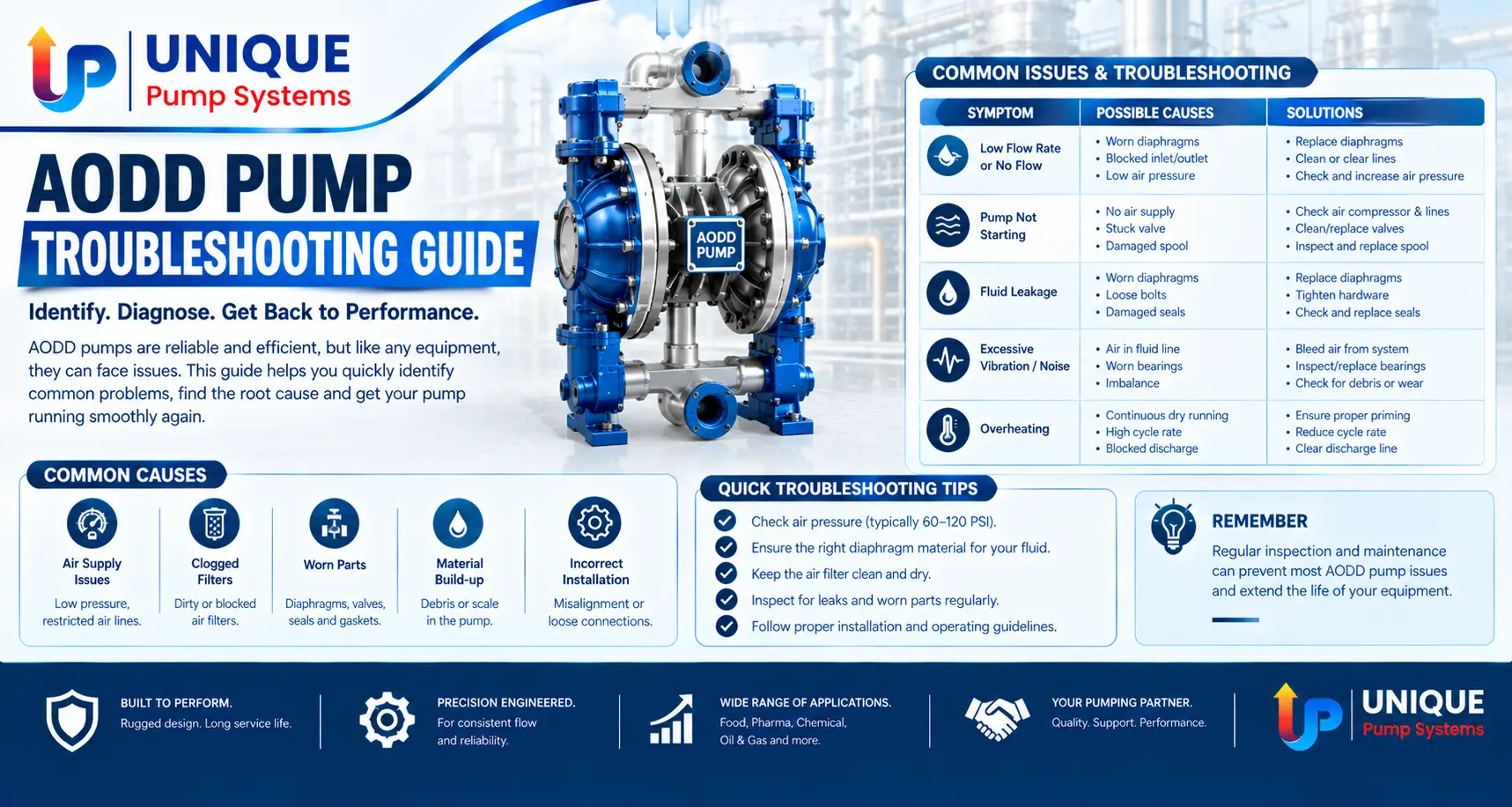
Quick Answer: Most AODD pump problems trace back to three areas: the air supply (low pressure, undersized lines, wet or dirty air, iced muffler), the liquid path (blocked suction, air leaks, worn or stuck check valve balls and seats, high suction lift or viscosity) and wear parts (ruptured diaphragms, worn air valve seals). If the pump will not cycle, check air pressure and the air valve. If it cycles but does not pump, check the suction side and check valves. If liquid comes out of the exhaust, a diaphragm has ruptured: stop the pump immediately.
An aodd pump is one of the most forgiving pumps in any plant. It can run dry, self-prime and stall safely against a closed valve. When it does misbehave, the cause is usually simple and quick to fix once you know where to look. This guide lists the most common AODD pump problems, their causes and the fixes, in the order a maintenance technician would check them.
Safety first: before any maintenance, shut off and bleed the air supply, close the liquid inlet and outlet valves, and relieve pressure in the pump and lines. Drain the pump and wear suitable protective equipment for the liquid. For flammable liquids or explosive zones, make sure the pump is a conductive version and is properly earthed.
Compressed air enters an air valve that directs it alternately behind two diaphragms connected by a shaft. As one diaphragm pushes liquid out of its chamber, the other pulls liquid into its chamber. Check valve balls and seats on the suction and discharge manifolds make sure the liquid only flows one way. When the stroke ends, the air valve shifts and the cycle reverses. For a detailed explanation, see How Does an AODD Pump Work.
| Problem | Possible causes | What to do |
|---|---|---|
| Pump does not start or cycle | No or low air pressure; closed air valve; blocked air filter; stalled or worn air valve or pilot valve; discharge valve closed (pump is dead-headed) | Check air supply pressure at the pump inlet; open valves; clean filter; inspect and service the air valve; open the discharge |
| Pump cycles but no liquid flows | Closed or blocked suction; empty supply tank; air leak in suction line; check balls not seating; suction lift too high; liquid too viscous | Open and clear suction; check tank level; tighten suction joints; clean or replace balls and seats; reduce lift; use larger ports or a slower stroke rate |
| Low flow or slow cycling | Low air pressure or flow; undersized or long air line; clogged filter regulator; iced muffler; worn balls or seats; blocked strainer; high discharge pressure | Raise air pressure (within rating); use a larger air line; clean filter; fit an anti-icing muffler or dryer; replace check valve parts; clean strainer; reduce discharge restriction |
| Pump runs fast and erratic (runaway) | Suction starved: empty tank, blocked suction, or pump sucking air | Restore liquid supply; clear suction; seal air leaks; reduce air pressure until supply is stable |
| Air bubbles in the discharge liquid | Loose suction connections; loose clamp bands or manifold bolts; ruptured diaphragm | Tighten fittings and clamps; inspect diaphragms |
| Liquid coming from the exhaust muffler | Ruptured diaphragm; loose diaphragm plate or shaft bolt | Stop the pump immediately; replace both diaphragms and check the shaft and plates |
| Muffler ices up | Moist compressed air; large pressure drop at the exhaust | Fit an air dryer or water separator; use an anti-icing muffler; pipe exhaust away; lower air pressure if possible |
| Pump stops mid-stroke (stalls) | Air valve centred or sticking; very low air pressure; worn air valve seals; dirt or oil sludge in the air valve | Briefly increase air pressure; clean or rebuild the air valve; improve air filtration |
| Leaks from manifolds or casing | Loose bolts or clamp bands; damaged O-rings or gaskets; wrong elastomer for the liquid | Tighten to the recommended torque; replace seals with a compatible material |
| High air consumption | Air pressure higher than needed; worn air valve seals; air leaks in fittings | Lower air pressure to the minimum that meets flow; rebuild the air valve; repair leaks |
| Excessive noise or vibration | High air pressure; loose mounting; high suction lift; no pulsation dampener | Reduce pressure; secure the pump; reduce lift; fit a dampener and flexible connections |
The air supply drives everything in an AODD pump, so it is the first place to look.
If the air side is working and the pump cycles but liquid does not move as expected, look at the liquid path.
Diaphragms are the main wear part of an AODD pump. A ruptured diaphragm lets liquid into the air side, so early replacement is much cheaper than cleaning up a spill.
| Cause of short diaphragm life | Prevention |
|---|---|
| Air pressure higher than needed | Run at the lowest pressure that gives the required flow |
| Wrong diaphragm material for the chemical or temperature | Select PTFE, Santoprene, EPDM, Buna-N or other materials based on chemical and temperature compatibility |
| High suction lift or blocked suction | Reduce lift; keep suction lines clear and large enough |
| Running dry at high speed for long periods | Reduce air pressure when dry running is possible; fit a stroke counter or leak detector |
| Abrasive solids | Use abrasion-resistant materials and a slower stroke rate |
| Over-tightened or uneven diaphragm plate | Follow the correct assembly torque |
Always replace both diaphragms together, and inspect check balls, seats and O-rings at the same time.
A standard AODD pump has a 1:1 pressure ratio: the maximum discharge pressure it can produce is roughly equal to the air pressure supplied. As discharge pressure approaches air pressure, the pump slows down and eventually stalls. This is a safety feature, not a fault. If you need more discharge pressure, increase the air pressure within the pump's rating, reduce system resistance, or consider a 2:1 pressure-boosting AODD pump or a different pump type.
Read More: How to Read an AODD Pump Curve
| Frequency | Task |
|---|---|
| Daily / every shift | Check for leaks, unusual noise, liquid at the exhaust and correct air pressure |
| Weekly | Drain the air filter, check the muffler for icing or blockage, check clamp bands and bolts |
| Monthly | Inspect check balls and seats on abrasive or critical duties; check mounting and connections |
| Every 3 to 6 months (or per stroke count) | Inspect diaphragms; service the air valve on heavily used pumps |
| Annually | Full overhaul: diaphragms, balls, seats, O-rings and air valve seals |
Keep a spare parts kit (diaphragms, balls, seats and O-rings) for each critical pump so that repairs take minutes, not days.
AODD pumps are excellent for transfer, sump emptying, slurries, chemicals and duties where the pump may run dry. But they are not ideal for every job:
AODD pumps also have no rotating shaft seal, so there is no mechanical seal to leak or wear. This makes them a good choice for toxic, abrasive or hard-to-seal liquids.
Read More: AODD Pump vs Centrifugal Pump
Unique Pump Systems supplies AODD pumps and spare parts, and can help you diagnose recurring problems or choose better-suited materials for your liquid.
If the pump is cycling but not pumping, the most likely causes are a blocked or closed suction, an empty tank, an air leak in the suction line, worn or stuck check valve balls, or a suction lift that is too high. If it is not cycling at all, check the air supply pressure and the air valve.
Liquid in the exhaust almost always means a ruptured diaphragm or a loose diaphragm plate. Stop the pump immediately, isolate air and liquid, and replace both diaphragms.
Stalling is usually caused by low air pressure, a sticking or worn air valve, dirty or wet air, or discharge pressure close to the air supply pressure. A standard AODD pump stalls when discharge pressure equals air pressure.
Compressed air expands and cools as it exhausts. If the air contains moisture, it freezes in the muffler and air valve. Use dry air, an anti-icing muffler and, if possible, a lower air pressure.
It depends on the liquid, air pressure and duty. Many users inspect diaphragms every 3 to 6 months on continuous duty and replace them annually or per the stroke count recommended by the manufacturer. Always replace both diaphragms together.
Yes. AODD pumps can run dry without damage, but running dry at high speed for long periods increases diaphragm and check valve wear. Reduce air pressure if dry running is expected.
Use the lowest air pressure that gives the flow and discharge pressure you need, and never exceed the pump's rated maximum, commonly around 7 to 8 bar. Lower pressure saves air and extends diaphragm life.
High air consumption is usually caused by running at higher air pressure than needed, worn air valve seals or leaks in air fittings. Reduce pressure to the minimum required and service the air valve.
Troubleshooting an AODD pump is straightforward when you work in order: check the air supply first, then the suction and liquid path, then the wear parts. Most problems come down to air pressure, suction leaks, worn check valves or diaphragms. A simple preventive maintenance routine and the right materials for your liquid will keep the pump running reliably for years.
If your AODD pump keeps giving trouble, contact Unique Pump Systems. We will help you find the cause and recommend the right pump, materials or spare parts.